What got you here won’t get you there
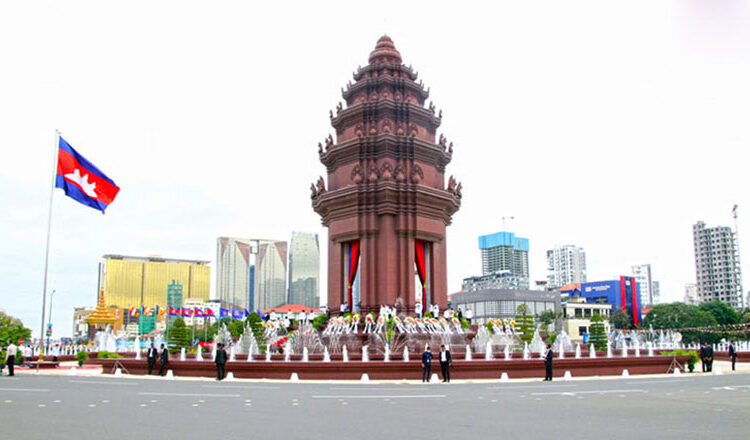 (File photo): Independence Monument, or Vimean Ekareach as it is referred to in Khmer, is a majestic structure that dominates Phnom Penh city center. AKP
#opinion
Garments, mass tourism and broad agricultural subsidies built modern Cambodia. They cannot, alone, take it to the next level.
Every economy outgrows its founding industries. South Korea moved beyond textiles. Singapore moved beyond entrepôt trade. Taiwan moved beyond cheap electronics assembly. The question is never whether to move on. It is whether you do it deliberately or get left behind.
Cambodia is at that inflexion point now. The three pillars that sustained 7.59% average annual growth from 1994 to 2017, which were garment manufacturing, mass tourism anchored to Angkor Wat, and broad agricultural production, are each hitting structural limits. Understanding why is the prerequisite for choosing what comes next.
Garments: Stuck in the middle
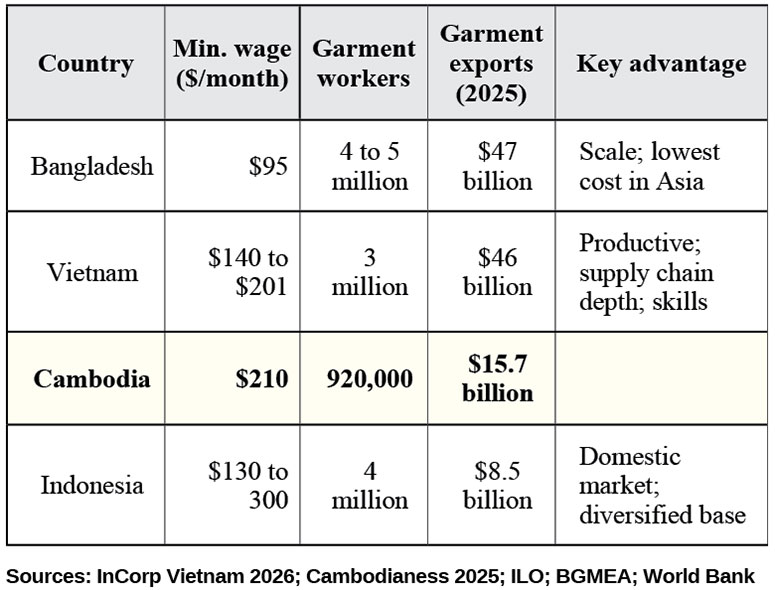
Cambodia’s garment sector generated $15.7 billion in exports in 2025 and employs approximately 920,000 workers. A genuine achievement. But the competitive logic that made Cambodia attractive is eroding.
Cambodia’s minimum wage is $210 per month as of 2026. Vietnam’s ranges from $140 to $201 depending on region. Cambodia is now more expensive than Vietnam across most regions. But the wage gap alone understates the problem. Vietnam sources 52 to 60% of garment inputs domestically. Cambodia imports almost everything from China. Every metre of imported fabric is a cost Vietnamese competitor do not carry.
The scale gap completes the picture. Vietnam exported $46 billion in garments in 2025. Bangladesh exported $47 billion. Cambodia exported $15.7 billion with a workforce one-third the size of Vietnam’s. At a population of 17 million, a volume war is not winnable. And the skills base and supply chain depth needed to compete on value are not yet in place. The garment sector should not be abandoned. But it cannot lead the next decade as the primary engine of the next decades.
Table 1. Garment industry comparison: Cambodia v peers (2024 to 2025)
Tourism: One wonder is not a strategy
Cambodia attracted 6.7 million visitors in 2024, surpassing its pre-pandemic peak. In 2025, arrivals fell to 5.57 million, a 16.9% decline driven by border tensions with Thailand. One diplomatic incident, one bad year.
Angkor Wat is one of the great architectural achievements in human history. It is also a once-in-a-lifetime destination. Visitors come. They see it. They do not return. Thailand welcomed 35 million visitors in 2024 across beaches, cultural cities, medical tourism, and festival circuits. People return to Thailand because there is always more to see. Outside Angkor Wat, Cambodia’s offering remains thin. Phnom Penh, Sihanoukville and Kampot have potential. None has been built into a destination that anchors an international tourism identity.
Agriculture: Climate is not a competitive advantage
Agriculture accounted for 16.1% of GDP in 2025 and employs 3.1 million people. Exports reached $6.46 billion, up 35% from 2024. The government is investing in agro-processing and the direction is right.
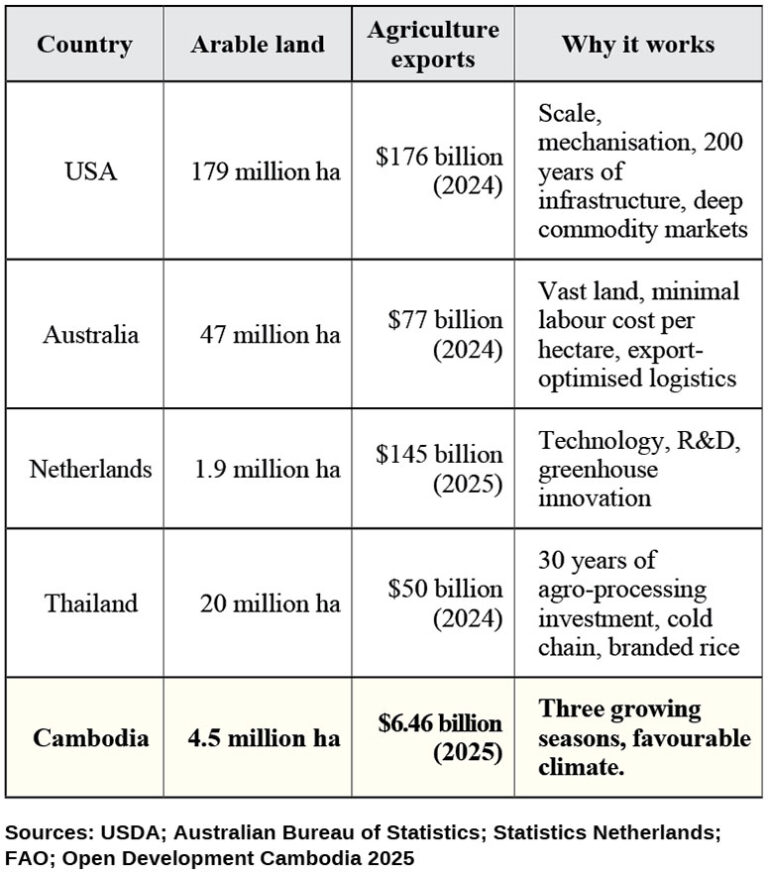
But consider who gets rich from agriculture. The United States exports $196 billion annually. Australia exports $72 billion. The Netherlands, smaller than Cambodia in land area, exports $130 billion. What they share is not climate. It is scale, mechanisation, decades of infrastructure, and deep processing capability. Thailand, with 20 million hectares and 30 years of agro-processing investment, earns $45 billion. Cambodia, with 4.5 million hectares and three growing seasons, earns $6.46 billion. The gap is structural, not climatic.
Niches such as Kampot pepper and organic cassava hold real promise. The question is whether agriculture, even with processing investment, can drive a meaningful share of national income at Cambodia’s land and population scale, or whether the same capital would generate far greater returns in sectors where Cambodia holds a structural advantage it does not share with every other country in the region.
Table 2. Agricultural exports: Countries that get rich from farming
The honest ssessment
None of this is criticism of the workers, farmers, and entrepreneurs who built these sectors from almost nothing in 30 years. That achievement deserves respect.
But economic strategy is not about sentiment. It is about where the next dollar of investment and policy attention generates the most return. The honest answer is that Cambodia needs new bets.
The next 11 columns identify what those bets should be, moving from how global value chains are being restructured and why manufacturing remains the fastest path to the middle class, to concrete prescriptions across finance, digital infrastructure, tourism, industrial zones, and governance.
Cambodia’s most underused competitive advantages have nothing to do with garments, temples, or rice paddies. They have to do with its currency, its geography, its position in a shifting global supply chain, and its regulatory flexibility. Those are the foundations worth building on.
Next in this series (Part 3): ‘Reading the value chain’ — How global supply chains are being restructured, where manufacturing is heading next, and where Cambodia sits in that shift.
Heemin Shin is a founding partner of Plateaux Capital, a private equity house based in New York, with prior roles as CFO of a Cambodian microfinance institution, managing director at Siguler Guff Company & LP, and founder of a fintech company he took to a successful exit. He writes in a personal capacity. Email: david@plateauxnewyork.com
-Khmer TImes-