Navigating Uncharted Waters: Cambodia’s UNCLOS Strategy to Resolve the Gulf of Thailand Dispute
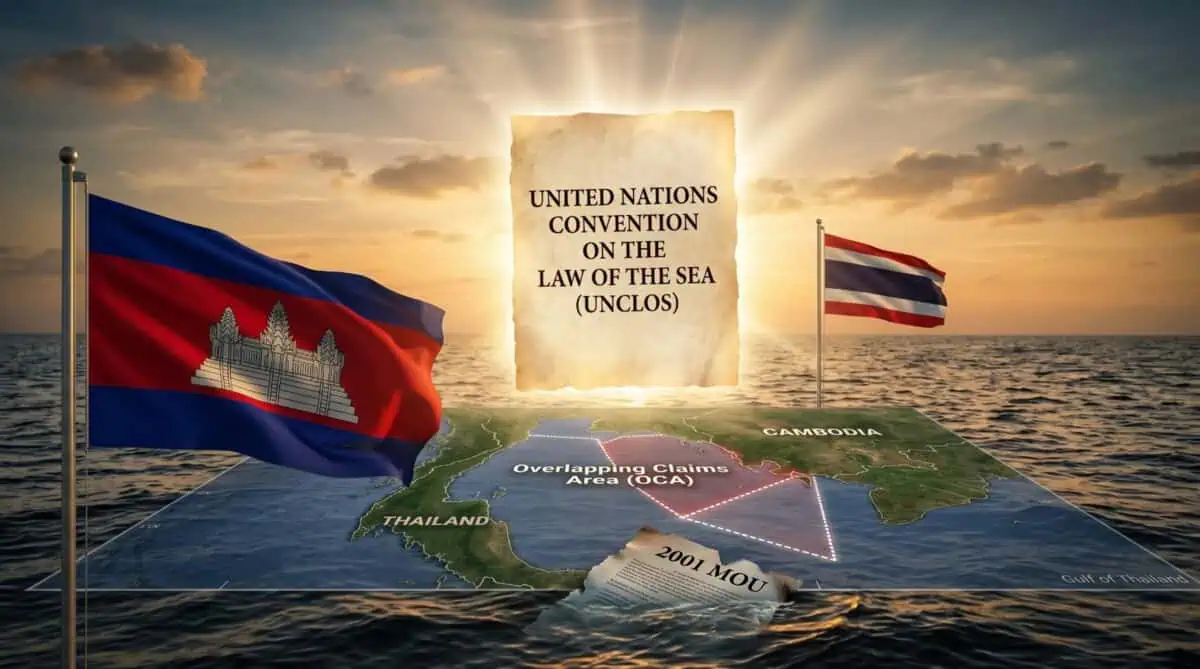 AI-generated image
Legal Shift: On June 2, 2026, Cambodia formally invoked the compulsory conciliation mechanism under UNCLOS to address its maritime boundary dispute with Thailand.
The Catalyst: The move directly follows Bangkok’s unilateral withdrawal in May 2026 from the 2001 Memorandum of Understanding (MOU-2001).
Procedural Clock: Thailand has a three-week window to appoint two representatives to a five-member independent, UN-backed commission.
Economic Stakes: The 26,000-square-kilometre Overlapping Claims Area (OCA) likely holds significant untapped energy resources, making a resolution critical for both nations’ energy security and economic growth.
Expected Outcome: While the commission’s final report will not be legally binding, both nations are obligated under international law to engage in good-faith negotiations based on its findings, likely steering them toward a Joint Development Area (JDA) framework.
After months of stalled bilateral diplomacy, the maritime boundary dispute between Cambodia and Thailand has officially entered a new legal phase. On June 2, 2026, Prime Minister Hun Manet announced that Cambodia had formally notified Thailand and the UN secretary-general of its decision to invoke compulsory conciliation under the UN Convention on the Law of the Sea (UNCLOS).
This decisive move shifts the trajectory of the Overlapping Claims Area (OCA) dispute from a bilateral track into the realm of international legal mediation, signalling a calculated effort by Phnom Penh to break the diplomatic deadlock.
The Collapse of Bilateralism and Domestic Political Realities
The catalyst for Cambodia’s pivot to international law was Bangkok’s unilateral withdrawal from the 2001 Memorandum of Understanding (MOU-2001) in May 2026. For a quarter of a century, the MOU had served as the foundational framework for both nations to address overlapping claims and explore joint resource development in the Gulf of Thailand.
Indeed, foreign policy is frequently shaped by domestic realities. In Thailand, the OCA has historically been a highly sensitive issue, subject to intense scrutiny from various political factions. The decision to withdraw from the MOU reflects these complex internal political pressures in Bangkok. Cambodia, viewing the MOU as a reflection of mutual commitment based on good faith, concluded that bilateral avenues had been exhausted following a final diplomatic meeting in New York on May 26.
By invoking a UN-backed commission, Cambodia effectively insulates the dispute from the political volatility of both capitals. The issue is transitioned into a neutral, international forum where the focus remains strictly on legal principles and technical maritime boundary delineation.
The Economic Engine: The Billions Beneath the Gulf
Beyond the principles of sovereignty, the urgency of this legal initiative is driven by massive economic stakes. The 26,000-square-kilometer OCA is widely believed to hold significant untapped oil and natural gas reserves.
For both nations, this represents a critical component of energy security.
Thailand is facing the rapid depletion of its existing Gulf gas fields and urgently requires new energy sources to sustain its heavy industrial base and stabilise domestic power costs. Conversely, Cambodia is seeking energy independence to fuel its rapid economic expansion. The conciliation process is not merely about drawing lines on a map; it is an effort to establish a legal framework capable of unlocking a multi-billion-dollar economic resource currently frozen by political indecision.
The Procedural Clock: Three Weeks for Thailand
With the UNCLOS mechanism formally triggered, a strict procedural timeline is now in effect. Briefing the media and the diplomatic corps on June 2, Minister of Foreign Affairs and International Cooperation Prak Sokhonn outlined the immediate legal requirements: Thailand has exactly three weeks to respond to the submission and appoint its representatives.
The conciliation process relies on a five-member commission:
Cambodia’s Selection: Phnom Penh has already moved swiftly, appointing Danish diplomat Peter Taksøe-Jensen and French academic Jean-Marc Thouvenin as its internationally recognised national conciliators.
Thailand’s Window: Bangkok must select its two corresponding conciliators or legal experts within the 21-day timeline. If a party declines to participate, the UN secretary-general retains the authority to step in and make the appointments to ensure the commission is properly formed.
The Joint Chair: Once the four national representatives are established, they will convene to select a fifth independent member who will serve as the commission’s chair.
The Anatomy of Compulsory Conciliation
Compulsory conciliation — governed procedurally by Annex V of UNCLOS — is specifically engineered for disputes where parties have not consented to binding adjudication but remain obligated to engage in structured conciliation if bilateral negotiations fail.
The commission’s mandate is not to issue a binding judicial ruling, but to act as an independent fact-finding and mediation body. Within 12 months of its constitution, the commission is required to evaluate the legal arguments, examine the evidence and issue a formal report containing practical recommendations grounded in international maritime law.
Crucially, while the final report is not legally binding, UNCLOS mandates that both parties must engage in “good faith negotiation” based on the report’s conclusions. This mechanism leverages the weight of international law, creating a structured environment that discourages uncompromising postures from either side.
The End-Game: Boundary Lines and Joint Development
While UNCLOS mechanisms are designed to adjudicate boundaries, drawing a definitive line through the OCA may remain politically complex for both governments to accept outright.
Therefore, the ultimate outcome of this commission may not be a partitioned territory, but a structured compromise. The commission could recommend a Joint Development Area (JDA) framework — similar to the revenue-sharing models successfully established between Malaysia and Thailand, or Malaysia and Vietnam. In this context, the UNCLOS mechanism serves to guide both parties back to the negotiating table under international supervision to finalise a JDA, ensuring equitable resource sharing.
ASEAN Centrality and the Timor-Leste Precedent
While the proceedings are fundamentally a bilateral legal matter, this case serves as a vital test for Southeast Asian diplomacy. The dispute involves two ASEAN member states, yet it is being addressed through a global legal mechanism rather than a regional body.
By utilising UNCLOS, Cambodia is demonstrating a commitment to the rules-based international order. This sets a precedent for how ASEAN nations can handle bilateral deadlocks peacefully and legally, without requiring intervention that could fracture the broader regional bloc.
Cambodia’s strategy aligns with recent international successes, notably the UNCLOS compulsory conciliation between Timor-Leste and Australia. Initiated in 2016, that commission successfully broke a decades-long deadlock, paving the way for a landmark agreement in 2018. By elevating the OCA dispute to an independent UNCLOS commission, Cambodia aims to replicate this model, seeking a fair resolution over resource-rich waters that ensures long-term stability and economic cooperation for generations to come.
Panhavuth Long is founder and attorney at law at Pan & Associates Lawfirm. The views and opinions expressed are his own.
-Phnom Penh Post-
AI-generated image