Cambodia pushes UNCLOS, international conciliation; Thai PM denies validity of French-era maps
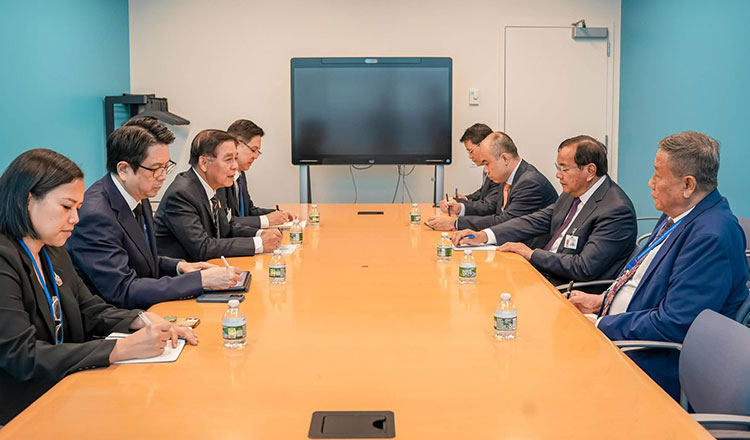 Foreign Affairs and International Cooperation Minister Prak Sokhonn (2-R) meets his Thai counterpart Sihasak Phuangketkeow (3-L) on the sidelines of the UN Security Council High-Level Open Debate in New York. MFAIC
Cambodia has reiterated its push for compulsory conciliation under the UN Convention on the Law of the Sea (UNCLOS) during renewed high-level talks with Thailand on the sidelines of a UN Security Council (UNSC) meeting in New York, as both countries attempt to manage ongoing border tensions through diplomacy and confidence-building measures.
The May 26 diplomatic engagement Minister of Foreign Affairs and International Cooperation Prak Sokhonn and Thai Foreign Minister Sihasak Phuangketkeow together, according to a statement from the Cambodian foreign ministry.
The meeting followed up on understandings reached during a trilateral Cambodia–Thailand–Philippines discussion on the sidelines of the 48th ASEAN Summit in Cebu on May 7, where regional leaders tasked both foreign ministers with advancing confidence-building measures and identifying a pathway forward on border-related issues.
Cambodia reaffirmed its position that compulsory conciliation under UNCLOS remains a central legal avenue for addressing unresolved disputes, while also urging the full and good-faith implementation of the Joint Statement of December 27, 2025, which Phnom Penh views as a key framework for maintaining stability along the border.
“During the meeting, both sides had a frank and open exchange of views on the border situation between the two countries,” the statement said.
“Sokhonn reiterated Cambodia’s position regarding the initiation of compulsory conciliation under the UNCLOS and called for the full and effective implementation, in good faith and with sincerity, of the Joint Statement of December 27, 2025, in its entirety,” it added.
The Cambodian side also informed Thailand that it was ready to work toward implementing measures agreed upon by the two prime ministers during the Cebu summit in an effort to rebuild trust and seek what Phnom Penh described as a “just and lasting solution”.
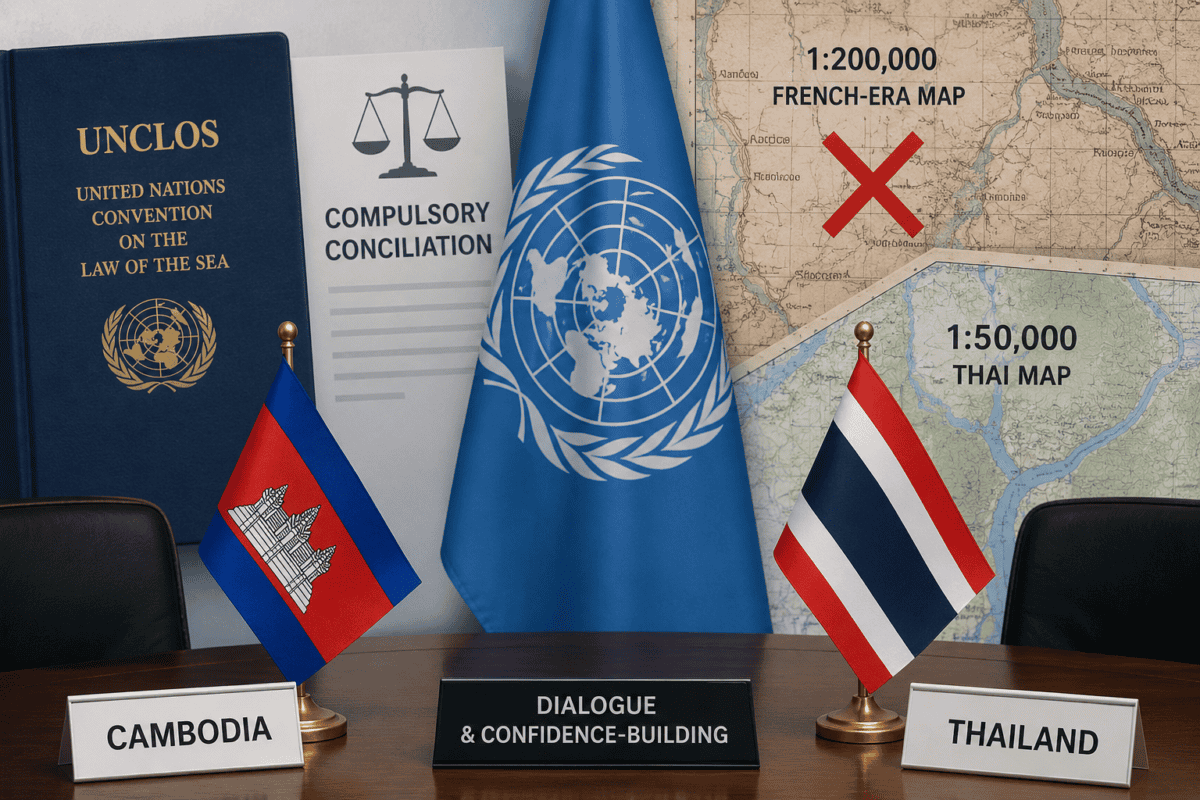
Communication is key
Both sides reaffirmed their commitment to maintaining “close and regular communication”, signalling efforts to prevent further escalation despite unresolved differences.
However, the latest round of diplomacy comes against a backdrop of widening divergence in legal and political approaches between the two countries.
According to Thai media reports, Prime Minister Anutin Charnvirakul has reiterated Thailand’s sovereignty position, stating that the French colonial-era maps frequently cited by Cambodia in border arguments “no longer exist” within Thailand’s official technical and administrative framework.
“Thailand adheres strictly to our established technical systems and existing bilateral conclusions,” Anutin was quoted as saying.
“Requests to rely on historical French maps do not hold sway. If anyone wishes to enforce that scale, they are looking at a completely different country,” he added.
He explained that Thailand currently relies on a 1:50,000-scale mapping system for border management in certain sectors, while maintaining openness to technical verification mechanisms if required.
His remarks underscore Bangkok’s claimed preference for a sovereignty-based and technical approach anchored in contemporary mapping standards and bilateral processes.
Thais reject historical norms
Taken together, the Thai position signals a firmer rejection of colonial-era cartographic baselines, further complicating Cambodia’s continued reliance on historical mapping references in its border discourse.
In contrast, Phnom Penh has increasingly turned to international legal mechanisms under UNCLOS, arguing that compulsory conciliation offers an impartial framework when bilateral negotiations face prolonged deadlock.
The New York meeting followed ASEAN-linked diplomatic engagement in Cebu, where both sides were encouraged to maintain dialogue and strengthen trust-building measures amid persistent tensions.
During the UNSC sideline talks, both foreign ministers exchanged frank views on the border situation, though no breakthrough was reported on establishing a future negotiation framework.
Thai media reported that Sihasak said the discussions were aimed at maintaining dialogue and improving the overall atmosphere between the two countries, while acknowledging that both sides had yet to agree on a clear structure for future negotiations.
He also pointed to continuing misunderstandings, saying Cambodia appeared to interpret Thailand’s cancellation of a bilateral memorandum of understanding as an attempt to avoid negotiations.
Thailand, however, maintains the decision was intended to reset the framework following limited progress under the 2001 MoU over more than two decades.
Sihasak further noted that circumstances have evolved significantly since the original agreement, particularly following Cambodia’s accession to UNCLOS.
Thailand’s position, he said, remains that bilateral discussions should continue before any move toward a formal conciliation process involving external parties.
He added that both sides could still reach mutual understanding through direct UNCLOS-related dialogue without necessarily activating compulsory conciliation mechanisms.
The contrasting approaches highlight an increasingly structural divide in the dispute: Cambodia is leaning further into international legal arbitration pathways, while Thailand is reinforcing sovereignty-based technical mapping and bilateral negotiation frameworks.
Differing views
Analysts say the dispute is now shaped not only by competing territorial claims, but also by fundamentally different interpretations of legal authority, historical documentation and the role of international institutions.
Geopolitical analyst Yang Peou said Thai military activity near disputed temple areas has deepened mistrust and increased domestic pressure on Cambodia’s leadership to continue defending its territorial claims through international diplomacy.
He questioned whether bilateral dialogue alone could be trusted to resolve tensions, citing unresolved issues on troop positions and physical barriers along contested areas.
Peou argued that Cambodia’s use of international forums, including the UN, was aimed at de-escalation and enforcement of agreements rather than escalation.
He added that external involvement had previously helped stabilise tensions during the 2025 border crisis, warning that the situation could deteriorate without it, saying: “Without international involvement, Thailand does not comply.”
Former Cambodian diplomat Pou Sothirak noted that tensions over the Cambodia–Thailand Maritime Overlapping Claims Area (OCA) expose weaknesses in ASEAN’s ability to manage maritime disputes, and urged both sides to avoid inflammatory rhetoric and maintain dialogue.
He highlighted how the 2001 MoU cancellation reflected competing interpretations over joint development and maritime delimitation, and said uncertainty remains over whether Cambodia will pursue formal UNCLOS mechanisms, including compulsory conciliation.
Pou warned that maritime escalation would be mutually damaging, stating: “If Thailand and Cambodia decide to go to war at sea, both lose.”
He stressed that ASEAN remains largely limited to preventive diplomacy, while deeper conflict-resolution mechanisms remain underdeveloped, and cautioned against oversimplifying mistrust between both sides.
Despite tensions, he said both countries still have shared interests in cooperation and joint development, and urged sensitive issues to be handled through quiet diplomacy rather than public confrontation.
-Phnom Penh Post-