Keeping peace through strength
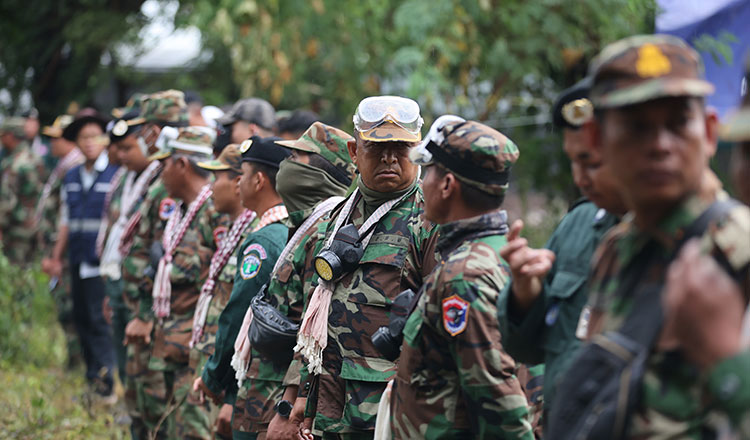 Photo: File photo shows unarmed Cambodian soldiers and police deployed to Chok Chey village in Banteay Meanchey province to protect the land from Thai incursions. KT/Khem Sovannara
See less
Photo: File photo shows unarmed Cambodian soldiers and police deployed to Chok Chey village in Banteay Meanchey province to protect the land from Thai incursions. KT/Khem Sovannara
See less
Few countries understand the value of peace more deeply. Cambodia has endured civil conflict, foreign intervention, occupation, genocide and national trauma. Its modern identity is built on the search for peace. Its foreign policy is grounded in neutrality, nonalignment, peaceful coexistence, and respect for international law.
But peace does not survive on good intentions alone. It must be defended.
Today, Cambodia faces a harsher world. International law is weakening. Global governance is fragmenting. Multilateral institutions are losing authority. Power politics is returning with a dangerous trend. Small states can no longer assume that rules alone will protect them.
Moreover, Thailand poses an existential threat to the very survival of Cambodia.
This is the uncomfortable reality behind Cambodia’s urgent need for defence reform and modernisation. It is a call for survival.
Prime Minister Hun Manet has stressed that, like it or not, Cambodia must build peace through strength.
Cambodia does not seek confrontation. But it must have the capacity, will, and readiness to defend itself if its sovereignty is threatened.
The recently adopted law on military conscription reflects this strategic shift. It is more than a personnel policy. It signals a whole-of-nation defence mindset.
For decades, small states like Cambodia have relied on the promise that borders are inviolable, treaties matter and disputes should be settled peacefully. These principles remain essential. But they are increasingly under strain.
The United Nations still matters. International law still matters. Diplomacy still matters. But none of them is sufficient if a state lacks the strength to protect its own sovereignty.
Around the world, a darker logic is gaining ground: might is right, faits accomplis are rewarded, and weaker states are expected to absorb pressure quietly.
Any use of force to change the status quo, challenge international boundaries or pressure Cambodia over its land, maritime rights or national dignity must never be tolerated.
Cambodia has rightly pursued peaceful settlement of border issues through international law, existing treaties, bilateral mechanisms and regional diplomacy. That approach should continue. But diplomacy without credible national strength is fragile.
Small states cannot be bigger. But they can be smarter, faster and more resilient.
For a small state, strength does not come from matching larger powers weapon for weapon. It comes from leadership, morale, intelligence, mobility, technology, unity and the ability to impose costs on any aggressor.
A weak defence invites pressure. A credible defence gives diplomacy weight.
Defence modernisation must begin with institutions. Weapons matter, but they are not enough. A country cannot defend itself with modern equipment and weak institutions.
Cambodia needs defence institutions built on integrity, professionalism, discipline and patriotism. Command responsibility must be strengthened. Promotion must be based on merit.
Coordination across forces must improve.
A professional military is not merely one that can fight. It is one that knows why it serves, how it serves and whom it serves.
Cambodia also needs armed forces capable of operating in a far more complex security environment. The battlefield is no longer limited to land. Threats can emerge at sea, in the air, in cyberspace, in the information domain and through economic pressure.
Border incidents, cyberattacks, disinformation, maritime coercion and psychological operations may all be part of modern conflict. Cambodia’s defence posture must therefore remain defensive in purpose but agile in practice.
Cross-sectoral collaboration and interoperability are now the foundation of national readiness.
Cambodia must also modernise its defence infrastructure and equipment. This includes surveillance systems, border monitoring, secure communications, logistics, mobility, maritime security, cyber defence, air defence and command-and-control systems.
Ream Naval Base and other strategic facilities should be understood in this context. Cambodia has a coastline, maritime zones and national interests at sea. It needs the capacity to protect them. A country with maritime interests cannot afford maritime weakness.
Cambodia must also invest in homegrown defence technology. It should build domestic capacity in drones, cybersecurity, geospatial mapping, telecommunications, surveillance, logistics software, disaster-response technology and defence-related engineering.
Cambodia also needs a modern military doctrine. It should combine people’s defence, asymmetric defence and hybrid defence.
Cambodia’s doctrine motto can be: Firm in sovereignty, agile in action, united with the people.
People’s defence is central to this vision. National defence is not the responsibility of soldiers alone. It requires patriotic citizens, resilient communities, capable local authorities, secure infrastructure, trusted public institutions and a shared national spirit.
Cambodia must build a whole-of-nation defence culture in which citizens understand that peace, sovereignty and independence are collective responsibilities.
This is especially important in the age of hybrid warfare. Future threats may not begin with tanks or artillery. They may begin with cyberattacks, information manipulation, legal warfare, economic pressure, proxy actors or efforts to divide society from within.
Cambodia must be able to detect threats early, respond quickly and maintain public confidence under pressure. That requires cyber resilience, strategic communication, intelligence analysis, crisis response systems and trusted channels of public information.
A confused society is vulnerable. A united society is difficult to coerce.
Defence modernisation must also be tied to economic strength. No country can sustain national defence without a strong economy, stable public finances, technological capacity and educated people.
Energy security, food security, digital infrastructure, logistics, industrial development and human capital are not only economic priorities; they are security priorities. A confident, productive and united society is one of the strongest forms of deterrence.
Cambodia’s history offers a painful warning. Peace was not given to Cambodia. It was achieved after decades of tragedy through political settlement, reconciliation and national reconstruction.
That peace remains Cambodia’s greatest national asset. But peace that is not defended can be lost.
The lesson of Cambodia’s past is not that the country should fear the world. It is that Cambodia must never again be unprepared for danger.
Friends and partners may support Cambodia. International institutions may help. Diplomacy may reduce risks. But in the end, no one will defend Cambodia better than Cambodians themselves.
The way forward is clear. Cambodia must accelerate defence reform and modernisation with seriousness and urgency. It must build strong institutions, professional armed forces, credible deterrence and a whole-of-nation defence spirit.
Chheang Vannarith is Chairman of National Assembly Advisory Council. The views expressed here are his own.