Cambodia needs a military doctrine for an age of uncertainty
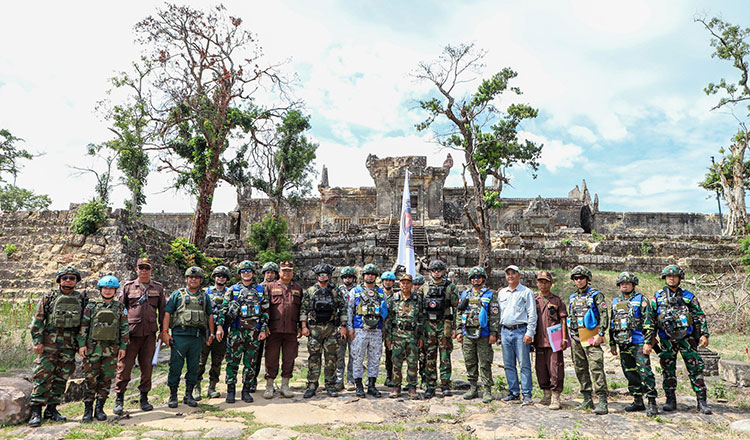 - ASEAN Observer Team under the Philippine Chairmanship of ASEAN observes, verifies, and reports on the border situation at Preah Vihear Temple in Preah Vihear province. Ministry of National Defence
Synopsis: Officials say nation remains committed to maintaining peace and stability along the shared border.
Ministry of National Defence has rejected Thai media allegations that Cambodian troops fired 11 rounds near the O’Smach International Border Checkpoint, as tensions simmer along the border with Thailand amid allegations of territorial encroachment, ceasefire violations and prolonged displacement of thousands.
Defence Ministry Spokeswoman Lieutenant General Maly Socheata labelled the claims “false information” and a “serious distortion of the truth”.
She added that no such incident occurred in Oddar Meanchey province.
Officials added that Cambodia remains committed to maintaining peace and stability along the shared border. The ministry added that all border issues continue to be managed through peaceful cooperation and existing diplomatic agreements with Thailand.
Both nations regularly use established joint mechanisms to ensure order and prevent misunderstandings between their security forces.
Thai media, citing the 2nd Army Region, reported on May 13–14 that Cambodian soldiers fired 11 rounds of small-arms fire near the O’Smach border area opposite Surin province.
The allegation was made on the same day British content creator and journalist Kevin Smith reported that Thai soldiers fired warning shots while he was documenting the O’Smach border area in Oddar Meanchey province, forcing him to leave the area yesterday.
Smith described the shots as unprovoked, alleging they were intended to scare people away from visiting or documenting the contested area.
Currently, the Thai military has encroached 420 metres into Cambodian territory at the international border checkpoint since the December 27, 2025 ceasefire agreement signed between the two nations ended three weeks of Thai military aggression against Cambodia last year.
Most government facilities at the checkpoint—including customs and excise, immigration, and the border coordination office—along with private commercial properties such as casinos and hostels, were allegedly occupied illegally, while Thai national flags were flown on the Cambodian side of the checkpoint.
Oddar Meanchey provincial deputy governor Met Measphakdey said Thai military forces had installed concrete drainage structures and barbed wire inside Cambodian territory near Border Marker 15 at the border checkpoint following the ceasefire.
He said the encroachment extended more than 420 metres beyond the recognised boundary and described it as a clear violation of Cambodia’s sovereignty.
“Following the initial military incursion by Thai troops, our border checkpoint was unilaterally suspended by Thailand in June 2025. This continued until armed clashes and an invasion broke out in July, followed by a second aggression in December,” he said.
“Regarding the second aggression, the invasion by Thai forces was severe and targeted Cambodian territory, particularly within Oddar Meanchey province. At the O’Smach checkpoint, we have suffered significant impacts, including damage to buildings, homes of innocent residents, commercial properties owned by traders, pagodas, schools and various state infrastructure,” he added.
On April 29, a tense incident occurred at the O’Smach International Border Checkpoint in Oddar Meanchey province involving gunfire by Thai forces in the presence of international observers.
Cambodian defence officials reported that Thai soldiers fired nine rounds from M79 and M16 weapons near the border checkpoint while the Military Attachés Corps in Phnom Penh (MACPP) — including representatives from 13 countries such as the US, Russia and China — was conducting an observation visit.
However, the Thai military rejected the claim that live firearms were used, stating that troops had set off three signal firecrackers as a warning measure rather than firing live ammunition. Thai authorities claimed they were responding to Cambodian soldiers approaching a barbed-wire boundary.
In November last year, the AOT was forced to suspend a ceasefire verification mission in Pursat province after gunfire was heard from the Thai side.
The AOT found evidence of alleged violations of the ceasefire agreement by Thai soldiers, including incursions and the installation of shipping containers and barbed wire to continue military occupation.
Currently, the Thai military has partly occupied Cambodian territory in the border provinces of Preah Vihear, Oddar Meanchey, Banteay Meanchey and Pursat.
The Head of Mission of the ASEAN Observer Team (HOM AOT) yesterday also carried out an observation mission to verify and report on the border situation at Preah Vihear Temple in Preah Vihear province.
The mission, facilitated by the Cambodian Liaison Group (CLG), marked the inaugural deployment of the ASEAN Observer Team under the Philippines’ mandate as ASEAN Chair.
The team visited the temple area in Choam Ksan district, Preah Vihear province, to observe and assess the current border situation and recent developments in the region.
The temple, a UNESCO World Heritage Site of significant historical and cultural value, sustained severe damage during attacks by the Thai military last year.
According to Lt Gen Socheata, the presence of the AOT aims to observe, verify and ensure the full and effective implementation of the ceasefire agreement between Cambodia and Thailand.
She noted that the mission seeks to strengthen transparency, accountability and mutual trust between the two countries while supporting efforts to restore normalcy, peace, stability and long-term security along the border.
Cambodia continues to extend full cooperation to the ASEAN Observer Team and emphasised the importance of strengthening the team’s role and mandate in monitoring the situation.
The government and the ministry reaffirmed their commitment to strictly implementing the Joint Statement of the 3rd Special Meeting of the Cambodia–Thailand General Border Committee held on December 27, as well as the Joint Statement on the Cambodia–Thailand Peace Agreement signed on October 26 last year, along with other relevant agreements.
These commitments aim to support the swift recovery of affected areas and ensure the restoration of peace, stability and safety for citizens living along the borders of both nations, she added.
More than 32,000 displaced Cambodians remain unable to return to their homes along the Cambodia-Thailand border despite the ceasefire agreement that took effect in December last year, according to the Ministry of Interior.
In a press release issued yesterday, the ministry said 32,160 displaced persons, including 16,584 women and 10,826 children, are still unable to return home due to the continued impact of border tensions.
The ministry noted that an additional 49 displaced people had recently returned to their homes, bringing the total number of returnees to more than 61,000 out of more than 64,000 displaced persons, or about 95 percent.
It said the Thai side had not fully adhered to the Joint Statement of the 3rd Special General Border Committee (GBC) since the ceasefire between Cambodia and Thailand came into effect on December 27, 2025.
It added Cambodian authorities continue to document alleged acts committed by the Thai side while pursuing legal and diplomatic measures to address the border situation and its impact on civilians.
According to the statement, essential public services remain suspended in several border provinces affected by the conflict.
In Oddar Meanchey province, eight schools and five hospitals or health centres remain closed. In Banteay Meanchey province, five schools and one hospital or health centre are still shut, while in Preah Vihear province, seven schools and two hospitals or health centres remain closed.
The ministry added that no new reports of damage to public or private property had been recorded since December 7, 2025, beyond previously documented cases.
The statement also reiterated the government’s support for the use of compulsory conciliation mechanisms under the United Nations Convention on the Law of the Sea (UNCLOS) to address overlapping maritime claims between Cambodia and Thailand following Thailand’s withdrawal from the Memorandum of Understanding (MoU) with Cambodia.
The ministry expressed support for Senate President Hun Sen, who recently called on the government to proceed directly with mechanisms provided under UNCLOS without waiting for bilateral negotiations with Thailand.
It also voiced support for Prime Minister Hun Manet in leading efforts to resolve the border issue through peaceful and diplomatic means in accordance with international law, with the aim of restoring sovereignty, territorial integrity and stability along the border.
-Khmer Times-