Phnom Penh rejects ‘anti-scam’ ruse for territorial aggression
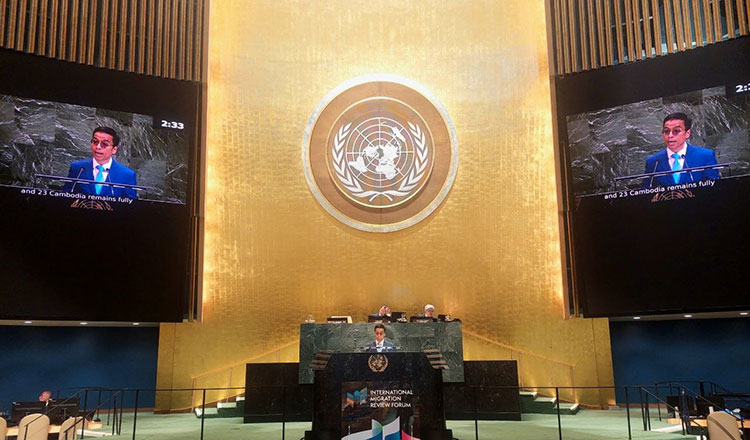 Cambodia’s Minister Counselor Doeuk Vannarith speaks at the Second International Migration Review Forum at the United Nations Headquarters in New York. Ministry of Foreign Affairs
Synopsis: At a UN forum, Cambodia yet again rejects attempts to use online scams as a pretext for territorial aggression by Thailand.
A Cambodian representative ripped into any attempt to use online scams as a pretext for territorial violations or aggression at a United Nations forum last week, referring to the military clashes between Cambodia and Thailand last year.
The message came on Friday last week by Doeuk Vannarith, Cambodia’s Minister Counsellor to the UN, while delivering his country’s statement at the Second International Migration Review Forum (IMRF) at the United Nations Headquarters in New York.
“Cambodia rejects any attempt to use such issues as a pretext for territorial violations or aggressions,” he said.
He noted that Cambodia is actively strengthening its internal response to a growing problem of transnational organised crime—especially online scams.
“We have intensified whole-of-government efforts and recently adopted a law on combating online scams to address evolving transnational organised crime,” he added.
Vannarith also reaffirmed Cambodia’s commitment to the comprehensive implementation of the Global Compact for Safe, Orderly and Regular Migration (GCM) in order to deliver tangible benefits for migrants and societies through the National Implementation Plan 2024–2026.
He underscored Cambodia’s efforts, including the recent adoption of the Law on Combating Online Scams, to address evolving transnational organised crime while expressing Cambodia’s rejection of any attempt to use online scams as a pretext for territorial violations or aggression.
According to the counsellor, Cambodia is expanding regular migration pathways through strengthened bilateral labour agreements, enhanced cooperation with destination countries, and improved labour protections.
“We are investing in skills development; strengthening the legal identity system, including universal bus registration; and ensuring migrants have access to accurate information to make informed decisions,” he said.
The Kingdom has also been prioritising the return and reintegration of migrants while strengthening the link between migration and national development planning, Vannarith added.
He added that during last year’s conflicts, Cambodia worked with partners to support more than 900,000 returning migrants, focusing on livelihood, socioeconomic reintegration, access to health services, and continued education for children.
“Cambodia remains firmly committed to preventing and combating trafficking in persons, including emerging forms of exploitation linked to online scam operations which are targeting vulnerable migrants,” he added.
In late 2025, Thailand reframed its border conflict with Cambodia as a “war against scammers”, justifying military strikes on Cambodian soil as necessary actions against a global cybercrime hub.
Thailand has framed the strikes as a service to the international community, arguing that Cambodia-based scam operations swindle billions of dollars globally and traffic thousands of victims into forced labour.
While the two countries have a decades-long history of border disputes over territory and ancient temples, recent Thai military operations specifically targeted casino and hotel complexes that Thai authorities identified as active scam centres.
Cambodian officials, including Deputy Prime Minister Sun Chanthol, have said that allegations of online scams do not justify invading a sovereign country or attacking buildings like hotels and casinos. Cambodia accuses Thailand of using the anti-scam narrative as a “guise” to reinforce its illegitimate occupation of disputed territory along the border.
Analysts argue that Thailand’s persistent portrayal of itself as the region’s champion against online scams—while labelling Cambodia as the hub despite the Cambodian government’s efforts to tackle technology-enabled crime—appears to be a tactic to deflect attention from Bangkok’s domestic challenges.
Asian Vision Institute (AVI) President Chheng Kimlong said action taken by Thai force on Tuesday proves that Thailand has not given up using online scams to justify aggression towards Cambodia.
Chheng Kimlong, president of the Asian Vision Institute, said that Thailand’s contention is illogical.
“Thailand is trying to change the narrative by making itself the hero, but it should never be forgotten that there is not a single treaty, convention or agreement that grants it such an authority,” Kimlong added.
“What Thailand is doing is showing clearly that it is violating the sovereignty of Cambodia.”
-khmer Times-