Understanding Thailand’s Realpolitik
 Understanding Thailand’s Realpolitik
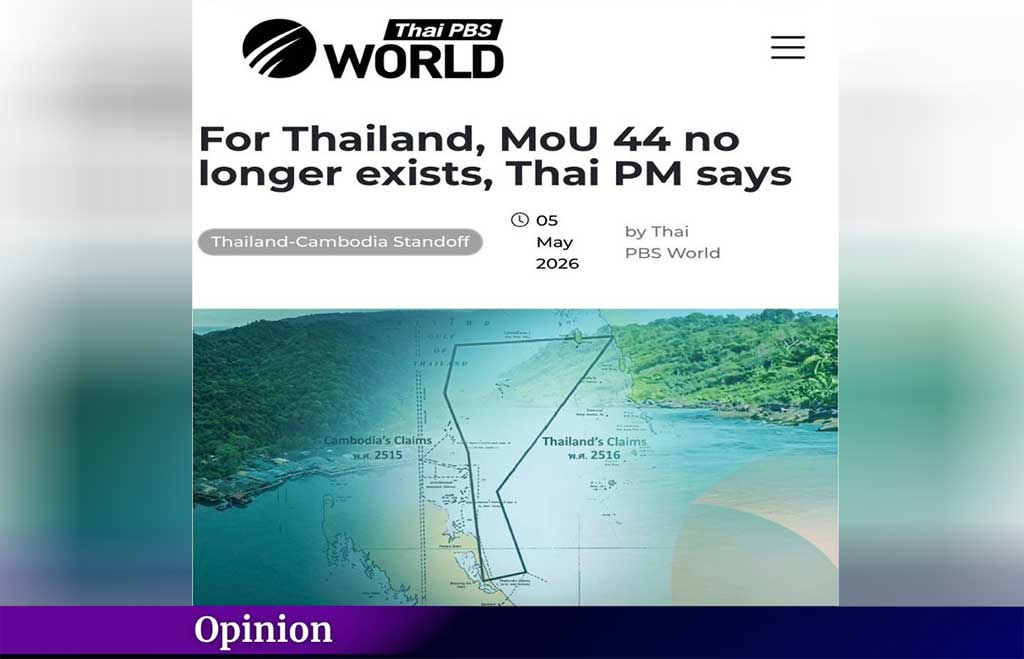
It is important to remember that Thailand’s unilateral withdrawal from the 2001 MOU which aimed to govern maritime disputes is occurring within a strategic, multidimensional, interconnected global chess game. The shift from the MOU to UNCLOS marks just one move in one domain in the strategic competition between Thailand and Cambodia.
Putting it a different way, the Cambodian government’s action is in response to the Thai government’s decision to withdraw from the MOU, and separate from the Cambodian government’s specific action elsewhere. There are multiple other connected events, circumstances and moves being made by both parties relative to the law of the sea that reverberate and influence each other.
For example, the shifting and positioning of military forces along the border, readiness of forces, etc. are actions that feed into the relationship of both countries. Separate from acting or responding to the other party, sometimes decisions are made to address or respond to internal matters or interests. It is plausible that the Thai government’s actions with respect to the MOU were more motivated by catering to Thai elite than circumstances surrounding Cambodia.
This is also likely, or perhaps definitively the case, with Thailand’s military aggressions against Cambodia (in the run up to Thai national elections.)
Once one stops looking at the Thai government’s actions in isolation from everything else that is happening and realises that they are all interconnected and part of a broader narrative or possibly even a larger strategy, “Thailand’s ‘strategy for all strategies’ or ‘strategic narrative’”, (see article by Dr. Pattajit Tangsinmunkong, “Reframing a Genocide: Strategic Narratives and the Legitimisation of Thailand’s support for the Khmer Rouge,”) then one sees the proverbial “forest for the trees”.
Youk Chhang is director of the Documentation Center of Cambodia (DC-Cam). The views and opinions expressed are his own.