Thailand’s enemy lies not across the border but within
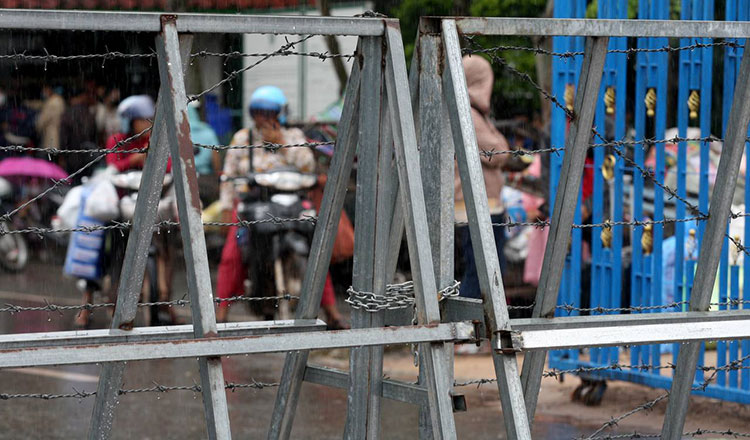 The land border between Thailand and Cambodia remains closed as the two nations continue feuding over territory. KT/Chor Sokunthea
#opinion
With chronic polycrisis at home, Thailand should focus on its domestic issues for the sake of its people instead of ruining its international reputation by invading and occupying Cambodia in violation of international law.
For decades, Thailand was the Siamese Tiger, an industrial powerhouse that served as the heartbeat of Southeast Asian manufacturing. But as 2026 unfolds, that roar has faded to a whimper.
From the outside looking in, the nation appears trapped in a toxic polycrisis—a convergence of demographic collapse, suffocating debt, and a structural industrial exodus that is turning the 2020s into a lost decade.
The most glaring sign of decay is the sheer scale of private liability.
While the official household debt load hovers near 90% of GDP, the true weight on the economy is far heavier when the explosion of shadow banking and predatory informal lending is included, pushing the effective debt-to-GDP ratio towards a crushing 170%.
Economists no longer call this a bubble that might burst; they call it a cancer that is slowly eating the country’s future. Families are now trapped in debt, funnelling 40–50% of their income just to service interest, creating a grotesque K-shaped reality where the elite remain insulated while the rest of the nation is mired in a retail slump where consumption has evaporated, and THB1.2 trillion in non-performing loans (NPLs) has turned banks into cautious gatekeepers, pushing the vulnerable towards predatory illegal lenders.
The industrial sector, once the bedrock of Thai prosperity, is hollowing out.
Between 2023 and 2024, over 4,300 factories closed, and current data suggest the haemorrhage is accelerating to over 100 closures per month.
Thailand is caught in a suffocating pincer movement: from below, a relentless flood of inexpensive Chinese imports is crushing local SMEs that lack the scale to compete, while from above, high-value manufacturing is increasingly bypassing the country for Vietnam and Indonesia due to a shrinking labour force and stagnant productivity. This structural decay is further accelerated by a mass industrial exit, as the downsizing of automotive giants like Suzuki and Honda effectively dismantles the vital supply chains upon which millions of Thai jobs depend.
The departure of Japanese firms—historically the backbone of the Thai economy—represents a tectonic shift in the region’s industrial landscape. As of 2026, the exodus has moved from a trickle to a significant flood, particularly in the automotive and high-tech sectors.
For decades, Thailand was dubbed the Detroit of the East, but the transition to electric vehicles (EVs) and the influx of Chinese competition have broken the Japanese stranglehold. Following a disastrous 2023 when domestic sales plummeted, Suzuki announced the full closure of its production plant in Rayong by the end of 2025. This facility once produced 60,000 units annually; now, Suzuki will pivot to importing finished vehicles from India and Japan. After five consecutive years of losses, Subaru ceased all vehicle manufacturing in Thailand at the end of 2024. In a massive consolidation move, Honda has shut down its production lines in Ayutthaya, moving all operations to its Prachinburi plant.
The crisis is not limited to cars. Japanese firms across the spectrum are evaluating their Thailand risk. Between 2023 and 2025, over 5,000 factories closed in Thailand. While the Ministry of Industry does not always categorise these by nationality, the Japanese Chamber of Commerce notes that nearly 20% of Japanese firms in Thailand are planning to decrease investment or exit entirely due to rising labour costs and an ageing workforce.
Thailand’s economy is reeling from a severe energy shock as global spikes in oil and liquefied natural gas (LNG) prices—driven by an intensified Middle East conflict—have forced the government to hike diesel prices to a record THB 39 per litre, triggering a 25% surge in logistics costs that is being passed directly to consumers.
This crisis is particularly acute because the nation’s power grid remains dangerously over-reliant on expensive imported LNG, a dependency that has doubled in recent years and resulted in electricity tariffs climbing towards THB4.60 per unit, crippling the competitiveness of energy-intensive industries like steel, cement, and chemicals. The Federation of Thai Industries warns that this energy tax on production is pushing inflation towards 5–6% and could slash 2026 GDP growth to a dismal 1.0%, as manufacturers are forced to either cut production or join the growing exodus of firms fleeing to regional neighbours with more stable and affordable power structures.
Nowhere is the strain more visible—or more tragic—than in the public health sector.
Thailand’s much-vaunted universal healthcare system is facing a collapse of liquidity. Public hospitals have accumulated a combined deficit exceeding THB4.2 billion, with hundreds of facilities operating at a loss.
The healthcare crisis is defined by a two-fold failure of strategy and demographics: first, a severe personnel drain is occurring as the government’s aggressive pursuit of medical tourism dollars—now accounting for 0.4% of GDP—effectively cannibalises the domestic system by luring skilled doctors and nurses to high-paying private hospitals for foreigners, leaving the public sector at a staggering 72% of its staffing target. This shortage is exacerbated by an immense ageing burden, as a super-aged society floods public wards with chronic, non-communicable diseases, pushing provinces like Bueng Kan into red zone territory with doctor vacancies exceeding 40%. For the average citizen who cannot afford private care, this reality manifests as postponed surgeries, rationed medication supplies, and dangerously overcrowded facilities that have reached a breaking point.
The 2026 growth forecast of 1.6–2.1% is a siren song of stagnation.
The nation is facing the ultimate middle-income trap penalty: it is growing old before it has grown rich. Its factories are closing, its households are drowning in debt, and its hospitals are bankrupt.
With chronic polycrisis at home, Thailand should focus on its domestic issues for the sake of its people instead of ruining its international reputation by invading and occupying Cambodia in violation of international law. At times of polycrisis, countries need international cooperation, and it is definitely not a time to make a permanent neighbour an enemy.
Cambodia is not Thailand’s enemy. Thailand’s real enemy lies within its own borders.