France’s Role in Preserving Cambodia’s Territorial Integrity Amid Centuries of Threats
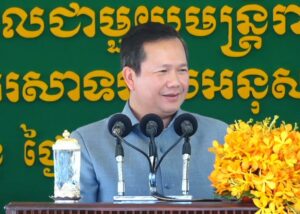
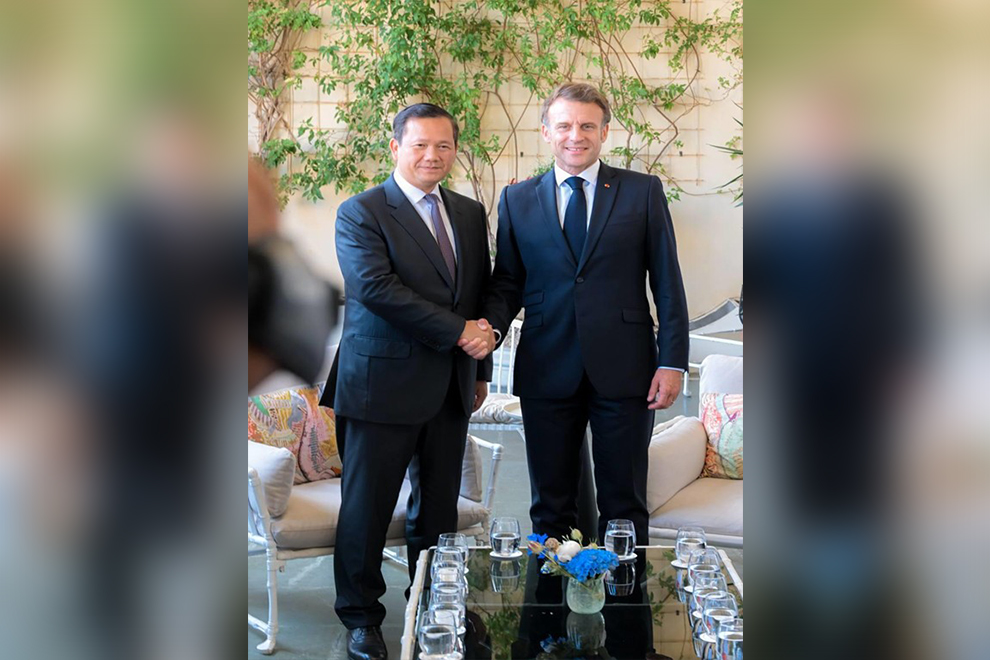 Prime Minister Hun Manet and French President Emmanuel Macron in Nice, France.
#opinion
As Cambodia once again confronted aggression along its volatile border with Thailand in 2025, resulting in the tragic loss of brave Cambodian soldiers and a renewed wave of instability that threatens regional peace, it is both timely and necessary to reflect deeply on our nation’s long and turbulent history. In moments of crisis like these, understanding the past is essential not only to grasp why these territorial disputes persist but also to appreciate the pivotal role one nation played in safeguarding Cambodia’s survival as a sovereign entity.
For centuries, Cambodia found itself squeezed between two powerful neighbours: Vietnam to the east and Siam — today Thailand — to the west. This precarious position repeatedly exposed the kingdom to the risk of gradual erosion or outright partition. The pattern became especially clear in the late 18th century.
In 1795, Siamese forces seized key western provinces, including Battambang, Banteay Meanchey, Siem Reap and the area around Preah Vihear Temple. These territories were not only strategically important but also culturally vital, forming part of the ancient Khmer heartland.
Throughout the 19th century, the danger intensified. Cambodia teetered on the brink of complete dismemberment as Vietnam pushed from the east and Siam expanded westward.
Both powers encroached on Khmer lands, competed for control of the Mekong River, and sought to prevent Cambodia from achieving genuine independence. Internal weaknesses, including political division and economic decline after the Angkor era, left the kingdom unable to defend itself effectively against such relentless pressure. Without outside help, it seemed likely that Cambodia would be swallowed up, its territories divided, and its unique cultural heritage severely damaged.
It was in this moment of existential vulnerability that France intervened decisively. In 1863, King Norodom placed Cambodia under French protection through a treaty establishing a protectorate. This step reflected the harsh reality that the Khmer monarchy could no longer ensure the kingdom’s survival alone.
For nearly a century, until full independence in 1953, the French protectorate served as a crucial shield. France helped prevent the total loss of Cambodian territory when the kingdom was too weakened to protect its borders independently. Though the arrangement carried colonial aspects, it ultimately preserved the core of modern Cambodia. Cambodians remain deeply grateful for this intervention, which safeguarded not only land but also the nation’s language, traditions, and magnificent cultural treasures — most notably the awe-inspiring temples of Angkor.
French contributions went further than protection alone. Between 1904 and 1907, French diplomats negotiated successfully with Siam to return the western provinces of Battambang, Banteay Meanchey, Siem Reap and Preah Vihear to Cambodian administration. This restored vital territories to Khmer control. French surveyors then carried out formal border demarcation, relying on historical maps and legal principles. Although the process displeased Siam, it established the foundation for modern boundaries that Cambodia continues to uphold.
This framework proved vital during the chaos of World War II. In 1940–1941, with Japanese support, Siam invaded and retook large parts of western Cambodia. After Japan’s defeat in 1945, France demanded and secured the return of these territories, reinforcing Cambodia’s claims at a critical time.
Cambodia achieved full independence on November 9, 1953. However, challenges remained. In 1954, Thai forces temporarily occupied the Preah Vihear Temple area. Cambodia took the case to the International Court of Justice (ICJ) in 1959. The 1962 ICJ ruling affirmed that the temple belongs to Cambodia, yet it left the precise boundaries of surrounding areas ambiguous — an issue that still fuels tension today.
Later events, including the temple’s designation as a UNESCO World Heritage Site in 2008 and the ICJ’s clarifying ruling in 2013, have kept the dispute in the spotlight.
Recent clashes in 2025, involving gunfire and loss of life around the roughly 4.6 square kilometres near Preah Vihear and areas such as Ta Mone and Ta Krabei, trace back to these unresolved segments. Such incidents are often worsened by Thai domestic politics, where border nationalism serves as a tool for political advantage. Cambodia, meanwhile, has consistently advocated for peaceful solutions based on international law, dialogue and mutual respect for treaties and court decisions.
As we face these difficulties with resolve and restraint, Cambodia expresses profound gratitude to France. Without the 1863 protectorate and the diplomatic efforts that followed, large portions of Cambodia’s western territory — including the culturally priceless Siem Reap region and the sacred Angkor complex — might have been permanently lost. France’s negotiations, border mapping and defence of Cambodian interests during global crises gave the Kingdom a genuine opportunity to emerge as an independent nation with its cultural heart intact.
As we remember the sacrifices of the past, mourn the recent losses of our soldiers, and confront ongoing instability, let us also honour the historical friendship with France. In our hour of greatest need, French protection helped ensure that Cambodia still stands today as a proud, sovereign kingdom, its ancient heritage preserved for the world and for future generations of Khmer people.
May wisdom, restraint, and adherence to international law guide all parties toward a just and lasting peaceful resolution. Cambodia seeks only what is rightfully ours and stands ready to build good-neighbourly relations, cooperation and shared prosperity with Thailand once the borders are clearly, fairly and permanently settled according to legal and historical truth.
Dr. Seun Sam is a policy analyst at the Royal Academy of Cambodia. The views and opinions expressed are his own.
-Phnom Penh Post-
——————