Strengthening the Core: Why ASEAN’s Observer Teams Must Evolve for Strategic Stability
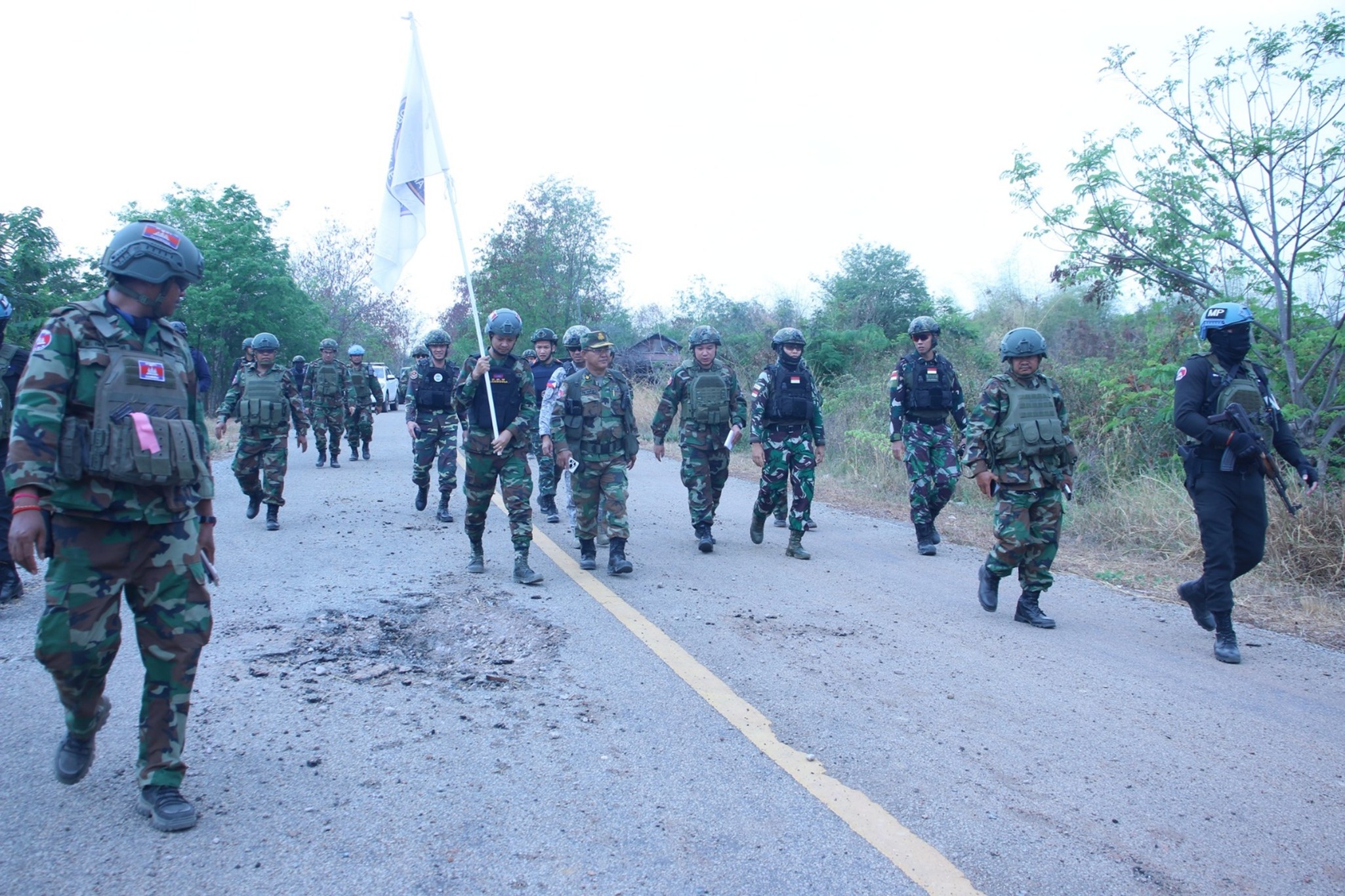 The AOT team visit the An Ses area in Preah Vihear province on February 26. Defence ministry
#opinion
The ASEAN Observer Teams (AOT) have played a quiet but consequential role in maintaining regional stability. In moments of border sensitivity, their presence has helped reduce uncertainty, encouraged restraint and preserved channels of communication. Their work reflects ASEAN’s long-standing commitment to dialogue over confrontation and discipline over escalation.
For decades, this model of discreet engagement has contributed meaningfully to peace along contested frontiers. The value of neutral, institutionally grounded observation should not be understated. It has helped prevent misinterpretation from hardening into conflict and ensured that tensions remained manageable within a regional framework.
Yet evolving regional dynamics now demand that effective presence translate into structured impact.
In an era marked by rapid information flows, heightened political sensitivity and increasing strategic competition, institutional credibility depends not only on observation, but on a measurable stabilising effect. Mechanisms must evolve to retain deterrent value.
Strengthening ASEAN’s Observer Teams is therefore not an exercise in critique. It is an exercise in institutional maturation.
Border stability in Southeast Asia has never depended solely on deterrence. It has depended on disciplined institutions capable of transforming potential incidents into managed processes. At the centre of that institutional architecture stand ASEAN’s Observer Teams — mechanisms whose continued relevance requires careful and deliberate evolution.
Observation records events. Impact shapes outcomes. The strategic task ahead is to ensure that ASEAN’s observer mechanism consistently delivers both.
Sovereignty and Structure Are Complementary
For ASEAN member states, sovereignty and territorial integrity remain non-negotiable. Legal boundaries, defensive readiness and national jurisdiction are foundational principles of the regional order.
However, firmness in principle does not eliminate the risk of miscalculation. Border tensions rarely escalate immediately into large-scale confrontation. More often, they begin with ambiguity — a patrol movement misinterpreted, an infrastructure activity misunderstood, a rumour amplified in the absence of verified facts.
Strategic stability requires structured mechanisms capable of clarifying incidents before they harden into disputes.
This is where ASEAN’s Observer Teams carry strategic importance.
The Dual Mandate: From Presence to Preventive Function
AOT operates under a dual mandate:
1. Monitoring ceasefire compliance and military posture
2. Assessing humanitarian and political conditions on the ground
Both mandates are significant. Their effectiveness, however, depends on systematic operationalisation.
Security Verification as Risk Management
The monitoring of ceasefire compliance and force posture serves a stabilising legal function. In contested or sensitive areas, perception often drives escalation. Without neutral verification, states rely on unilateral assessments that may be incomplete or politically influenced.
An effective observer mechanism performs three essential functions:
First, it establishes a shared evidentiary baseline.
Objective documentation of troop deployments and compliance with agreed arrangements reduces space for exaggerated claims and speculative narratives.
Second, it institutionalises timely clarification.
Structured review timelines for reported incidents prevent escalation cycles from gaining momentum. Rapid, credible clarification reduces political pressure and public anxiety.
Third, it links findings to deliberative follow-up.
Monitoring gains deterrent value when findings inform diplomatic engagement, consultation mechanisms or confidence-building adjustments. Verification without consequence weakens credibility; verification integrated into institutional processes reinforces restraint.
This function does not dilute sovereignty. On the contrary, it protects lawful sovereign conduct by distinguishing legitimate defensive measures from destabilising escalation. Observation becomes preventive when it shapes behaviour.
Humanitarian and Political Assessment as Early Warning
The second mandate — assessment of humanitarian and political conditions — is equally central to strategic stability.
Border tensions affect civilian populations before they affect formal diplomatic channels. Farmers may lose access to land. Traders may face interrupted routes. Local communities may experience anxiety fuelled by rumour.
An effective AOT framework should systematically document:
• Civilian displacement risks
• Disruption of trade corridors
• Infrastructure strain
• Access to essential services
• Community stability indicators
This data is not merely descriptive. It performs an early-warning function.
Civilian instability can generate domestic political pressure. Economic disruption may harden negotiating positions. Local rumour can escalate into national narrative. By identifying these dynamics early, ASEAN creates space for preventive adjustment.
Peace, in institutional terms, is not merely the absence of armed confrontation. It is the preservation of normal civic and economic life.
When observer findings inform practical stabilisation measures, the mechanism moves from symbolic oversight to tangible impact.
Transparency as a Strategic Multiplier
ASEAN’s tradition of quiet diplomacy has long contributed to regional cohesion. Discretion remains valuable. However, contemporary information environments impose new challenges.
In moments of tension, silence can unintentionally create informational vacuums. Those vacuums are often filled by misinformation, politically motivated narratives or speculative reporting.
Calibrated transparency strengthens institutional credibility without compromising operational sensitivity.
This does not require disclosure of tactical details. It requires carefully structured communication confirming:
• Whether ceasefire terms are being respected
• Whether verified large-scale mobilisation has occurred
• Whether civilian conditions remain stable
Measured public summaries can:
• Reduce public anxiety
• Counter misinformation
• Preserve political space for diplomatic engagement
• Reinforce ASEAN’s authority as the primary manager of regional disputes
Transparency, when disciplined and factual, enhances deterrence. Actors are less likely to test boundaries when actions are independently observed and institutionally acknowledged.
An observer mechanism that monitors quietly but communicates strategically becomes more credible — and therefore more effective.
Institutionalizing Impact
For the ASEAN Observer Teams to evolve meaningfully, several institutional enhancements warrant consideration:
· Clearly defined verification benchmarks
· Predictable engagement cycles, not solely reactive deployment
· Structured incident clarification timelines
· Institutional memory and data continuity
· Formal linkage between field findings and ASEAN deliberative bodies
· Measurable follow-up mechanisms for stabilisation
These reforms do not expand authority. They refine execution.
Impact is not measured by how frequently observers intervene. It is measured by how rarely tensions escalate because the mechanism exists.
When parties understand that actions will be independently documented, evaluated and processed within a regional framework, restraint becomes rational.
This is deterrence through institutional architecture — not force projection.
Reinforcing ASEAN Centrality
The credibility of ASEAN’s observer mechanism also bears directly on ASEAN centrality.
When regional institutions demonstrate procedural integrity and consistent follow-through, disputes remain within ASEAN’s own architecture. When mechanisms appear passive or inconsistent, external narratives and external actors may gain influence.
Strengthening AOT is therefore not only about managing individual border tensions. It is about preserving ASEAN’s
autonomy in dispute management and reinforcing confidence in its institutional capacity.
Institutional strength protects regional ownership.
From Observation to Strategic Stability
“Strengthening the Core” is not an abstract aspiration. ASEAN’s Observer Teams already occupy a central position within the region’s preventive security framework. The question is whether that core remains adaptive to contemporary pressures.
Observation records events. Impact shapes outcomes.
When monitoring is structured, verification is linked to follow-up, civilian stability is systematically assessed, and transparency is responsibly calibrated, the observer mechanism becomes more than reassurance.
It becomes preventive governance. Strong states defend their sovereignty. Strategic regions institutionalise stability.
If that AOT evolves with discipline and clarity, peace along contested borders will not depend on restraint alone. It will rest on institutional design.
And institutional design — when credible, consistent, and transparent — is the most durable guarantor of strategic stability in Southeast Asia.
Panhavuth Long is founder and attorney-at-law for Pan & Associates Lawfirm. The views and opinions expressed are his own.
-Phnom Penh Post-
———————