An Open Letter to Thailand: Historical Facts Regarding Ta Krabei Temple and Shared Khmer Heritage
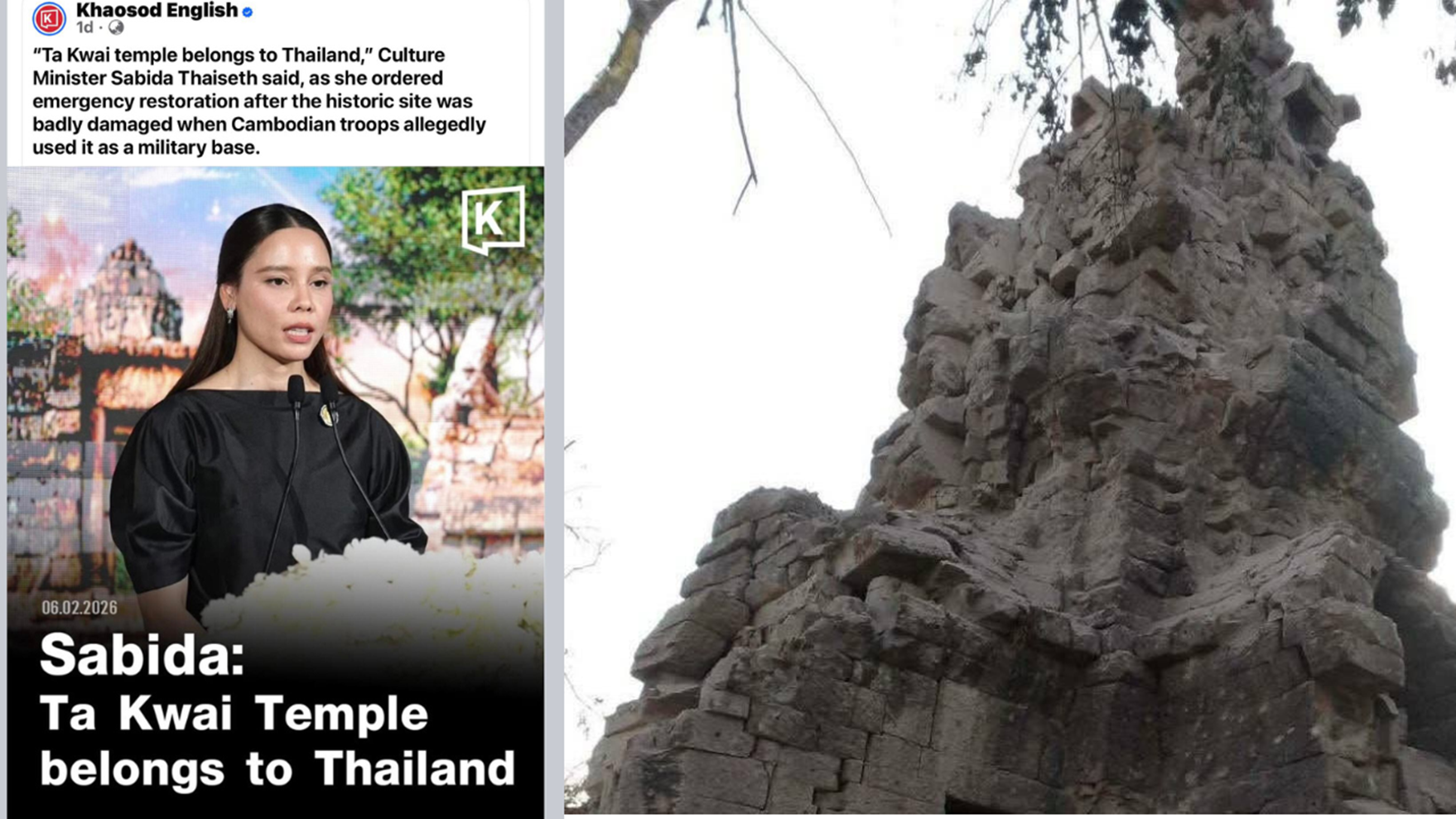 Ta Krabei Temple, in Preah Vihear province, has been claimed by a senior Thai official. It was damaged by Thai soldiers during the fighting of last December. Supplied
#opinion
Dear Minister Sabida Thaiseth,
I was deeply concerned to read your recent statement, reported by Khaosod English, asserting that “Ta Krabei (Ta Kwai) Temple belongs to Thailand”. As Thailand’s Minister of Culture, your office carries a professional and ethical obligation to uphold historical accuracy and internationally accepted standards of cultural heritage interpretation. Statements that conflate modern territorial administration with ancient cultural authorship risk misleading the public and undermining well-established scholarly consensus.
Ta Krabei Temple and the Weight of Historical Truth
Recent reporting by Khaosod English, repeating a senior Thai official’s claim that Ta Krabei “belongs to Thailand”, warrants careful historical and academic scrutiny. Declarations made by state authorities — particularly those entrusted with culture and heritage — carry institutional authority. When such declarations blur the distinction between contemporary sovereignty and premodern civilisation, they risk distorting public understanding of history.
Ta Krabei Temple must be understood within the broader archaeological and historical context of mainland Southeast Asia. Across present-day Thailand — especially in the northeastern and eastern regions — stand well over a thousand temples and archaeological sites constructed during the Khmer Empire between the 9th and 13th centuries. These monuments predate the formation of the modern Thai nation-state by several centuries and were built long before contemporary borders existed. At the time of their construction, these regions were firmly integrated into the political, religious and cultural system centred at Angkor.
The Khmer origin of these monuments is not a matter of political interpretation or national sentiment. It is established through multiple independent lines of evidence: architectural typology, construction techniques, spatial orientation, religious iconography, epigraphy and historical documentation. Scholars such as George Coedès, Philippe Stern, Claude Jacques, Michael Vickery and Hiram Woodward — along with research conducted by Thailand’s own Fine Arts Department — have consistently identified these structures as products of the Angkorian Khmer civilisation.
These temples conform to Angkorian architectural canons, reflect Khmer religious cosmology, were dedicated to Hindu deities or later Mahayana Buddhist traditions, and bear inscriptions in Old Khmer and Sanskrit — not in the Thai language. This applies not only to major monuments such as Prasat Phanom Rung and Prasat Muang Tam, but also to satellite sanctuaries associated with the Preah Vihear complex and to numerous lesser-known ruins distributed throughout the region.
When archaeological assessments include not only large, well-preserved monuments but also satellite shrines, laterite foundations, damaged structures and partially documented remains, the number of Khmer-period sites within present-day Thailand reasonably exceeds 2,000. This figure does not imply 2,000 monumental temples of equal scale; rather, it reflects the extensive administrative, religious and infrastructural footprint of the Khmer state across these territories.
Ta Krabei Temple must therefore be situated within this established historical framework. To state that the temple “belongs to Thailand” without acknowledging its Khmer origin conflates modern territorial jurisdiction with ancient cultural authorship. While the site may currently fall under Thai administrative control following recent border developments, this fact does not alter who commissioned its construction, which civilisation produced it or which cultural tradition it represents.
International heritage principles — including those applied by UNESCO — draw a clear distinction between present-day state stewardship and historical origin. Many World Heritage sites are administered by modern states different from the civilisations that created them.
Acknowledging the Khmer provenance of Ta Krabei Temple and similar monuments does not diminish Thailand’s sovereignty or its responsibility to conserve heritage within its borders. On the contrary, historical accuracy enhances institutional credibility, scholarly integrity and regional respect.
History does not change when borders shift, nor do monuments acquire new identities through modern political claims. Ta Krabei Temple remains — by every archaeological, epigraphic and historical measure — a legacy of the Khmer civilisation. Recognising this reality is not an act of hostility toward any nation. It is a responsibility — to historical truth, to academic standards and to the informed public.
Tesh Chanthorn is a Cambodian who longs for peace, The views and opinions expressed are his own.
-Phnom Penh Post-
——————–