Cambodia baulks at Thai claims over Ta Krabei and Ta Moan
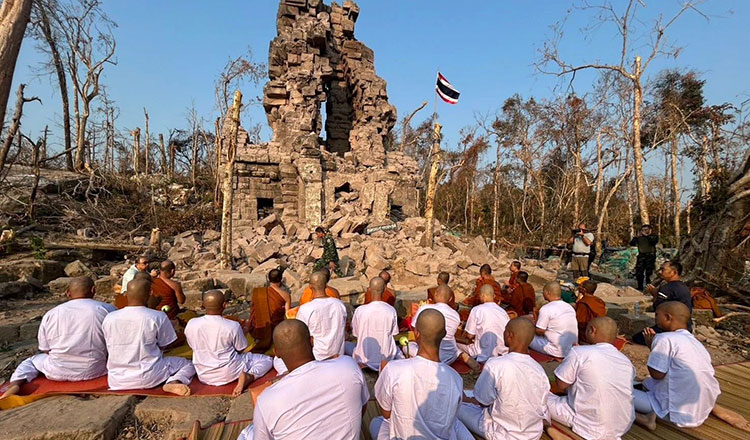 Thai soldiers and monks at Ta Krabei Temple. 22nd Infantry Battalion, Task Force 2
#National
Synopsis: Phnom Penh signals readiness to seek a binding ruling from the International Court of Justice as historical and territorial disputes intensify.
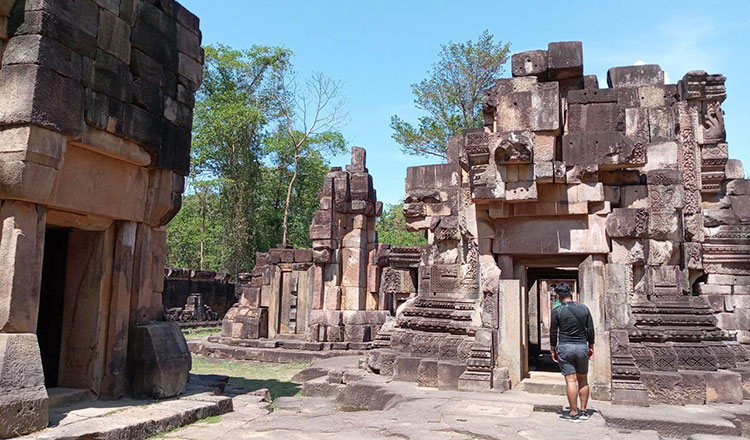
The Ministry of Culture and Fine Arts has rejected recent statements by Thailand’s Minister of Culture, reiterating that the Ta Krabei Temple and the Ta Moan Temple Complex are located entirely within Cambodia.
In a statement issued Sunday, the ministry dismissed remarks made on February 6 by Thailand’s Minister of Culture Sabida Thaiseth, who claimed that the sites—which Thailand calls Ta Kwai and Ta Moan—fall under Thai sovereignty.
“The Ministry of Culture and Fine Arts of the Kingdom of Cambodia firmly rejects the recent statements made on February 6, 2026,” the statement said, adding that it “categorically denies the claim that Ta Krabei Temple and the Ta Moan Temple Complex fall under Thai sovereignty.”
The ministry stressed that the location of the temples is clearly established by the Franco-Siamese Treaties of 1904 and 1907 and their annexed maps. It added that these legal foundations are the ones upheld by the International Court of Justice (ICJ) in its 1962 judgement related to the Temple of Preah Vihear.
Rejecting arguments based on Thailand’s domestic administrative actions, the ministry said, “Claims based on unilateral registrations, domestic administrative acts from 1935, or non-recognised maps hold no legal validity under international law and cannot override binding bilateral treaties.”
The statement also warned against any restoration or construction activities carried out without Cambodia’s consent, saying that “any ‘restoration’ work conducted without the consent of the territorial state constitutes a violation of the 2000 Memorandum of Understanding on Land Border Demarcation and undermines the spirit of ASEAN cooperation.”
The ministry statement underscored that cultural heritage must not be used or controlled through force, saying that “the occupation or control of cultural heritage through military presence or force is strictly prohibited under the UN Charter and the 1954 Hague Convention for the Protection of Cultural Property in the Event of Armed Conflict.”
Despite the strong language, Cambodia reiterated its pledge to peaceful and lawful solutions. “Cambodia remains committed to a peaceful, rules-based resolution,” the ministry said, calling on Thailand “to cease all unilateral activities at these sites.”
It added that if disagreements persist, Cambodia “invites a transparent and legally binding settlement through the International Court of Justice, rather than through the use of force or inflammatory rhetoric.”
As of February, the Ta Krabei Temple (known as Ta Kwai in Thailand) is at the centre of renewed sovereignty disputes between Cambodia and Thailand.
The temple was the site of conflict in 2025, with control shifting between the two countries, including reports of Cambodian forces occupying it in July, followed by Thai claims of retaking it in December last year.
The temple was damaged during clashes.
Cambodia has signalled its intent to refer the disputed areas od Ta Moan Thom, Ta Moan Touch, and Ta Krabei to the ICJ.
Documentation Centre of Cambodia Director Youk Chhang said the dispute between Cambodia and Thailand is as much a conflict between different versions of history and circumstances on the ground as it is between two opposing armies.
“There is nothing wrong with competing opinions about history, but there are problems with different versions of history, and though Cambodia holds a superior position in the current conflict over history and the facts on the ground, there are many different ways Cambodia can improve its command over the facts,” he said.
“For example, we can increase our understanding of our own history and the history of Thailand. Second, we can take greater initiative in collecting evidence of the current events and use this evidence to help the international community understand what is happening.”
Youk suggested that Cambodians use historical facts more effectively in their engagements with the world and Thailand.
“Collecting, preserving and protecting true history and the true facts occurring today are not secondary considerations; they are a strategic battleground in this conflict that traces back generations.
Indeed, failure to take command over the truth of this history guarantees its perpetuation for generations to come,” he added.
-Khmer Times-
—————-