Phnom Penh vows to eradicate online scam networks by Khmer New Year
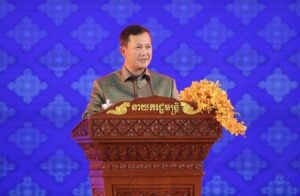
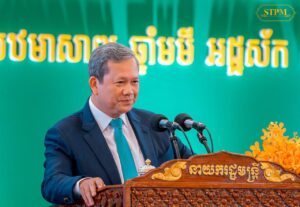
 Montage shows Interior Minister Sar Sokha (R) and a series of police raids and arrests on scam compounds in Cambodia. Khmer Times
#National
Synopsis: The government is taking a take-no-prisoners approach to eliminating modern crime syndicates by April, saying it has the resources, expertise, and international backing to fulfil the mission after years battling the scourge.
Cambodia has pledged to eradicate all cybercrime networks in Cambodia before Khmer New Year, the Kingdom’s biggest holiday, in April.
The decision took centre stage at the weekly meeting on Tuesday chaired by Interior Minister Sar Sokha to monitor the progress of the national crackdown on technology-based fraud, said Chou Bun Eng, Secretary of State at the Ministry of Interior and Permanent Vice-Chair of the National Committee for Counter Trafficking (NCCT), in an exclusive interview with Khmer Times.
Bun Eng said serious enforcement actions will be rolled out across the country to achieve the goal.
“The large-scale nationwide crackdown is ongoing and will only get bigger, and the government will eradicate all forms of online scams before the Khmer New Year holiday,” Bun Eng said.
“All authorities and agencies, as well as provincial officials, will work harder than ever on the same mission to make sure that there is not a single syndicate left in our country.”
She added that every provincial administration now bears responsibility for reporting on the modern crimes, which in recent years have damaged the Kingdom’s reputation.
Bun Eng said Cambodian officials have learnt from experience, especially in tracing and investigative techniques, which allows them to increase the effectiveness and accuracy of law-enforcement measures.
“In the past, when we conducted investigations on each reported case separately, we always ran into the problem of the offenders fleeing the scenes, from one den to another,” she said.

“Now, we are fighting a massive network, but we have the experience, work force and resources that we need for a nationwide crackdown.”
As Cambodia intensifies domestic efforts to wipe out online scam syndicates, cooperation with foreign countries and partner organisations has also significantly improved.
“As our work on sharing information and reporting has become so much better, these countries have displayed more efforts in deporting the criminals and assisting the victims, both of whom are their citizens,” she said.
“Of course, by saying that, I do not include those who are still evading us and out in the streets. But, as our local officials are beefing up their reporting, they will not be out there for long.”
Speaking on behalf of the government, Bun Eng called on Cambodians to join hands with local authorities in the effort by reporting suspicious activities and operations in their neighbourhoods.
“Every report will be carefully investigated, and if a link to a scamming activity is detected, action will be taken,” she said. “Only by working together can we secure success for our country as well as the region.”
Online scams in Cambodia have expanded rapidly in recent years. The frauds range from investment and romance scams to fake job offers, phishing, and cryptocurrency-related schemes. Many operations use social media platforms, messaging apps, and online marketplaces to target both Cambodians and foreign victims.
While denying some reports that it says are “exaggerated”, the Cambodian government has acknowledged the problem and stepped up enforcement.
Prime Minister Hun Manet himself chairs the Commission for Combatting Online Scams (CCOS), a high-level task force established in February last year. The commission is tasked with implementing measures to prevent, suppress, and crack down on cyber fraud. Operating on a separate financial budget and using the stamps of the Council of Ministers for its official documents and materials, it provides guidance, coordination, and support to enhance the efficiency of ministries, institutions, and law enforcement agencies.
Additionally, the commission monitors, inspects, and evaluates the efforts of government bodies in combatting cyber fraud and cooperates with international partners to address transnational online crime.
Since the creation of the special commission, Cambodia has reported success in crackdown on online scam syndicates, almost all of which were run by foreigners.
In the latter half of 2025, authorities carried out enforcement operations at 118 suspected crime locations across Cambodia, resulting in the arrest of 4,983 suspects from 23 nationalities.
The intensified crackdown continues to bear fruit in 2026, with the arrest and deportation of Chen Zhi, founder of Prince Group and alleged ringleader of online scam operations—in addition to more raids in multiple provinces. The most recent and also notable case took place on the last day of January in Bavet City of Svay Rieng province, resulting in the arrest of 2,044 foreigners.
In mid-January, Mr Hun Manet issued a public appeal for national unity and intensified efforts to combat the scourge of online scam networks, calling cyber fraud a serious transnational crime threatening the country’s social security and reputation as well as the stability of the region.
“The continuous implementation of strict and decisive measures against online scam crimes in recent times stands as evidence of the government’s political commitment to combating this transnational crime, which is a shared concern of Cambodia, the region, and the world,” he said.
“Therefore, I sincerely wish to see participation, commitment, and national sacrifice from all relevant stakeholders—especially from Cambodian citizens of all backgrounds and beliefs, as well as civil servants, local authorities, and all competent forces—so that we may unite as a great national solidarity force to eradicate all negative issues related to online scam crimes and to elevate the good reputation of the Kingdom of Cambodia on the international stage.”
Asian Vision Institute President Chheng Kimlong praised the government for its “great response” to the problem.
“This is not only about protecting the country’s reputation but also the matter of security, as Thailand recently used online scams as an excuse to attack and invade Cambodia,” he said.
Kimlong called on other countries to recognise and aid in the Kingdom’s efforts.
“Every country has to join hands with Cambodia to combat the cybercrimes based on the spirit of sovereign equality and good faith,” he said.
“By helping Cambodia, they are also extending a helping hand to their people. Online scams, as we all know by now, recognise no boundary.”
-Khmer Times-
—————-