Cambodia raises alarm over Thailand’s second delay of JBC meeting while pressing ahead with diplomatic efforts to resume joint surveys
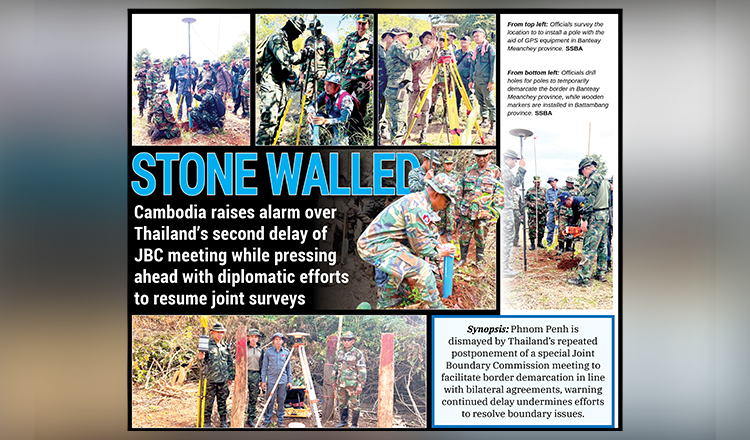 Cambodia raises alarm over Thailand’s second delay of JBC meeting while pressing ahead with diplomatic efforts to resume joint surveys
#National
Synopsis: Phnom Penh is dismayed by Thailand’s repeated postponement of a special Joint Boundary Commission meeting to facilitate border demarcation in line with bilateral agreements, warning continued delay undermines efforts to resolve boundary issues.
Cambodia has voiced serious concern over Thailand’s second request to postpone a special meeting of the Joint Boundary Commission (JBC), warning that the continued delay undermines agreed mechanisms for resolving border issues, even as Phnom Penh presses ahead with diplomatic and technical efforts to resume joint surveys and uphold commitments under existing bilateral agreements.
Since the Thai military launched assaults on Cambodia last year, in July and again in December, Thailand has illegally occupied Cambodian territory in four border provinces—Preah Vihear, Oddar Meanchey, Banteay Meanchey and Pursat— and refused to withdraw its troops, while building military strongholds and installing barbed wire and shipping containers to block refugees from returning home.
According to the Ministry of Interior yesterday, 5,820 more displaced persons have returned to their villages. As a result, about half a million among the 640,000 displaced persons have reintegrated into their communities, while 144,326 remain in displacement camps.
Despite the outcome of the two-day Special Meeting of the Cambodian-Thai Joint Commission on Demarcation for Land Boundary (JBC), hosted by Thailand in October, at which the two nations agreed that Cambodia would host the next JBC meeting in Siem Reap province in the first week of January, Thailand has broken its commitments by continuing to delay the meeting.
In a press release issued on Wednesday, the State Secretariat of Border Affairs (SSBA) said the Cambodian side had proposed holding the special JBC meeting in Siem Reap province during the second or third week of January, but the Thai side again requested a delay, citing the need to prepare for the formation of a new cabinet after the general election expected to be held early next month.
While awaiting the rescheduled meeting, Cambodia has sought to accelerate agreed field operations by formally requesting Thailand to deploy Joint Survey Teams (JSTs) to resume joint surveying and placement of temporary markers along specific boundary segments.
According to the SSBA, through a diplomatic note dated January 13, Cambodia proposed dispatching JSTs between January 19 and 23 to continue work on boundary segments between Boundary Pillars 42–47 and 52–59. The exercise began last November but was suspended on December 8 due to what Cambodia described as acts of aggression against its sovereignty and territorial integrity.
Cambodia also requested that both sides deploy JSTs between January 26 and 30 to replace 15 boundary pillars that had already been mutually agreed upon in terms of location and specifications.
The SSBA stressed that all proposed field activities fully comply with agreed procedures and technical instructions, as outlined in the Agreed Minutes of the Special Meeting of the Cambodia–Thailand Joint Boundary Commission held on October 22 last year in Thailand’s Chanthaburi province.
The statement cited remarks by Thai Prime Minister Anutin Charnvirakul earlier this month acknowledging the limitations of a caretaker government. As reported by The Nation Thailand, Anutin said: “During a caretaker period… meetings of the Thai-Cambodian JBC cannot proceed because the JBC chair’s term has ended with the government’s mandate. However, working-level teams,” he said, “are still continuing their tasks.”
Reaffirming Cambodia’s legal and historical position, the SSBA said the Cambodian JBC remains firmly committed to safeguarding the international boundary inherited from earlier delimitation commissions and grounded in international law, including the principle of uti possidetis juris, Franco-Siamese treaties, official maps and relevant bilateral agreements.
The statement underscored Cambodia’s position that it “will not recognise any alteration of the boundary line resulting from the use of force”.
The SSBA called on the public to place full confidence in the government and the Cambodian side of the JBC, emphasising that national sovereignty and territorial integrity remain paramount as Cambodia continues to pursue peaceful and professional boundary demarcation efforts aimed at long-term stability along the border.
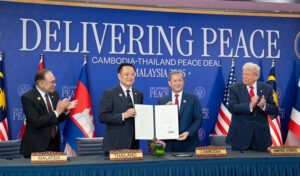
Despite the outcome of the third Special GBC meeting signed between the two countries on December 27, which stated that civilians living in affected border areas should be allowed to return “at the earliest, without obstruction and in safety and dignity, to their homes and normal livelihoods on their own side”, the Thai army has continued to block villagers from returning. This has reportedly been carried out through the installation of barbed wire and shipping containers to block roads and surround border villages.
According to the Cambodian government, Thailand is illegally occupying Cambodian territory in Preah Vihear, Oddar Meanchey, Banteay Meanchey and Pursat provinces. In Banteay Meanchey province alone, the Thai military has partially or fully occupied six villages, forcing tens of thousands to remain in refugee camps indefinitely.
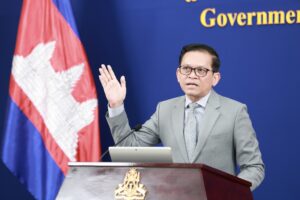
“Cambodia does not recognise any alteration of the border resulting from the use of force,” said government spokesman Pen Bona in a recent press briefing.
According to the joint press statement issued after the meeting, both sides reached a consensus on several key technical measures—including finalising the Technical Instruction for the joint survey and emplacement of temporary markers between Boundary Pillars No 42 to 47, a segment that has seen heightened tension in recent months.
Both sides also agreed to direct their respective local civilian and military authorities to “ensure the safety of the Joint Survey Team”, prevent any acts of provocation, and confirm that all operations are free of landmines, in line with Article 3 of the 2000 Memorandum of Understanding on boundary cooperation.
Cambodia and Thailand endorsed a six-point joint outcome to further their boundary demarcation efforts. The Joint Technical Sub-Commission was tasked with replacing 15 boundary pillars at their original positions and specifications, while three submerged pillars will also be repositioned at mutually agreed locations.
To modernise and expedite mapping and surveying work, both countries agreed to revise the 2003 Terms of Reference governing orthophoto map production by incorporating LiDAR (Light Detection and Ranging) and other advanced technologies.
The Ministry of National Defence confirmed that a meeting of the Cambodia-Thailand Regional Border Committee was held yesterday at the Choam-Sa Ngam International Point of Entry in Anlong Veng district.
-Khmer Times-