Eight-armed Lokeshvara statue sparks public debate
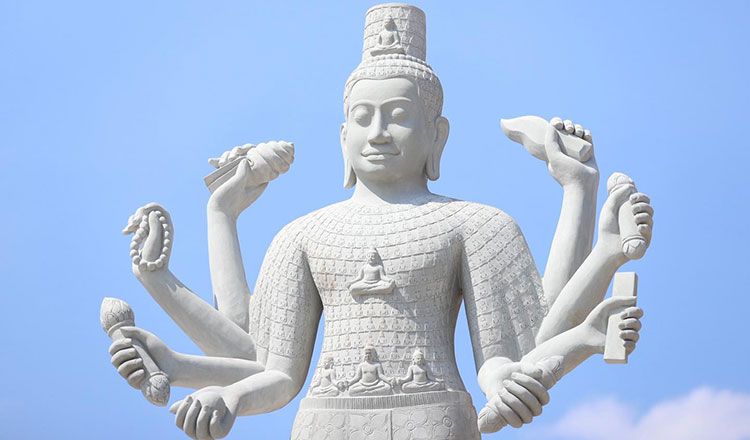 The eight-armed Lokeshvara statue at the provincial town roundabout in Oddar Meanchey. Oddar Meanchey Provincial Administration
#National
Synopsis: Authorities defend Oddar Meanchey statue amid religious design concerns.
Oddar Meanchey provincial authorities have completed the construction of the Lokeshvara statue, also known as the “eight-armed statue roundabout”. This impressive symbol is intended to welcome tourists and instil pride in the local community.
Following the completion of the statue, some members of the public—particularly Buddhist monks—criticised it and engaged in heated debate on Facebook over its artistic style, claiming that it may be disrespectful to Buddhism.
Oddar Meanchey Provincial Governor Mean Chanyada wrote on his Facebook page on Sunday that the provincial administration decided to construct the Lokeshvara statue to serve as a prominent and magnificent symbol of Oddar Meanchey and to welcome tourists and inspire local pride.
The aim is also to enhance the beauty of the provincial town and preserve the province’s rich cultural identity, he added.
He said, “After many months of work, the eight-armed statue in our town of Oddar Meanchey province has now been 100 per cent completed, even though the province has endured the hardships of war.”
Shortly after the announcement highlighting the statue’s design, public debate intensified on social media, especially among Buddhist monks, regarding the artistic style of the Lokeshvara statue.
Lokeshvara, also known as Avalokiteshvara, is a central figure in Mahayana Buddhism. Celebrated as the Bodhisattva of Compassion, Lokeshvara embodies boundless compassion and mercy and is committed to relieving the suffering of all sentient beings.
Venerable Koeun Sokkin, chief monk of Wat Narin Koy in Kampong Thom, has raised concerns about the design of the statue, particularly the small Buddha images carved on the statue’s toes, ankles, and waist. He asked questions about how Buddhists should interpret these details and whether they show disrespect to Buddhism, which is the state religion. He hopes those involved in the statue project will clarify the matter to the public.
In response, the Oddar Meanchey provincial administration stated that the worship of Lokeshvara dates back to the 10th century and became especially prominent during the reign of King Jayavarman VII in the late 12th century, as evidenced by inscriptions at Preah Khan Temple (K.908).
Chuon Kakada, Undersecretary of State at the Ministry of Cult and Religion, said small Buddha figures are featured on the feet of Lokeshvara in Khmer art, particularly those in the Bayon style of the late 12th and early 13th centuries.
He said that before Mahayana Buddhism was established in Cambodia, these statues were known as Lokeshvara, or “radiant Avalokiteshvara”. In Mahayana Buddhism, Lokeshvara represents compassion and the salvation of sentient beings, with small Buddha statues on his body illustrating the spread of compassion.
Kakada said that the close association of Lokeshvara statues and King Jayavarman VII, who revered the Bodhisattva, signified divine protection for his kingdom.
“Most of the small Buddha figures are Amitabha Buddha, the spiritual teacher of Lokeshvara,” Kakada said. “This type of statue is found in large numbers at Banteay Chhmar and Preah Khan Temples. One of the most famous examples is currently housed at the National Museum in Phnom Penh.”
He added that the presence of Buddha images at the statue’s feet is not an insult. Rather, in Mahayana art, it symbolises completeness and the dissemination of the Buddha’s essence everywhere to relieve the suffering of sentient beings.
-Khmer Times-