What should Cambodia do during the current “quiet but not silent” situation?
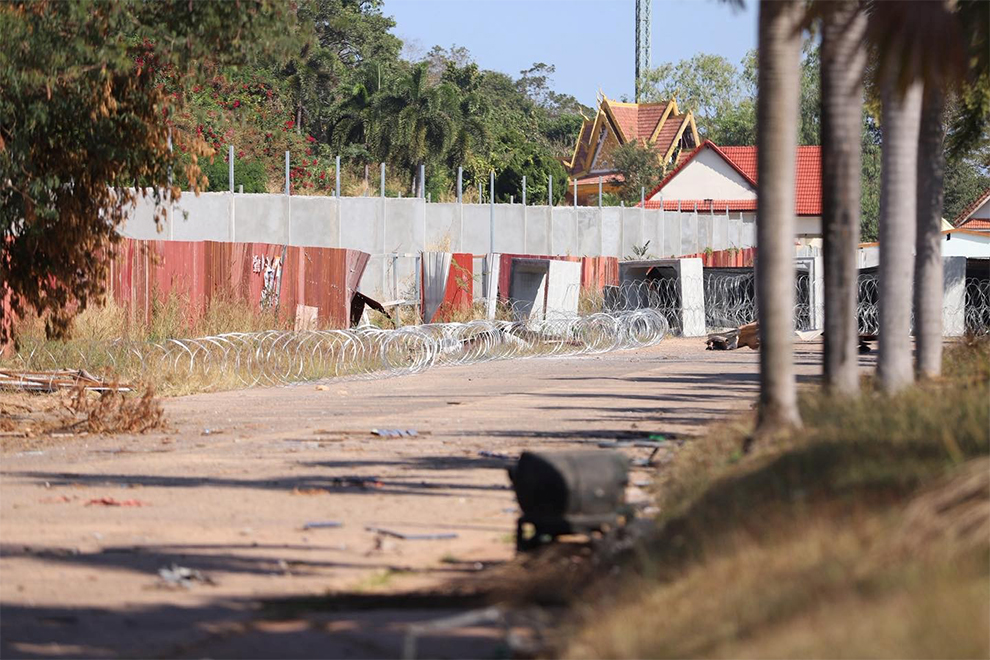 The O Smach border checkpoint in Oddar Meanchey province was blocked by Thai military razor wire barricades following the December 27 ceasefire. Oddar Meanchey provincial governor Mean Chanyada.
#National
The conflict between Cambodia and Thailand appears to have quieted down since the December 27 ceasefire and the release of 18 captured Cambodian soldiers on December 31. However, despite this calm, the Thai side has not remained idle.
In some border areas with a Thai military presence, there have been reports of activities such as the placing of shipping containers and razor wire barricades and the clearing of the homes of Cambodian citizens.
Concurrently, the Thai side continues to postpone meetings of the Joint Boundary Commission (JBC), a vital bilateral mechanism for finding a peaceful resolution to the border dispute.
During this period of relative calm, analysts have highlighted several necessary and urgent actions that Cambodia needs to undertake.
Kin Phea, director of the International Relations Institute at the Royal Academy of Cambodia, stated that under current circumstances, Cambodia should pursue legal mechanisms. This entails filing complaints against Thailand to all relevant international institutions regarding acts of aggression and crimes involving the destruction of civilian infrastructure, lives and property.
Simultaneously, Cambodia must intensify its diplomatic efforts and widely disseminate information to the international community presenting Thai military illegal actions, including the looting of Cambodian civilian properties.
“Cambodia must document and create clear reports of the various crimes committed by the invading Thai soldiers against Cambodia, its citizens and its property. We must demand full restitution for justice and for all the damage they have inflicted upon our nation,” said Phea.
Another crucial point he raised is how Cambodia must stand firmly united as one against the common aggressor. In these difficult times, Khmer solidarity must not be fractured.
Last week, Thailand rejected a Cambodian proposal to hold a JBC meeting in the first week of January. Following the rejection, Cambodia proposed rescheduling the meeting for the second or third week of January in Siem Reap province, but there has been no response from the Thai side yet.
Regarding the postponement of this meeting, legal expert Sok Sam Oeun stated on social media that Thailand is making excuses to delay the meeting.
He argued that if they participate, it would imply that they have no right to occupy the positions they have held since the 21-day conflict, or that they would have to return the seized land to Cambodia.
“Consequently, Thailand is finding various pretexts to avoid the JBC meeting,” he opined.
Sam Oeun stated that under these circumstances, Cambodia must find ways to pressure Thailand to participate in the meeting.
He believed that simultaneously, Cambodia should utilise UN mechanisms by filing complaints with the UN Security Council and the UN secretary-general, demanding that Thailand withdraw its troops, pay compensation for damages to citizens’ property and temples and urging Thailand to return to the border demarcation commission mechanism.
“If Thailand still refuses, Cambodia can file a complaint with the International Court of Justice (ICJ) regarding the border issue, and sue Thailand at the International Criminal Court (ICC) for crimes against humanity, war crimes or crimes of aggression, provided we have sufficient evidence,” he said.
He continued that if this conflict is resolved through negotiations between Cambodia and Thailand, the liability might fall upon the respective governments, as Thailand would certainly set conditions preventing Cambodia from making claims. Cambodia might accept such conditions in order to end the conflict and maintain peace.
On the option that Cambodia can sue Thailand for compensation, he stated that Cambodia must “demonstrate that the use of destructive force and looting constituted an illegal use of force. Secondly, it must be proven that the damage was to civilian infrastructure and civilian property, not military targets”.
He encouraged the filing of clear records, such as photographic or video evidence showing the existence of houses, inventory lists of materials left there and the precise locations of those homes. Additionally, the total value of the lost property must be specified.
Citing Prey Chan village as an example, he explained that if, in the future, the village is determined to be on Khmer soil, Cambodia would then be able to sue for compensation.
Regarding the legal procedures, he noted that individual citizens can draft their own complaints and submit them privately or as a group to a government working group. Furthermore, the government should establish an investigative team to gather such evidence, particularly regarding state buildings and civilian infrastructure.
“The collection of this information is to enable the Royal Government to prepare documentation for filing complaints with UN mechanisms and international courts,” he said.
-The Phnom Penh Post-