Cambodia as the Scapegoat in Narratives About China
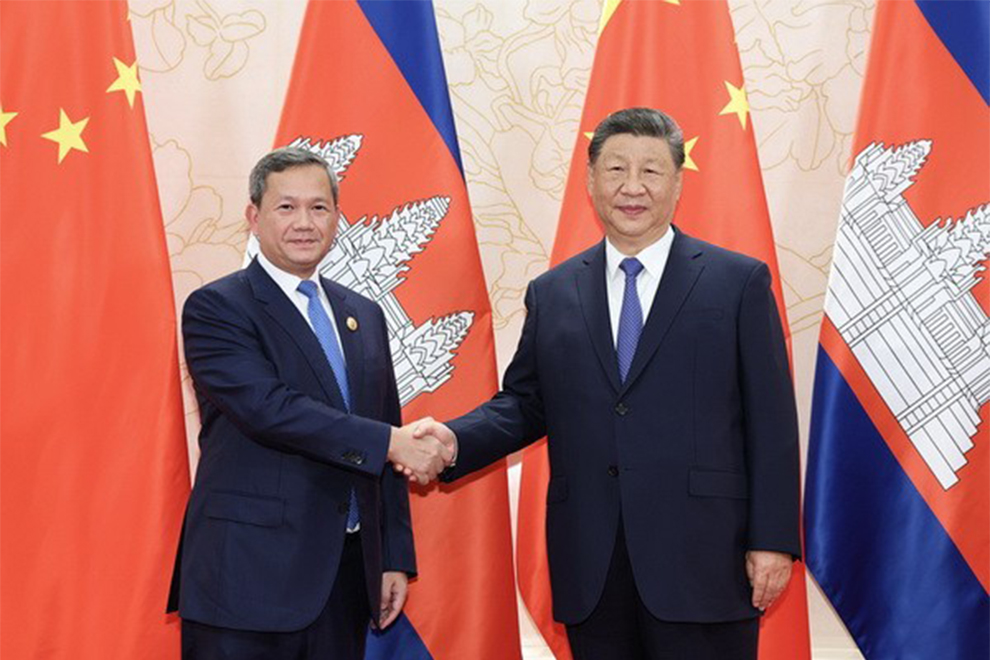 President Xi Jinping met with Cambodian Prime Minister Hun Manet, who was in China for the Shanghai Cooperation Organization Summit 2025, at the Tianjin Guest House. Supplied
#Opinion
In the grand theatre of international relations, Cambodia often finds itself cast as the unwilling villain in stories about China. When global commentators and media outlets seek to criticise Beijing’s growing influence, they invariably drag Cambodia into the fray, painting Cambodia as a hapless pawn or enabler of China’s alleged misdeeds. Yet, when the script flips to praise China’s economic prowess or military collaborations, Cambodia mysteriously vanishes from the stage. This selective amnesia is not just inconsistent — it’s profoundly unfair, reflecting a deeper bias against smaller nations like Cambodia that dare to forge independent partnerships.
Consider the pattern in media coverage of Cambodia-China ties. Critics frequently invoke Cambodia to underscore China’s “debt trap diplomacy” or its strategic footholds in Southeast Asia. For instance, the expansion of Cambodia’s Ream Naval Base, supported by Chinese funding, has been repeatedly framed as a covert Chinese military outpost, stoking US fears of Beijing’s regional ambitions.
Reports highlight concerns over environmental impacts, sovereignty erosion and even links to organised crime syndicates involving Chinese migrants, which have unfortunately tainted the image of long-standing Chinese communities in Cambodia.
These narratives amplify negative stereotypes, portraying Cambodia as a weak state succumbing to authoritarian influence, while conveniently overlooking Cambodia’s sovereign choices in pursuing infrastructure that benefits Cambodian people.
This negativity peaks during high-level engagements. When Cambodian Prime Minister Hun Manet visited China in August in 2023 after he became the prime minister of Cambodia and in 2025 when he went to China for the Shanghai Cooperation Organization Summit, or when Chinese President Xi Jinping travelled to Phnom Penh earlier that year, the commentary often turned sour.
Social media and news outlets buzzed with accusations of Cambodia “choosing sides” or enabling China’s expansionism, with some even linking it to broader tensions like those in the South China Sea or border disputes with neighbours.
One thinks of the historical echoes, such as the backlash against Henry Kissinger’s legacy, where Cambodia was singled out as a symbol of US-China realpolitik gone wrong, even decades later.
Such coverage doesn’t just critique China — it demeans Cambodia, implying Cambodian leaders are mere puppets in Beijing’s grand strategy. Contrast this with how visits by leaders from other nations are treated. When French President Emmanuel Macron, UK Prime Minister Keir Starmer, the Thai prime minister, the Vietnamese prime minister or other EU leaders travel to China, or even when the South Korean President visits China, the focus shifts to opportunities for trade, investment and diplomatic breakthroughs.
Rarely do these stories devolve into handwringing about sovereignty or hidden agendas. Even in trilateral talks involving China, Cambodia and Thailand, the emphasis is on constructive dialogue, not finger-pointing at Phnom Penh.
Why the double standard? Larger powers or Western allies get a pass, their engagements seen as pragmatic realpolitik. But for Cambodia, a developing nation navigating a complex geopolitical landscape, every handshake with China becomes fodder for suspicion. On the flip side, when the world wants to laud China’s achievements, Cambodia is conveniently forgotten. Discussions of the Belt and Road Initiative (BRI) often highlight successes in infrastructure and economic growth across Asia and Africa, praising Beijing’s role in fostering development.
Military cooperations, such as joint exercises or technology transfers, are framed as stabilising forces in the region. Yet, Cambodia’s gains from these partnerships — billions in investments for roads, ports and energy projects that have lifted millions out of poverty — are sidelined or dismissed as exceptions marred by controversy. Experts at think tanks and media seminars have noted this bias, warning that disinformation campaigns distort the genuine friendship and mutual benefits between the two countries.
This unfairness stems from a broader issue: the tendency to view smaller nations through the lens of great-power rivalry. Cambodia, with its history of conflict and recovery, becomes an easy target for those eager to score points against China without confronting Beijing directly. International media, often influenced by Western perspectives, perpetuate this by relying on sources that amplify opposition voices while ignoring Phnom Penh’s achievements.
As one report on Cambodia’s media landscape points out, journalists face pressures that skew coverage, but the global narrative adds an extra layer of distortion.
It’s time for a more balanced view. Cambodia’s relationship with China is one of equals, built on shared history and future aspirations, not coercion. Cambodia welcome scrutiny, but not selective vilification. The world should recognize that partnerships like Cambodia-China contribute to regional stability, just as they do for Thailand, Vietnam or any other nation engaging with China.
Until then, the unfair spotlight on Cambodia only reveals the hypocrisy in global discourse—using Cambodia as a prop when convenient and discarding Cambodia when not. Cambodia is a friend to all countries around the world. China is a very good friend of ASEAN countries and all countries around the world. Every country should respect and follow through international law and should follow through on documents and treaties that have already been signed.
Dr. Seun Sam is a policy analyst of the Royal Academy of Cambodia. The views and opinions expressed are his own.
-The Phnom Penh Post-