Cambodia slams Thailand’s allegations of new mines being planted at the border after a Thai soldier loses a leg in a blast
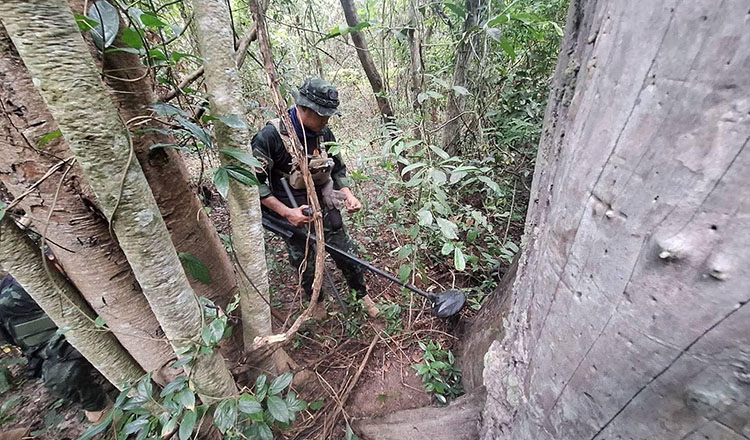 A bomb disposal expert deployed by Thailand’s 2nd Army Region sweeps the area surrounding Hill 350 for landmines. Royal Thai Army
…
Synopsis: Phnom Penh firmly rejects Thailand’s claims of newly planted landmines near the disputed Ta Krabei border, insisting the explosives are remnants of past conflicts. The CMAA, supported by international demining organisations, points to Cambodia’s adherence to the Ottawa Convention and calls for humanitarian clearance efforts.
A new landmine explosion near the frontier at Ta Krabei Temple, fully controlled by Cambodia since the border war, has sparked a renewed war of words between the two nations, overshadowing the recent Regional Border Committee (RBC) meeting.
Cambodia stated that Thailand’s claim of new “plastic” landmines undetectable by standard mine detectors “lacks clear investigation or credible evidence.”
In a statement, the Cambodian Mine Action and Victim Assistance Authority (CMAA) rejected the latest allegation that Cambodian forces planted new landmines near Ta Krabei Temple, where a Thai soldier was severely injured on Wednesday.
CMAA expressed sympathy for the soldier, who lost part of his lower right leg, but insisted the incident was caused by long-standing contamination rather than new activity.
“These claims lack clear investigation or credible evidence. Cambodia remains fully committed to the ceasefire and to its obligations as a State Party to the Ottawa Convention since 2000, maintaining a zero-tolerance policy on anti-personnel mines,” CMAA said.
The border zone near Ta Krabei is one of the most heavily mined areas from Cambodia’s civil war and Khmer Rouge era, when plastic-cased devices, which are difficult to detect with standard equipment, remain scattered.
“The fact that a plastic-cased mine escaped routine detection is therefore entirely consistent with the long-standing legacy contamination in this area, not evidence of new planting,” the statement added.
CMAA stressed that Cambodia has not produced, used, or deployed new landmines since joining the Ottawa Treaty in 1999. It urged Thailand to share evidence for its claims for independent verification. CMAA called for calm, cooperation, and stronger humanitarian clearance efforts through existing bilateral mechanisms, saying the priority should be to remove remnants of war, not escalate tensions.
The Thai army on Wednesday claimed that three of its soldiers were injured in a landmine attack along the Thailand-Cambodia border, revising an earlier report that had mentioned only one casualty.
According to the statement, a patrol from the 22nd Infantry Battalion had stepped on an improvised PMN-2 anti-personnel mine while on duty between operational bases 11 and 12, west of the temple in Surin province.
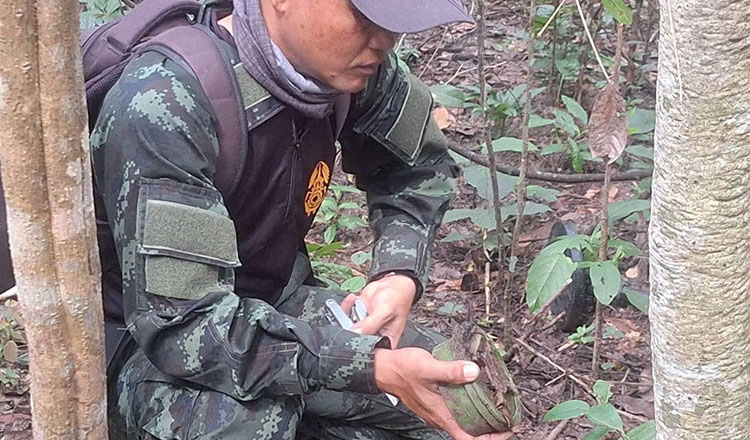
The injured soldiers were identified as Private Adisorn Pomklang of the 1st Infantry Battalion, 23rd Infantry Regiment, who suffered a severed right ankle; Sergeant Major 1st Class Nattapong Sichin of the same unit, who sustained minor shrapnel wounds to his back; and Private Thannatorn Taokratok of the 22nd Infantry Battalion, who sustained a minor injury to his left wrist.
The Ministry of National Defence yesterday rejected allegations that Cambodian forces were responsible for a mine explosion that injured Thai soldiers along the border, insisting the area remains contaminated with remnants of past conflicts.
In a statement, the ministry said Cambodia has always complied with its international obligations. “The Ministry of National Defence of Cambodia reaffirms that it has not used or placed any new landmines and remains fully committed to the Ottawa Convention on the Prohibition of Anti-Personnel Mines, to which it is a State Party,” it said.
The ministry reminded Thailand and the international community that stretches of Cambodia’s border still contain explosives dating back to the civil war, calling for all sides to exercise restraint.
In the statement, Cambodia stressed on its adherence to recent ceasefire and bilateral agreements. It also highlighted the commitments it made in the August 27 Regional Border Committee meeting, in which both parties pledged to prevent clashes and resolve disputes peacefully through existing mechanisms.
“Cambodia urges that Thailand adhere to the same spirit. Cambodia reaffirms its stance to resolve the issues peacefully, in good faith, in accordance with international law, the UN Charter, and the ASEAN Charter,” it added.
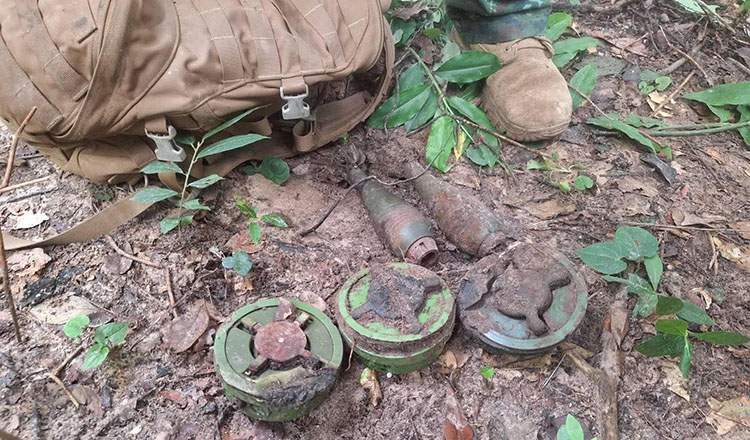
The Wednesday incident was the latest in a series of cases of Thai soldiers stepping on landmines while on patrol. Since July, five such incidents have occurred, resulting in five Thai soldiers losing their legs and injuries to several others.
Ministry of Foreign Affairs and International Cooperation spokesman Chum Sounry said several international demining organisations – including Anti-Personnel Landmines Detection Product, Mines Advisory Group, and Halo Trust – supported Cambodia’s position that the mines discovered by Thailand are “remnants of past conflicts, not new deployments.”
The Ottawa Convention committee has also officially recognised the fact.
The Wednesday incident occurred the same day the two countries concluded an Extraordinary Meeting of the Cambodia–Thailand Regional Border Committee (RBC), agreeing to an 11-point joint statement to “resolve all issues peacefully and avoid clashes,” including the establishment of a coordinating group to enhance communication at all levels.
Sounry, in a press briefing yesterday, rejected the allegation that Cambodia uses civilians as human shields in a confrontation at Banteay Meanchey province’s O’Beichoan commune, where the Thai army installed barbed wire to seize Cambodian villagers’ homes.
“Such accusations are unfounded and misrepresent the reality on the ground, where Cambodian civilians have long resided and are in fact the victims of unilateral military action, including the laying of barbed wire barricades that prevent them from accessing their homes and farmland,” he said.
He said Cambodia has also many times refuted the accusation that it has laid new anti-personnel mines.
“As one of the most mine-affected countries in the world, Cambodia has no policy, rationale, or interest in the use of such dangerous weapons. Any tragic incidents that may occur are the result of remnants of mines from past decades of armed conflict, which continue to pose danger to civilians on both sides of the border.”
Cambodia reaffirms its full adherence to the UN Charter and all core international human rights treaties, to which Cambodia is a State Party, he added.
“Cambodia categorically rejects allegations of violations and underscores that Cambodia has consistently worked in close cooperation with the United Nations system and international partners to strengthen the promotion and protection of human rights,” he said.
The ceasefire between Cambodia and Thailand turned a month old yesterday.
According to government spokesman Pen Bona, during this period, Cambodia has fully respected and fulfilled all the terms of the agreement.
“Cambodia has shown its sincere and faithful commitment to peace and the well-being of its people. This is what makes the pacifist heart of Cambodian leadership widely acknowledged, both domestically and internationally,” he said.
He cited an August 20 letter from US President Donald Trump to Prime Minister Hun Manet, released by the government on Wednesday, in which the American leader praised Mr Hun Manet as a strong leader who values human life and cherishes peace.
Lieutenant General Maly Socheata, spokeswoman for the Ministry of National Defence, said yesterday that the situation along the frontline in Military Regions 4 and 5 – covering Preah Vihear, Oddar Meanchey, and Banteay Meanchey provinces – remains calm, with no new developments reported.
“Cambodian military forces stand strong and remain fully vigilant in defending the country, sovereignty, and territorial integrity at all costs,” she said.
She said Cambodia has urged Thailand to honour all terms and conditions of the ceasefire, as well as those agreed upon at the Extraordinary GBC meeting, which stipulate that both sides must maintain existing troop deployments without further movements from the time the ceasefire took effect at midnight of July 28. This includes a ban on any troop movements, such as patrols, towards the other side’s positions.
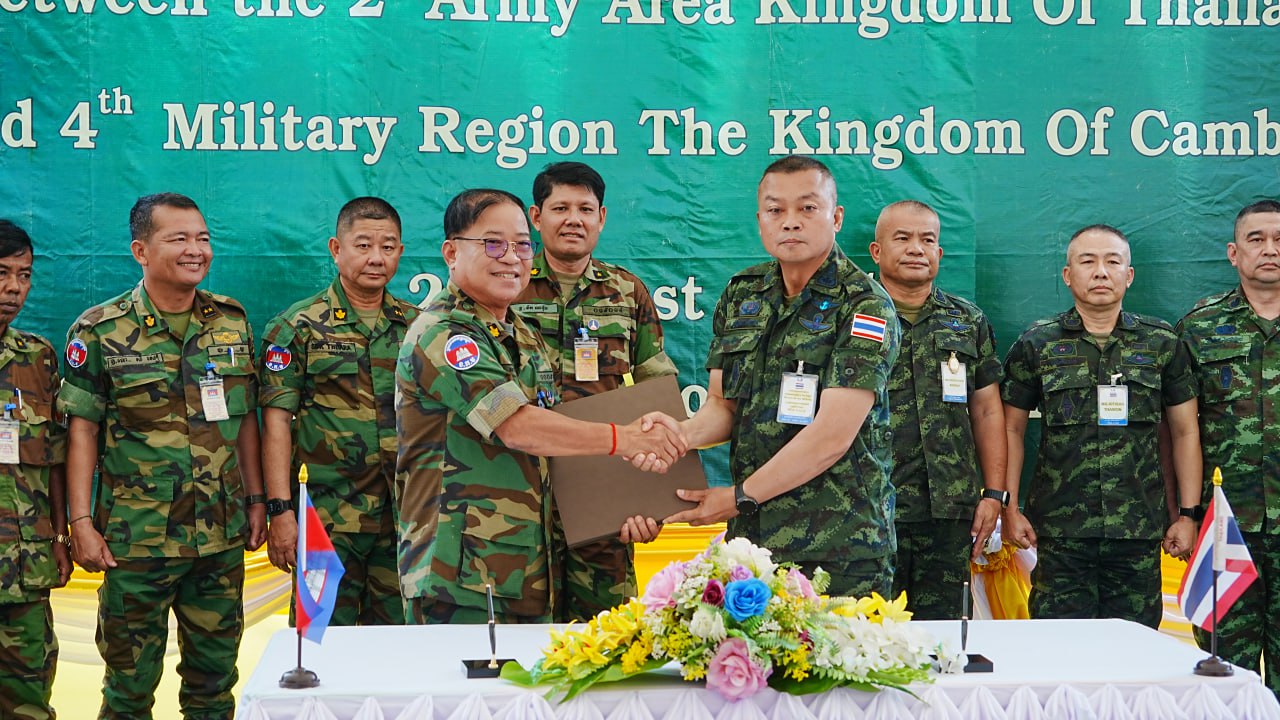
Cambodia reaffirmed its commitment to the consensus reached at the Extraordinary RBC meeting between Cambodia’s 4th Military Region and Thailand’s 2nd Army Area, on August 27. Both sides agreed to build confidence, de-escalate tensions, and maintain peace along the border by using established mechanisms to resolve disputes peacefully. The agreement emphasised neighbourliness, friendship, and solidarity, and stipulated that whenever problems arise, both parties shall address them jointly through existing channels.
“In this case, Cambodia urged that Thailand adhere to the same spirit. Cambodia reaffirmed its stand to resolve the issue peacefully in good faith in accordance with international law, the UN Charter, and the ASEAN Charter,” she added.
At the same time, Cambodia continued to urge Thailand to release 18 Cambodian soldeirs in its custody so they may reunite with their families, who have been waiting anxiously for their return.
It stressed that the soldiers were illegally captured by Thai forces immediately after the ceasefire took effect, on the morning of July 29. They had been detained for 31 days.
The government underlined the importance of de-escalation and constructive engagement, reaffirming Cambodia’s commitment to the ceasefire achieved in Putrajaya on July 28 and reaffirmed at the Extraordinary General Border Committee meeting in Kuala Lumpur on August 7.
It reiterated its dedication to the peaceful settlement of disputes, adherence to international law, and the promotion of neighbourly relations as essential to ensuring stability and security along the Cambodia-Thailand border.
-Khmer Times-