Cambodia has fallen victim to a manufacturing consent campaign
 Cambodia has fallen victim to a manufacturing consent campaign
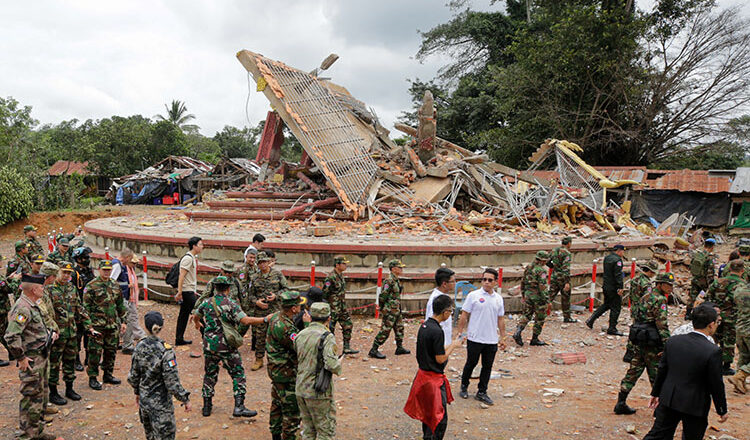
Military attaches and diplomats from 13 countries observe the implementation of the Cambodia–Thailand ceasefire agreement next to a destroyed building by the An Ses border checkpoint in Cambodia’s Preah Vihear province. AFP
As a longtime resident of Cambodia, I have been awed and sickened by what Thai and global media outlets have been involved in during the border conflict, which thank God, has been paused.
Media inside Thailand and international news outlets have been running a campaign to manufacture consent to justify the aggression against Cambodia, ignoring international law and defying common sense.
As a trained linguist, I am well versed with and acknowledge as brilliant most of the works of Noam Chomsky, a giant of my former academic field. The work for which he is most famous is, Manufacturing Consent: The Political Economy of the Mass Media, published in 1988. In the book, he and his co-author state that the mainstream media in the US “are effective and powerful ideological institutions that carry out a system-supportive propaganda function… without overt coercion,” and the theory’s coined title “manufacturing consent” comes from the idea that the aim of this narrative-scripting in media spaces for public consumption leads to the general public becoming, if not supportive of wars, at least giving consent to their pursuit.
Over the decades since its publication, the theory of ‘manufacturing consent’ has also in its popular usage come to encompass what might be coercive measures (for example, censorship and insistence on only publishing government or military-approved narratives, in addition to self-censorship due to fear of consequences), or even false flags or outright propaganda. Due to this, it has lessened its bite ethically to make the claim, and some have even used it to mitigate truthful reporting. Nonetheless, this campaign is clearly observable in our case.
Let us flip the script for a moment and look at this issue. Many of you may have seen CCTV footage clips of a bunch of thugs beating up Khmer migrant workers. Savvy Thai media people will seize upon this footage being circulated in the Cambodia media space claiming it is “manufacturing consent” and by extension is proof of so-called Cambodian government efforts to “fuel conflict.” But the truth is that those events actually happened, we can see them with our own eyes, there is nothing “manufactured” about it. Does it outrage Cambodians? I am sure it does. It should outrage anyone. And that is why we have seen calls to not retaliate against Thais here among us in Phnom Penh despite our anger because we shouldn’t lower ourselves to that level of thuggery no matter how great our anger or frustration. That is not manufacturing consent. Reality matters, and manufacturing consent is twisting reality into something it is not in order to allow war and other evils.
Manufacturing consent is when we are told in the West that there is no famine or genocide in Gaza, reports ignore or whitewash the facts to allow for public consent for the killings to continue. It is a fact that up to a million people are starving to death as we speak and that the ICJ has ruled that actions of the Israeli state and military amount to genocide by legal definition and is being pursued actively by Israel with criminal intent. (We will come back to the issue of ICJ rulings.) All Western and pro-Israeli media have been for years engaged in a campaign of manufacturing consent and silencing real reporting and opposing voices.
Another example from history that has a closer comparison to our circumstances is the event that started World War II, the so-called Gleiwitz Incident, which was later – after the war – proven to be a false flag based upon testimony given by German SS officers during the Nuremberg Trials. In the Gleiwitz Incident, Nazi Germany proclaimed that Polish troops had in an act of war crossed the border – in this case briefly seizing a radio station – and in so doing “invaded” Germany and that this act of war must be punished.
Does this narrative sound familiar to anyone? That is manufacturing consent – making demonstrably false claims in order to engender consent for war among a given public. It might even be claimed that those efforts in manufacturing consent might be made to trigger latent or overt biases, racism or ideological differences. German manufacturing of consent for war that lead to the invasion of Poland and the start of WW2 was supported by a public that had been long trained for years by their media to see Polish neighbours as subhuman, immoral, unethical, liars and the list goes on. I am sure that the German media had some equivalent coinage for their Polish neighbours that is a direct corollary of the term “Scambodia” that Thai-based and even global media outlets have propagated and have been leaning hard into not only after but even before the death of the Cambodian soldier on May 25 this year.
Thus, despite the completely unreasonable claim by Germany that Poland started WW2 by attacking a radio station on their border, the German public embraced the event as “true” and subsequently German Panzer tanks were facing off against Polish cavalry. And while the Thais aren’t yet hardened by recent past wars and aggression, nor are the Khmer so vulnerable that they had to, as it were, defend their country with a cavalry charge versus tanks. Nonetheless, both events expose media misrepresentation and the vast gulf between the levels of military technology that exist between the two countries. Anyone viewing events with the slightest rationality and common sense would never accept that the Poles attacked their militarily more powerful neighbour, Germany, any more so than the absurd claim that Cambodia attacked Thailand.
In my life, I have never seen any cat attack a dog except in self-defence or the defence of their offspring, but some dogs cannot resist messing around with cats, playing with them violently, bullying them or even killing them out of instinctive sport.
This common sense assessment of the recent events is supported by important facts and telling clues. And now is when we return to the ICJ – the International Court of Justice – to which every single member nation of the United Nations is required by law, and by the UN Charter they signed, to abide by. Taiwan, which currently has no place in the United Nations, is strictly speaking, not required to abide by the court’s decisions (although I think they at some point issued a statement saying that they would voluntarily abide by UN and ICJ decisions). However, Thailand is a member of the UN. At varying times under varying governments they have either abided by the decision or unilaterally rejected the court’s jurisdiction. However, by international law, the only way they can reject it is by leaving the UN. Moreover, if they vacate their position vis-à-vis such international treaties they might as well vacate them, leave ASEAN and every other body and agreement. Today, Thailand flouts international law and mimics Donald Trump and Israel, breaking international treaties and ignoring at their leisure whatever agreements they are legally obliged to accept and that do not suit them. In fact, this is a secondary issue and cause of the conflict that we have witnessed for some days.
The fact of the matter is that, by international law via multiple rulings of the ICJ, the last of which was in November 2013, the lands immediately adjacent to the temples are inherently Cambodian territory, no different than any other square inch of Cambodia where you or I might be sitting at the moment. However, even local media discussed this and coined the term “border dispute” for it. The term “border dispute” means there are two competing claims either of which might be valid; that is incorrect.
Almost universally, media outlets have overwhelmingly described events in this context as a “border dispute,” or a “border spat” (thus belittling it), or later after the killing of a Cambodian soldier in late May as a “skirmish” while often neglecting to tell anyone that someone died. Even among respected alternative media figures, all media either based in Thailand or globally has “reported” on the events in this manner.
That is step one of manufacturing consent. The reality that the temples allegedly in question have been Cambodian territory since the relevant ICJ ruling in 1962, and their immediate environs have been so since November 11, 2013 due to a subsequent ICJ ruling are ignored. The fact that Cambodian forces are stationed there and have not moved for years and that thousands of Cambodian tourists have visited that territory without crossing any border are ignored. This is step one of manufacturing consent: misrepresenting the context of the story being reported to the advantage of, in this case, Thailand. It is a very easy step to accomplish, as human beings regularly simply repeat what they hear and read without much thought and use language that is less than precise. Nonetheless, it is the first step.
The second step is more deliberate and local people here will begin to feel outraged while international onlookers already trained to think it is a “dispute” between two sides make claims that “both sides are fuelling the dispute” and then engage in frankly irrational, unsubstantiated arguments. But the gist of this second step is to deliberately redefine locations, and we can trace that to for one example “The Nation” an English-language news website in Bangkok. When you look at their reporting they regularly in multiple reports refer to Wat Ta Moan Thom and other specific locations and adjacent land as “Thai territory.” When the media go so far as to give the version of the name of that location in another language we will be witnessing a step not only in manufacturing consent, but step one of the conquest or annexation of a neighbour, e.g. Koh Tral is now Phu Quoc.
With the context shifted and then the location redefined and reports disseminated supporting these untruths as “facts,” we move to step three of redefining actions. That is how Thai and some global media justified reports of an “invasion” of Thailand by Cambodia. Just as when a rude person invades your privacy without remorse, they do so because they view your space as theirs and that you have no rights to it. Having established in multiple reports a “dispute” that involves now “Thai territory,” subsequent actions can then be reported within this context.
Therefore Cambodian forces stationed and unmoving for years can now have their state of being and actions redefined from being stationed on legally and internationally recognised Cambodian territory, to “invading Thai territory”. Thailand, its local Thai-media partners and some global media outlets then incoherently repeated this false reporting that manufactures consent both domestically and globally for a military “response” to Cambodia; literally claim that Cambodians invaded Thailand without moving. Despite “invading” meaning to forcefully transgress a border without permission and in aggression.
It is a bit as if we foreigners here woke up one morning in Phnom Penh and were rudely informed by someone in a strange uniform that you are in fact in Thailand, have no legal visa and are a criminal illegal alien, now come with me. It would be an absurd outrage.
Subsequent reporting hammered this home again and again. Such as with the criminal charges pressed on an individual Cambodian citizen in a Thai court for “insulting a Thai soldier”. Despite the reality being that the Thai soldier was the actual invader, the Cambodian tourist was in his own country, that didn’t stop the campaign to manufacture consent by redefining location.
The entire landmines issue is related to this effort; and the additional false narrative of “Russian” landmines added weight. These mines were in Cambodia but via manufacturing of consent reporting they “invaded” Thailand all on their own! They stood up on their little legs and ran to aggressively blow themselves up on the legs and behinds of Thai soldiers. I jest here but the truth is very disturbing. It would appear that Thai generals marched their troops into a Cambodian minefield deliberately just to create a perfect news item to outrage Thai rallying then “to defend their country” and justify continued aggression. That was perfect manufacturing of consent.
The addition of the “Russian” landmines element to the story was meant to engender enthusiastic support in the liberal West who have for years vilified Russia with the faux Russiagate, and any number of boogie man claims, and regularly placed the blame for almost anything and everything on Russia. Now, variably Cambodia is become merely a puppet of Russia or China, or alternately some claimed even America, and according to them Cambodia started a war because they are “crazy” or “mere proxies.”
The manufacturing consent campaign is now complete. All relevant facts have, step by step, been brushed aside until we are now in the realm of complete fiction.
An example of this was a report that appeared in Sputnik, by Pepe Escobar, who is based in Bangkok, and not only did he manage to side-step the obvious conclusion that conflict has been engineered by Thai generals, even one specific general, but even he took a pot-shot at the now deposed Shinawatras, while vilifying Cambodia’s government as well. I am sure he will be treated to a fine dinner by someone well connected to the junta in Bangkok, certainly he need not fear expulsion or jail for lese majeste.
Pepe Escobar, a very respected journalist I myself have relied on for years, produced an irrational fantasy offering zero proof to substantiate his claim to “follow the money.” He said that the fighting had nothing to do with the border and that the war started because ‘Hun Sen is angry that Yingluck Shinawatra’s husband is building a casino in Phuket, and that will cause the Hun family to lose a lot of income.’ Even if you accept all those fictional elements as true, that the border is irrelevant and that “it is a war of the clans,” it is completely irrational. When one actually follows the money there are only loses and no benefits. How does starting a war make international tourists who are already avoiding Thailand and choosing Cambodia by 50.7%, as reported in the Khmer Times, year on year, choose to go to Cambodia in a war zone over the other side of the same war in Thailand? It is an absurd irrational argument but I am sure tens of thousands of his readers accepted it without question or actual proof. This is the height of manufacturing consent for war.
It is a disrespect to the lives lost first in Cambodia then in Thailand, and it epitomises this campaign. And he is in the alternative media space. I refer you to a past opinion piece here at Khmer Times where rightfully the coverage of Channel News Asia (CNA) was so appalling. That too was manufacturing consent.
Now I ask you, dear reader, to follow the money in earnest. Pepe Escobar, CNA and every other media outlet worldwide knows that there are more Thais and more people in the West who know Thailand than there are Cambodians and those that know Cambodia. Therefore, more people will click on links and laud pro-Thai reporting, thus driving monetisation of the reporting. Truth and objectivity have been completely thrown out the window. That is the economic aspect of the theory of manufacturing consent as it is put in practice.
Right now the entire media space globally is more or less pro-Thai; the public’s consent has been very professionally manufactured in favour of Thailand and against Cambodia, while some dismiss both out of hand. Even on the most free platform of Telegram channels I have encounter strong bias and derision. When I answered someone posting, “You know, it really makes no sense why little Cambodia would attack Thailand?” My response (“because they didn’t”) was attacked, trolled and vulgarly denigrated even racially; then I was banned by the admin. It happened repeatedly. Only one military affairs channel based in West Asia whose admin I contacted directly began to report in more balanced manner after I explained the circumstances. In all of news media I only found one report from Telesur English that actually reported the facts about the ICJ rulings and that used unbiased language in their reporting. It was by no means pro-Cambodian, it just relied on facts.
We are at a very dangerous juncture for Cambodia. While I am sure we all pray that peace will last, I see a great danger that ANY event will be twisted to blame Cambodia. There still exist internal reasons in Thailand to return to conflict, as well as geopolitical and geo-economic reasons why outside actors would be happy for a return to war. Even greedy media outlets would be happy to fuel the conflict by posting polarising and infuriatingly false content. There is a lot of money to be made by the vultures of conflict and war, especially in the sale of arms.
I ask all readers to think critically and consider facts and the reality here on the ground in our joint home. Please recognise that manufacturing consent is a real process that negatively impacts us all.
Robert Wadleigh
Khmer Times