Editorial 78 – Mangroves Hold Land and Sea Together
 Editorial 78 – Mangroves Hold Land and Sea Together
Opening Thought
“A mangrove stands in moving water and holds two worlds in relationship.”
Editorial
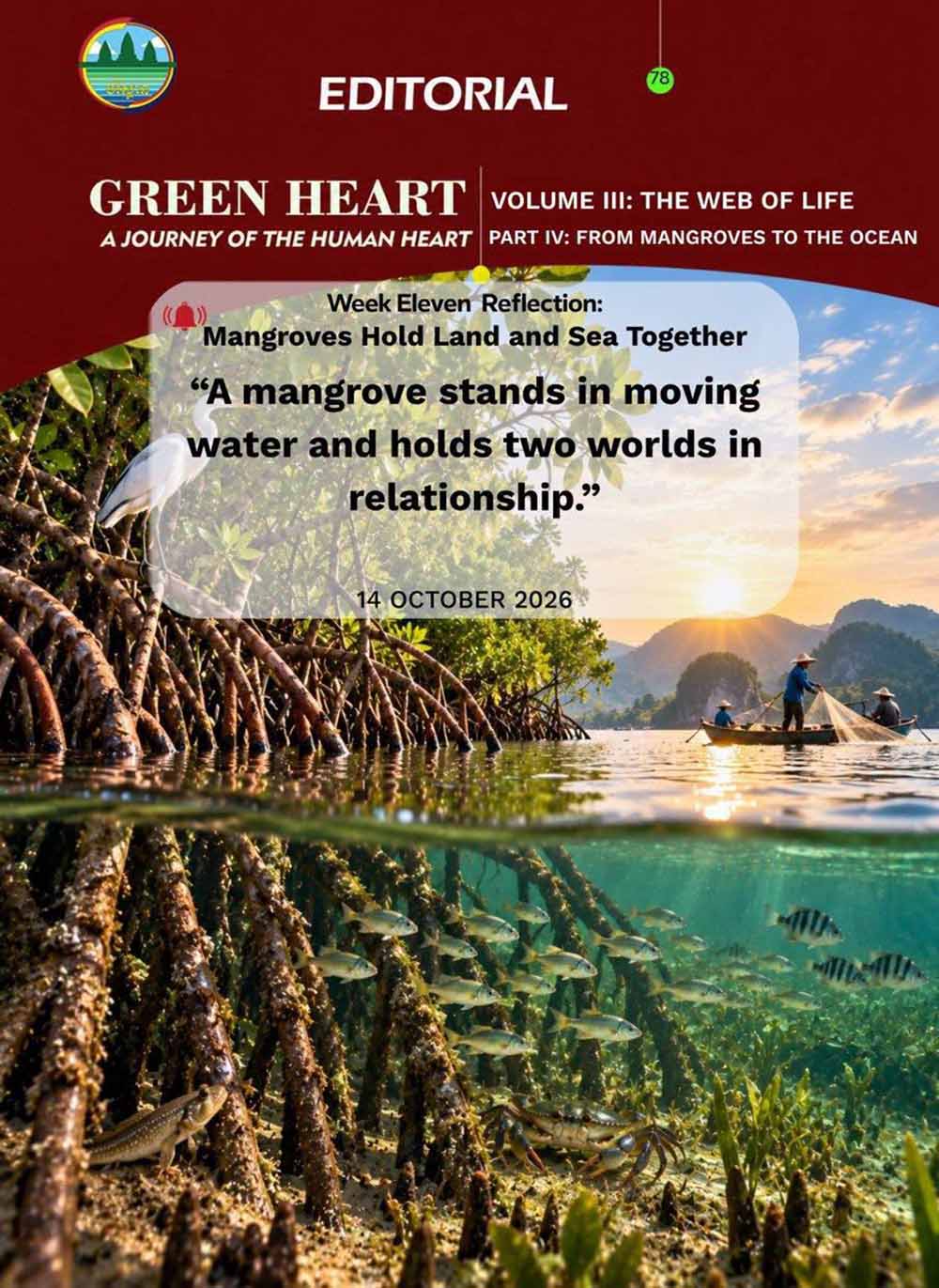
Mangroves are trees and shrubs adapted to saline coastal environments in tropical and subtropical regions. Their roots rise, arch, or spread through mud and water, creating a forest where land, river, and sea meet.
Different mangrove species manage salt in different ways. Some exclude much of it at the roots, while others excrete or store it. Specialized roots help plants obtain oxygen in waterlogged soils where air is limited.
The root structure slows water and traps sediment. Mangroves can reduce wave energy and erosion under certain conditions, helping protect shorelines and communities. They are not an absolute shield against every storm, and protection depends on forest width, condition, coastline, and event intensity.
Roots provide shelter and feeding areas for fish, crabs, shrimp, mollusks, birds, reptiles, and other animals. Some species use mangroves as nurseries before moving to seagrass beds, reefs, rivers, or open water.
Mangrove soils can store large amounts of carbon, especially below ground. When forests are cleared or soils disturbed, stored carbon may be released. Protecting mangroves can support biodiversity, fisheries, climate, and coastal resilience.
People depend on mangroves for food, wood, livelihoods, tourism, culture, and protection. Conservation should include community rights, sustainable use, and fair benefits. Excluding local stewards without alternatives can create hardship and weaken protection.
Threats include conversion, pollution, altered water flow, overharvest, coastal development, and rising seas. Mangroves may move inland as sea level changes, but roads or buildings can block that movement.
Restoration is more than planting seedlings. The correct tidal flow, elevation, sediment, species, and space must exist. In some places, restoring water movement allows natural recovery more effectively than mass planting.
Mangroves teach us to protect transitions. They are valuable not despite being between land and sea, but because of it. Their tangled roots are a visible form of connection.
Stand at a safe mangrove edge and listen to mud, water, leaves, birds, and human activity. Two worlds are not colliding. They are building a third.
That third world depends on water flow. A mangrove cut off from tides or freshwater may decline even when trees remain standing for a time. Restoration must therefore follow hydrology—the movement and timing of water—before focusing on the number of seedlings.
Coastal space matters too. If sea level rises and hard development blocks inland movement, mangroves can become squeezed between water and walls. Planning room for migration protects future forests as well as present ones.
Buddhist Reflection
We often seek fixed categories, but wisdom recognizes the value of in-between places. Mangroves flourish through adaptation and relationship, reminding us that flexibility can be a source of strength.
Today’s Reflection
Which mangrove benefit depends directly on its position between land and sea?
Today’s Action
Draw a mangrove cross-section showing tides, roots, sediment, fish, birds, people, and a path to open water.
Today’s Pledge
Today I will protect the living edges that connect land, river, community, and sea.
When we protect nature, we protect all beings—including ourselves.