Echoes Across the Borderlands: A Pattern of Frontier Revisionism We Cannot Ignore
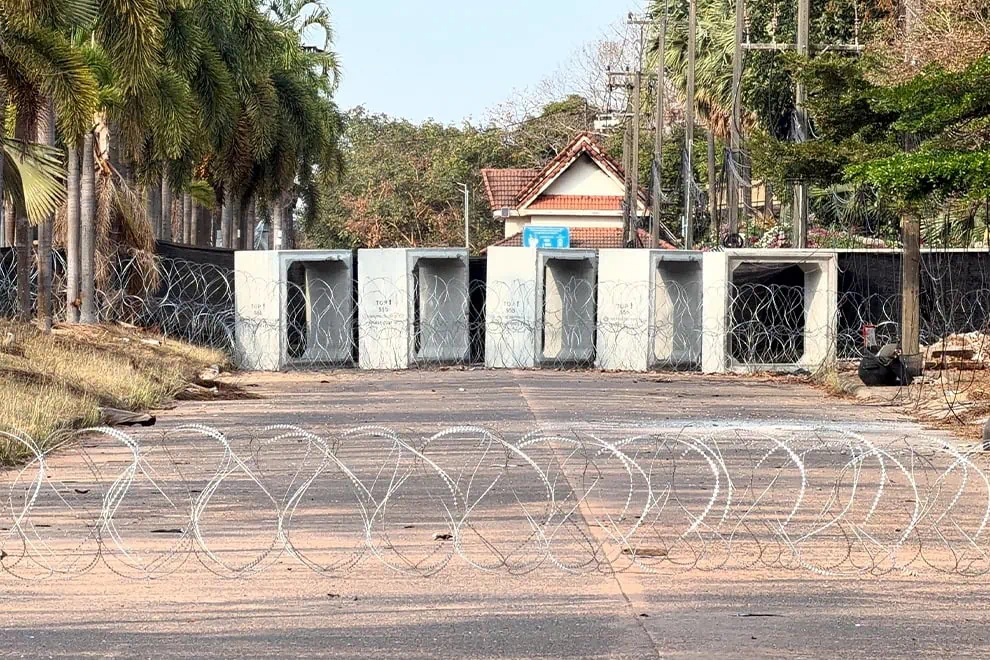 -Thai razor wire and concrete culvert barricades stand on occupied Cambodian land. Supplied
For those of us who have long observed the contested frontiers of mainland Southeast Asia, recurring standoffs along Thailand’s borders carry a sense of profound déjà vu. The diplomatic rhetoric, the abrupt introduction of competing surveys and the gradual forward deployment of military units are neither isolated incidents nor recent developments. They are elements of a well-rehearsed territorial strategy that Thailand has employed against its neighbours — from Laos to Cambodia — for decades.
To understand why these friction points persist, one must look directly at the foundational agreements that defined modern boundaries in the region: the Franco-Siamese Treaties of 1904 and 1907. Under those accords, bilateral mixed commissions were tasked with surveying, delimiting and fixing lines meant to ensure long-term regional stability. What has unfolded instead is a systematic attempt to challenge established delimitation maps whenever their practical reality restricts Bangkok’s geopolitical or territorial ambitions.
The Map versus Text Manoeuvre
The primary legal tactic in this playbook is the deliberate separation of treaty text from the resulting delimitation maps. The 1904 and 1907 treaties outlined natural principles — such as watershed ridges or river thalwegs — while delegating actual cartographic demarcation to field survey commissions. Yet, whenever official maps awarded territory or strategic features to the Indochinese side, Thai authorities repeatedly claimed that the maps were technical mistakes that deviated from natural geography.
This exact argument was rejected by the International Court of Justice (ICJ) in the landmark 1962 Preah Vihear Temple case, where the court made clear that Thailand could not accept and benefit from a treaty map for over fifty years and then unilaterally declare it invalid. Yet this identical rationale resurfaced in Thailand’s disputes with Laos, revealing an enduring unwillingness to abide by settled colonial-era cartography when it does not favour domestic interests.
Unilateral Surveys and Manufactured Facts
Another recurring element is the replacement of binding bilateral agreements with unilateral domestic or third-party surveys. In 1984, the dispute over the Three Villages — Ban Mai, Ban Klang and Ban Sawang along the border between Uttaradit and Laos’s Xainyaburi province — erupted when Thai authorities disregarded the 1907 boundary and relied instead on a unilateral 1978 US Army Map Service survey. The result was armed occupation, civilian upheaval and an unnecessary standoff.
Three years later, this same pattern triggered the bloody Thai–Laotian Border War of 1987–1988 around Ban Romklao. Thai forces advanced into the valley and entrenched themselves atop Hill 1428, claiming the border followed a different tributary than the one recognised under the 1907 treaty. That dispute escalated into months of heavy artillery exchanges and air strikes before a ceasefire restored the status quo.
The progression across these episodes is identical to what we have witnessed along the Cambodian border: deploy forward posts, construct unilateral infrastructure, label clear historical borders as “overlapping claim zones” and attempts to present a neighbour with a fait accompli.
The Trap of Asymmetric Bilateralism
Why does this script continue? Because it relies on trapping smaller neighbours in purely bilateral negotiations. Whenever neighbouring countries call for third-party arbitration, international observation or multilateral oversight, the stance from Bangkok is almost invariably an insistence on handling matters strictly through bilateral Joint Boundary Commissions (JBCs).
In a closed bilateral vacuum, the larger, economically and militarily dominant state holds the leverage. Negotiations can be dragged out, stalled or rescheduled indefinitely while physical encroachment hardens into de facto administrative control.
Upholding the Inviolability of Frontiers
Genuine regional peace cannot be built on perpetual border revisionism. The stability of Southeast Asia depends on strict respect for international border law and the sanctity of established treaties. Calling settled borders into question every time political dynamics shift does not just destabilise border communities — it threatens the collective legal order that protects every sovereign nation in our region.
Tesh Chanthorn is a Cambodian citizen who longs for peace. The views and opinions expressed are his own.
-Phnom Penh Post-