Thailand Should Honour UN and International Law by Respecting the Sovereignty of Cambodia
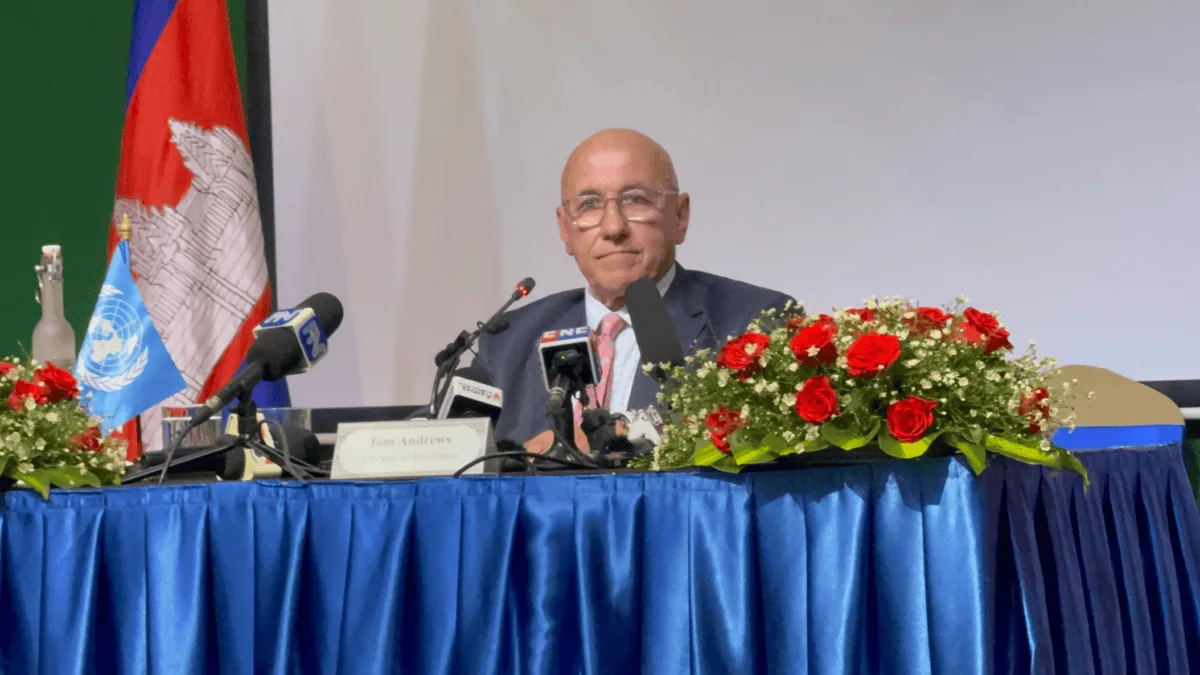 U.N. Special Rapporteur on the situation of human rights Tom Andrews gestures as he answers the questions during a press conference in Phnom Penh, Cambodia, Friday, July 31, 2026. (AP Photo/Heng Sinith)
The long-standing border issues between Cambodia and Thailand have once again tested the principles of international law, sovereignty and peaceful coexistence in Southeast Asia. Recent developments, including the findings of the UN special rapporteur on the situation of human rights in Cambodia, underscore a simple yet profound truth: lasting peace and stability can only be achieved when nations uphold the UN Charter, respect binding treaties and resolve disputes through established legal mechanisms rather than unilateral actions or force.
Thailand must honour these commitments by fully respecting Cambodia’s sovereignty.
UN Special Rapporteur Tom Andrews recently completed his first official visit to Cambodia and issued an end-of-mission statement that carefully documented the human impact of the border conflict.
He highlighted the displacement of approximately 650,000 Cambodian civilians, with more than 20,000 still unable to return to their homes and livelihoods months after the December 2025 ceasefire agreement. Andrews observed damaged properties, destroyed businesses and the lingering presence of unexploded ordnance. Critically, he emphasised that international law guarantees the right of those displaced by armed conflict to return safely and without obstruction — a principle also reflected in the ceasefire understandings between the two countries.
Thailand has publicly challenged aspects of the rapporteur’s assessment. Yet Andrews has clarified that he provided Thai authorities with an advance draft of the relevant section of his statement two days before its release and received no response.
He has explicitly welcomed feedback, stating his openness to discussing Thailand’s perspective. Thailand should respect this invitation. Engaging constructively with the special rapporteur’s process, rather than dismissing the findings outright, demonstrates good faith and commitment to the UN system.
Special procedures of the Human Rights Council exist precisely to examine situations on the ground and promote accountability under international human rights and humanitarian law. Ignoring or rejecting the call for dialogue undermines the very institutions both nations have pledged to support.
Thailand should not assume that the international community fails to distinguish right from wrong. The world has watched the recurrent tensions along the Cambodia-Thailand border with growing concern.
The principles at stake are clear: the prohibition on the threat or use of force against the territorial integrity or political independence of any state, as enshrined in Article 2(4) of the UN Charter; the obligation to settle disputes peacefully; and the binding force of judicial decisions and treaties.
Cambodia has repeatedly invoked these norms, including through communications to the UN Security Council regarding incidents that it maintains violated its sovereignty. International observers, including UN officials and regional partners, understand that borders are not redrawn by military presence, fences or administrative claims on the ground. They are defined by law.
If Thailand maintains that certain Cambodian communities have lived on what it regards as Thai land, the correct response is not to impose a unilateral reality but to allow the Joint Boundary Commission (JBC) of Thailand and Cambodia to perform its technical work.
The JBC was established under the 2000 Memorandum of Understanding on the survey and demarcation of the land boundary. Its mandate is to apply agreed technical methods — drawing on the relevant historical treaties, maps, and subsequent understandings — to determine the precise alignment of the boundary. Borders cannot be forced through occupation or faits accomplis. They must be established and confirmed through international law and bilateral mechanisms that both sides have accepted.
Cambodia has consistently expressed readiness to advance demarcation through the JBC and related technical bodies. Progress has been made in past meetings on verifying boundary pillars, utilising modern survey technologies such as LiDAR, and preparing joint instructions for field work. Suspending or delaying this technical cooperation while asserting territorial claims only prolongs uncertainty and human suffering.
Allowing the JBC experts from both countries to carry out surveys, including temporary marking where appropriate, and rigorous technical analysis is the responsible path. It replaces confrontation with competence and replaces assertion with evidence-based resolution.
Above all, Thailand must respect all international laws, treaties, and agreements it has signed with Cambodia and within the UN framework.
These include the Franco-Siamese treaties of 1904 and 1907 that form the foundational legal basis for the land boundary, subsequent bilateral agreements, the judgments of the International Court of Justice in the Temple of Preah Vihear case (1962 and the 2013 interpretation), the 2000 Memorandum of Understanding on boundary survey and demarcation, and the various ceasefire and joint statements reached in 2025.
Membership in the UN carries the obligation to act in accordance with the Charter. Special rapporteurs operate under mandates approved by the Human Rights Council; their work deserves serious consideration rather than selective rejection.
Respect for these instruments is not a concession of weakness. It is an affirmation of the rules-based international order that benefits all states, large and small. Unilateral measures that alter facts on the ground, restrict civilian returns, or bypass agreed mechanisms erode trust and invite further escalation.
Conversely, good-faith cooperation through the JBC, constructive engagement with UN processes, and full implementation of ceasefire commitments create the conditions for displaced families to return home, for cross-border communities to resume normal life and for bilateral relations to stabilise.
Cambodia has repeatedly affirmed its commitment to peaceful resolution in accordance with international law. It seeks neither confrontation nor the abandonment of its sovereign rights, but rather the consistent application of the legal frameworks both nations have accepted. Thailand now faces a clear choice: to continue contesting independent assessments and delaying technical demarcation, or to honour the UN, the treaties it has signed and the principle of sovereign equality by engaging sincerely.
The people living along the border — Cambodian and Thai alike — deserve security, the chance to rebuild their lives and the certainty that their governments will resolve differences through law rather than force.
The international community will judge both nations by their actions in the months ahead. Thailand should seize this moment to demonstrate leadership by respecting the UN special rapporteur’s invitation for feedback, recognising that the world understands the difference between lawful claim and unlawful imposition, enabling the Joint Boundary Commission to complete its technical mandate, and upholding every treaty and agreement that binds it to Cambodia and to the United Nations.
Sovereignty is not secured by denial of international scrutiny or by delaying agreed processes. It is secured by fidelity to the law. Thailand should honour that fidelity.
Dr. Seun Sam is a policy analyst at the Royal Academy of Cambodia. The views and opinions expressed are his own.
-Phnom Penh Post-
—————–
U.N. Special Rapporteur on the situation of human rights Tom Andrews gestures as he answers the questions during a press conference in Phnom Penh, Cambodia, Friday, July 31, 2026. (AP Photo/Heng Sinith)