Displaced child’s dream: ‘I just want to go home as soon as possible’
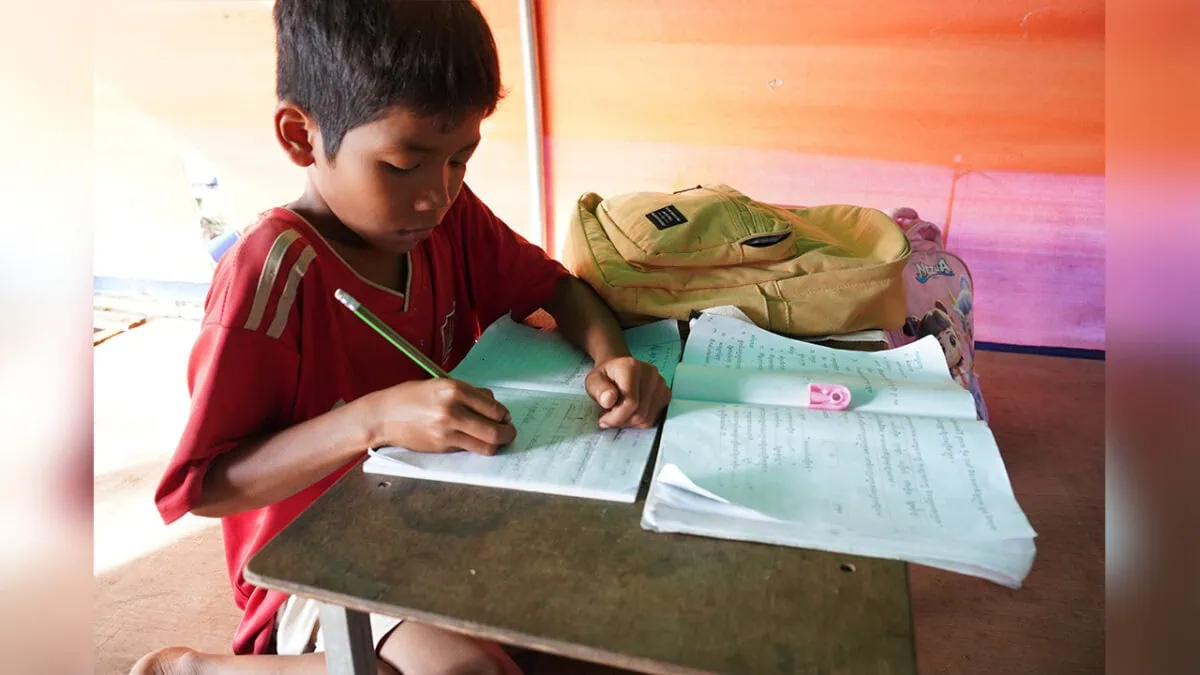 Despite studying hard, third-grader Mach Raksmey has one overriding wish: to return to his home in Pursat province’s Veal Veng district, as soon as possible. Hong Raksmey
Despite continuing attending classes three times a day while displaced, third-grader Mach Raksmey has one overriding wish: to return to his home in Thmar Da, Veal Veng district, Pursat province, as soon as possible.
For the young boy, going home would mean returning to the school he once knew, seeing his family’s land again and resuming the ordinary life he was forced to leave behind – studying hard, while also helping grow crops and raise chickens and ducks.
“I want to go home as soon as possible,” Raksmey said.
Raksmey fled his home in the Thmar Da area following fighting along the Cambodia-Thailand border.
For months, he has been unable to return to see his house, school, farmland or relatives who remain in the area.
“I miss my home and my school, and I miss my uncles and aunts there. I haven’t seen them for a long time,” he said.
At his current sanctuary, Raksmey has continued his education. He attends a state school in the morning and afternoon and then studies again at the displacement site. In his own words, he now studies “three times” a day.
Raksmey acknowledged that he has opportunities to study he did in Thmar Da, but what is missing, he said, is his home and the life he once had there.
“Here, I can study, but I can’t do anything else. I just stay here. I can’t grow any crops,” Raksmey said.
“Back there, we have our home. We can live at home, grow crops and raise chickens and ducks,” he added.
For Raksmey, returning home would not mean leaving education behind. He wants to resume his studies at his old school while living with his family on the land where they once farmed and raised animals.
Asked what he would do if he were allowed to return home, Raksmey replied: “I want to raise chickens and ducks, grow crops and study.”
Before the displacement, Raksmey’s family lived in a wooden house, which the boy described simply as “big enough for the family to live in”. Around their home, they grew crops and kept a dog, chickens and ducks.
Raksmey still thinks about the animals he once helped care for. After being away for so long, however, he does not know where they are or whether they survived.
“I don’t know where they have all gone. I haven’t been back for so long. I don’t even know if they are all alive,” he said.
Before the family fled, they had planted crops and expected to harvest them for food within about a month. The fighting forced them to leave before the crops were ready.
“We worked hard to grow the crops there, thinking that in another month we would have food to eat. But before even one month had passed, everything was gone,” Raksmey said.
According to the boy, his father returned to check on their home and land. The chickens the family had raised were gone, while their crops had been destroyed.
“I feel sorry for my crops and the chickens I raised. Now they are all gone. My father went back to look and everything was gone. The crops were destroyed and dead,” he said.
Raksmey said the family’s wooden home was also damaged and partly burned. Some of the timber was broken, while clothes and other belongings were destroyed by fire.
The memory of the day his family fled remains vivid for the third-grader.
“When we left, there was shooting – boom, boom, boom,” Raksmey said, imitating the sounds he remembered hearing.
Asked if he had been afraid, his answer was brief: “I was scared.”
Beyond fear, Raksmey said he also feels angry and sometimes wants to cry when he thinks about being unable to return home.
In the boy’s understanding, Thai forces have surrounded the area where his family’s home and land are located, preventing them from returning.
“I’m angry. My home is surrounded like that every day. Sometimes I want to cry,” Raksmey said.
Asked what he wanted to say to the Thai side, the young boy offered a simple plea: “Please don’t take my home anymore.”
For Raksmey, the losses from the border conflict are not abstract issues discussed only by adults. They are the house, land, crops and animals that formed part of his daily life.
“We lost our land and home. We lost our crops, our chickens and our money. They have taken everything at home,” he said.
“Our crops and our land are there. Now it is all gone. Where else do we have land? That was the only land we have,” he added.
What Raksmey misses most is seeing the places where he once lived and studied.
“I want to go home so I can see my school and see my land. I haven’t seen my land for a long time,” he said.
For now, however, Raksmey does not know when he and his family will be able to return.
“I still don’t know. They still haven’t allowed us to go back,” he said.
As he waits, Raksmey continues to study. For the young boy, education is also part of his hope of one day returning and rebuilding life in his home community.
“I have to study hard and take my knowledge back to rebuild the place,” he said.
The third-grader’s wish is uncomplicated. He wants to return home, continue his education and live again on his family’s land.
There, Raksmey imagines going to school and, in his free time, helping grow crops and raise chickens and ducks.
“I want to go home as soon as possible,” he said.
-Phnom Penh Post-