Regarding the Claims of the Joint Information Center on the Thai-Cambodian Situation (JIC) June 22, 2026
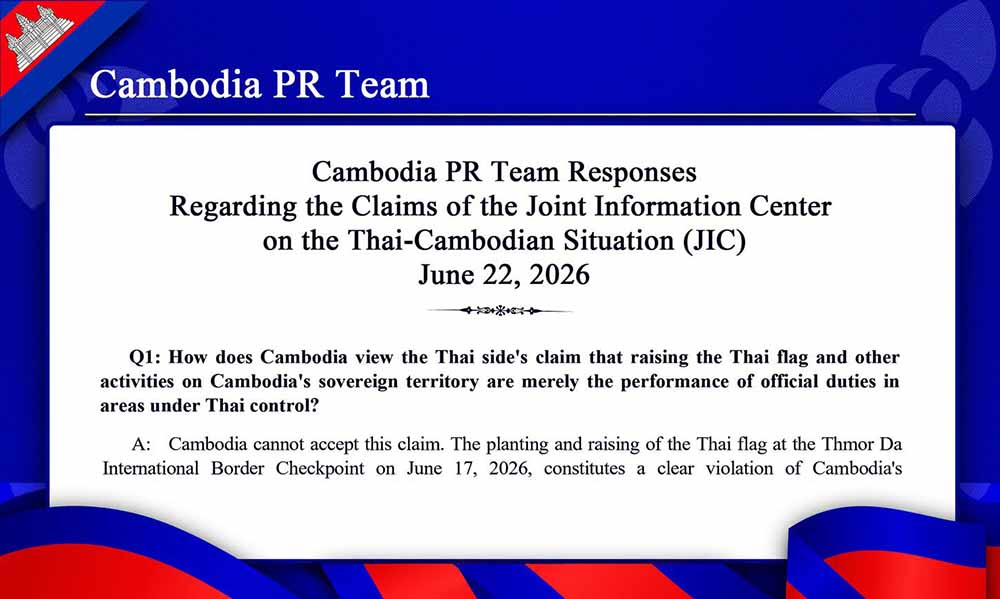 Regarding the Claims of the Joint Information Center on the Thai-Cambodian Situation (JIC) June 22, 2026
Cambodia PR Team Responses
Regarding the Claims of the Joint Information Center on the Thai-Cambodian Situation (JIC)
June 22, 2026
Q1: How does Cambodia view the Thai side’s claim that raising the Thai flag and other activities on Cambodia’s sovereign territory are merely the performance of official duties in areas under Thai control?
A: Cambodia cannot accept this claim. The planting and raising of the Thai flag at the Thmor Da International Border Checkpoint on June 17, 2026, constitutes a clear violation of Cambodia’s sovereignty and territorial integrity. This location is within Cambodian territory, as defined by the 1:200,000 scale map in accordance with the Franco-Siamese Convention of 1904 and the Treaty of 1907. Furthermore, the Cambodian JBC has submitted 42 protest notes since the first ceasefire, demonstrating that Cambodia has never recognized the occupation or unilateral alteration of territorial status. Cambodia has consistently urged the Thai side to deploy technical teams to conduct ground surveys as soon as possible to clearly define the border demarcation, but the Thai side has continued to delay the process to this day.
Q2: Can the construction of fences or security structures by the Thai side truly be considered as not intended to alter the border, as claimed by Thailand?
A: Cambodia considers that the construction of concrete fences or other structures in areas with unresolved border issues cannot be regarded as normal activities, as they could lead to the creation of fait accompli, thereby undermining the border resolution process. In practice, Thai forces have constructed a concrete fence in the area of Ta Krabey Temple while border issues there remain unresolved through joint mechanisms. Cambodia views such unilateral actions as contrary to the spirit of the MOU-2000, which requires both parties to maintain the status quo and resolve issues through joint mechanisms prior to official survey and demarcation. If Thailand wishes to build a border fence, it should urgently deploy technical teams to conduct survey and demarcation. Once an agreement is reached, Thailand may construct a fence within its own sovereign territory in accordance with international law.
Q3: Can Thailand’s actions be considered as compliance with the MOU-2000, as claimed by Thailand?
A: Respect for the MOU-2000 should be measured through concrete actions, not merely through lip service. The MOU-2000 requires both parties to resolve border issues through the JBC mechanism and the Joint Survey Teams (JSTs), while also avoiding unilateral actions. In practice, since the second ceasefire, the Cambodian JBC has sent 9 diplomatic notes to propose JBC meetings and the deployment of JSTs, but the Thai side has yet to implement these measures. At the same time, there have been unilateral actions along the border, such as the raising of flags and the construction of concrete fences. Therefore, Cambodia believes that respect for the MOU-2000 should be demonstrated through active participation in the JBC mechanism, the deployment of JSTs, and the avoidance of any actions that could unilaterally alter the situation on the ground.