Cambodia-Russia Relations: From Historical Friendship to Deeper Cooperation in a New Era
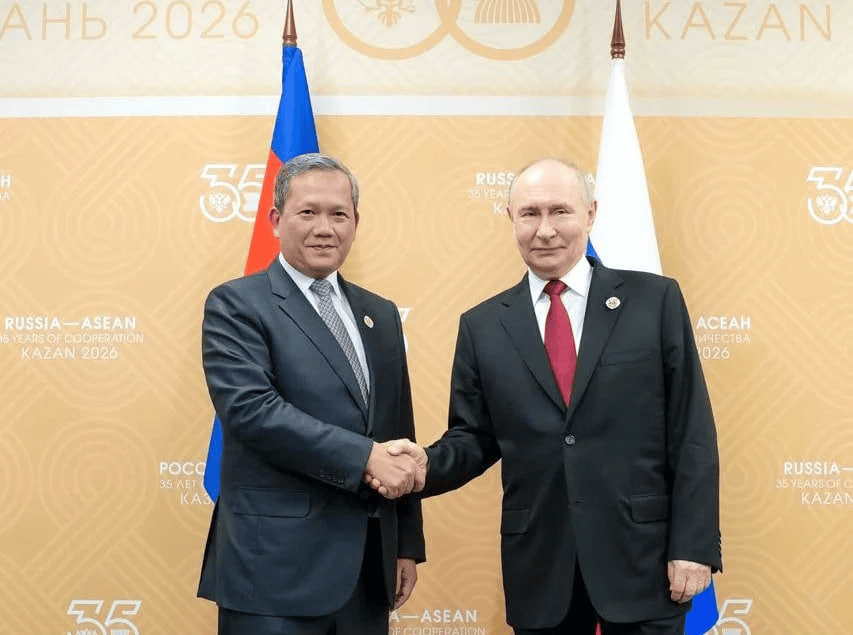 - Prime Minister Hun Manet (left) met with Russian President Vladimir Putin in Kazan, Russia, on June 18.
#opinion
Prime Minister Hun Manet’s visit to Russia and his June 18 Kazan bilateral meeting with Vladimir Putin, President of the Russian Federation, marked an important diplomatic milestone in further strengthening Cambodia-Russia relations. The meeting took place as Cambodia and Russia commemorate the 70th anniversary of diplomatic relations, and in the broader context of the summit marking the 35th anniversary of ASEAN-Russia relations. Therefore, this was not merely a routine protocol meeting, but one carrying historical, political, strategic and forward-looking significance for cooperation between the two countries.
What is most notable is that the meeting reaffirmed that Cambodia-Russia relations are firmly grounded in traditional friendship, political trust, mutual respect and shared interests. Since the establishment of diplomatic relations in 1956, Cambodia and Russia have gone through many historical phases, including the Cold War era, periods of political crisis, and the process of national reconstruction. Despite profound changes in the international environment, the friendship between the two countries has maintained its resilience and consistency. This demonstrates that Cambodia-Russia relations are not based merely on short-term interests, but on historical understanding and long-standing trust built over many decades.
During the meeting, Putin’s description of Cambodia as a long-standing friend and partner carried important political meaning. It showed that Russia continues to value Cambodia’s role in the region and within the ASEAN framework. For Cambodia, Manet’s recollection of and gratitude for the support provided by the former Soviet Union and the Russian Federation, particularly during difficult moments in Cambodia’s national history, reflected a diplomatic culture that does not forget old friends, does not forget kindness and does not overlook the value of historical friendship.
From an analytical perspective, the visit also demonstrated Cambodia’s independent, active and balanced foreign policy. In a world increasingly shaped by complex geopolitical competition, Cambodia needs to broaden its relations with multiple partners in order to protect its national interests, promote development and expand its strategic options. Strengthening relations with Russia should not be interpreted as choosing one side over another. On the contrary, it is part of Cambodia’s practice of diversified diplomacy, based on sovereignty, independence, peace, mutual respect and cooperation for shared benefits.
Beyond politics, economic, trade and investment cooperation should be further promoted. Although political relations between Cambodia and Russia remain strong, economic relations have yet to fully reflect the real potential of the two countries. Cambodia has strong potential in agriculture, tourism, a young labour force and a geographical location that can connect it to regional markets. Russia, for its part, possesses extensive experience and strong capacity in energy, technology, industry, agro-industry and technical education. Therefore, the two countries should work to transform political trust into concrete economic outcomes.
In this regard, Samdech Thipadei’s proposal for Russia to support the establishment of a free trade agreement between Cambodia and the Eurasian Economic Union is a forward-looking initiative.
If this process can move ahead, it will open new opportunities for Cambodian products to access larger markets, expand exports, create jobs and strengthen Cambodia’s economic resilience. In particular, Cambodian agricultural products such as rice, rubber, pepper, mangoes, bananas, cashew nuts and other processed products could gain greater opportunities if effective trade mechanisms, standards, logistics systems and market connectivity are put in place.
Energy is another important area with strong potential. Cambodia is continuing its economic development and industrialisation, which has steadily increased demand for energy. Russia is a country with long-standing experience in energy and related technologies. Therefore, cooperation in this field could contribute to energy security, knowledge transfer, technical training and the study of energy options suitable for Cambodia’s development needs.
Military and defence cooperation also remains an important part of bilateral relations. History shows that Cambodia has benefited from training and technical support from the former Soviet Union and Russia. In the current context, military cooperation should be viewed in terms of strengthening national defence capacity, human resource training, experience-sharing and contribution to peace and stability. This cooperation is not intended to create confrontation or oppose any country. Rather, it is about building Cambodia’s self-defence capacity and responsible defence diplomacy.
Education and training constitute one of the deepest and most meaningful foundations of Cambodia-Russia relations. Many Cambodian students, officials, specialists, engineers, doctors and intellectuals received education and training in the former Soviet Union and Russia. These former students and trainees have become bridges of friendship between the two countries and important human resources for Cambodia’s development. Therefore, the continued expansion of scholarships, student exchanges, academic exchanges, research cooperation and technical training should be regarded as a long-term investment in friendship between the peoples of the two countries.
At the same time, agriculture could become a new foundation for practical cooperation. Cambodia has strong agricultural production potential, while Russia can offer markets, technology, fertilisers, agricultural equipment and experience in improving productivity. If both sides can establish effective mechanisms to connect farmers, investors and markets, such cooperation will help increase the added value of Cambodian agricultural products and improve the livelihoods of Cambodian farmers.
Overall, the prime minister’s visit and his meeting with Putin sent a clear positive signal for the future of Cambodia-Russia relations. The meeting reaffirmed historical friendship, strengthened political trust and opened new opportunities for cooperation in many important fields. The most important task ahead is to transform political will into concrete projects and tangible outcomes that can bring real benefits to the peoples of both countries.
On the occasion of the 70th anniversary of diplomatic relations, Cambodia and Russia have a solid foundation to elevate their relations to a new level that is deeper, more practical and broader in scope. The key expectation is that relations between the two countries will continue to grow across all fields, especially political trust, military cooperation, the economy, trade, energy, education, agriculture, tourism, health, culture and people-to-people connectivity.
If this relationship continues to be advanced through long-term vision and practical implementation, it will not only benefit Cambodia and Russia, but also contribute to peace, stability, cooperation and strategic balance in the region and the world.
Kin Phea is alternate member of the Royal Academy of Cambodia. The views and opinions expressed are his own.
-Phnom Penh Post-