Remembering Sergeant Suon Roan; the first casualty of the border conflict
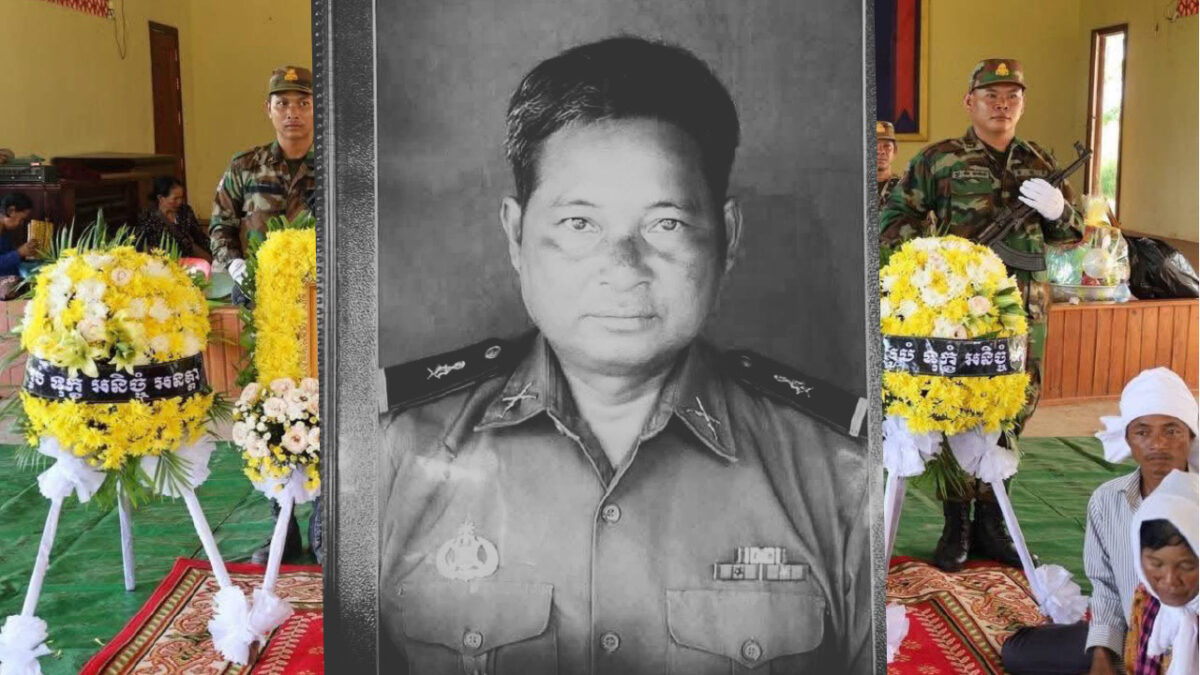 Sergeant Suon Raon, considered the first Khmer casualty of the 2025 border fighting. When he was shot dead by Thai soldiers in May 28, he was clad only in shorts and flip flops. Post Staff
Today, May 28, saw many Cambodians observing an unofficial “National Day of Remembrance”, the first anniversary of the death of Sergeant Suon Roan. He was shot dead by Thai troops in the early hours of the morning, clad only in a pair of shorts.
The incident took place in the Preah Vihear province “Emerald Triangle”, close to where the borders of Cambodia, Thailand and Loas meet.
At around 5.30am, gunfire erupted near a Cambodian trench in Techo Morakot village, Choam Ksant district, and continued for around ten minutes.
When the shooting was over, Suon lay dead.
Thailand later claimed that their troops fired in self-defence at Cambodian troops who were preparing fortifications in Thai territory, while the Cambodian Ministry of National Defence insisted that the Thais crossed the border and attacked a legitimate army post.
Defence minister Tea Seiha offered a succinct explanation for Cambodia’s position.
“When my soldiers go to fight, they dress in full uniform before battle is joined. When the sergeant was killed, he was not even dressed. How can the Thais claim we initiated the shooting?” he asked.
“The Thai side did not express any regrets over the incident, but told their media that Cambodia started firing. We sent a diplomatic note to them, asking them to investigate and determine who fired first,” he added, in early June last year.
The loss of the Cambodian soldier did not mark the end of the conflict, although Seiha said both sides tried to de-escalate the situation.
Heavy fighting broke out on July 24 and lasted until the 28th, and again from December 7 to 27, with extensive artillery exchanges and Thailand launching airstrikes deep into Cambodian territory. Hundreds of deaths were reported on both sides, with hundreds of thousands of civilians displaced by the fighting. Many Cambodians have yet to return home.
What does the death of Suon Raon mean to Cambodians?
Today, May 28, Cambodians took to social media to remember the fallen soldier, and the lessons that the Kingdom’s citizens can learn from the tragic loss.
“As Cambodian people — and especially as members of the younger generation — we must remember our historical journey; the pain, the losses and the struggles. We must transform the lessons from the scars of our past into a driving force to develop our capabilities, strengthen our spirit of patriotism, and participate in preserving the peace, stability and societal achievements that Cambodia enjoys today,” said Facebook influencer Ratha Touch.
“This is not about recalling the past to create division, discrimination or vengeance. Rather, it is to awaken the spirit of the Khmer nation to understand the value of unity, peace and tolerance, and to build a shared future together while absolutely avoiding all forms of extremism,” he added.
Chhang Youk, director of the Documentation Center of Cambodia (DC-Cam), believed that it would be appropriate and necessary for a court to decide on whether the circumstances that led to the death of the sergeant, and all other soldiers and civilians who were killed, were justified under the laws of armed conflict.
“The world is governed by laws and not the whims of any general or government and ultimately the history of this conflict requires investigation by a neutral third party,” he said.
Political analyst Kin Phea declared that the death of Suon Roan represented more than the loss a brave soldier’s life, but a historic wound that the entire Khmer nation must always remember. The blood shed upon the border by heroic Khmer fighters was not shed in vain, he explained.
“On the contrary, it has become a symbol of national sacrifice and a powerful inspiration to awaken the spirit of solidarity and the firm resolve of the Khmer nation to unite behind the Royal Government’s unwavering stance to defend and reclaim our territorial integrity without ever backing down,” he added.
He also warned that the border issue with Cambodia has consistently been used by Thai politicians as a tool for domestic politics.
“Whenever Thailand faces a political or economic crisis or internal power struggles, they employ ultra-nationalist rhetoric to distract the public from internal issues and gain short-term political popularity, he added.
As a lesson learned, Phea urged Cambodians to use the anniversary as a lesson in the importance of internal unity and a wise and mature patriotism. They must continue to advocate for clear information and diplomacy, while strengthening national capacity through the building of human resources, as well as the strengthening of economic sovereignty, through the spirit of nationalism.
“Khmers united, Khmers strong, Khmers victorious!” he declared.