Cambodia reaffirms peace commitment at Beijing trilateral dialogue
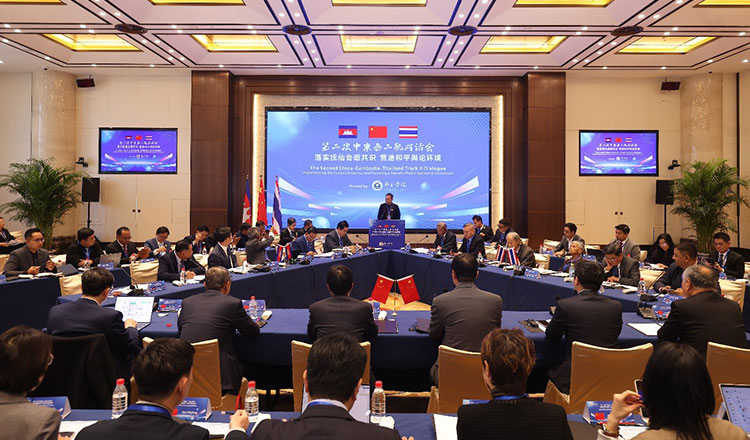 Im Sothearith, Advisor to Cambodian Journalist Club, takes the floor at the second China-Cambodia-Thailand Dialogue, in Beijing, on April 21. Supplied
#opinion
The Cambodian delegation, comprising distinguished scholars from leading think tanks, prominent civil society leaders, and experienced media professionals, has reaffirmed the Royal Government of Cambodia’s unwavering commitment to sustaining peace, stability, and harmonious relations along the Cambodia-Thailand border.
This important reaffirmation occurred during the second China-Cambodia-Thailand Track II Dialogue, held on April 20–21, 2026, at the China Foreign Affairs University in Beijing. The dialogue, themed “Implementing the Fuxian Consensus and Fostering a Peaceful Public Opinion Environment,” brought together representatives of think tanks, civil society organisations, and media outlets from Cambodia, China, and Thailand. It served as a vital platform for open, constructive engagement beyond official government channels, allowing experts to explore practical pathways toward lasting reconciliation.
The discussions built directly upon the landmark five-point Fuxian Consensus, reached in December 2025 at Fuxian Lake in Yunnan Province, China. That consensus, facilitated through high-level trilateral engagement, successfully paused active hostilities along the border between Cambodia and Thailand and established a clear framework for de-escalation, ceasefire consolidation, and the restoration of mutual trust. Following months of tension last year that saw tragic loss of life, civilian displacement, and disruption to cross-border trade, the Fuxian Consensus marked a turning point. It provided a much-needed diplomatic foundation for both nations to step back from confrontation and begin the arduous but essential work of rebuilding relations.
Participants in the Beijing Track II dialogue engaged in in-depth, candid exchanges. They shared practical recommendations aimed at consolidating the ceasefire, rebuilding eroded trust, and creating conducive conditions for long-term peace and mutually beneficial cooperation. The atmosphere was one of shared responsibility, with all sides recognising that sustainable peace cannot rely solely on official agreements but must be supported by broader societal understanding and collaborative action.
The Cambodian delegation emphasised that enduring peace demands sustained diplomatic engagement, responsible public communication, and tangible practical cooperation on the ground. The delegation stressed that peace is not merely the absence of conflict but the presence of mechanisms that prevent recurrence and deliver real benefits to ordinary citizens living along the shared frontier.
A key focus of the Cambodian contribution was the critical role of media and public discourse. The delegation called for strengthened collective efforts to promote accurate, balanced, and peace-orientated reporting across all three countries. In an era where information spreads rapidly through digital platforms, misinformation and inflammatory narratives can quickly undermine fragile trust and reignite tensions. The delegation urged media professionals and civil society actors to act responsibly, countering disinformation campaigns that might seek to exploit historical sensitivities or amplify isolated incidents for political gain. By fostering a public opinion environment rooted in facts, empathy, and a forward-looking vision, the three nations can create a supportive backdrop for diplomatic progress.
The Cambodian side highlighted the importance of concrete confidence-building measures as essential pillars for translating ceasefire agreements into genuine reconciliation. These measures include the gradual and safe resumption of cross-border trade, which has historically brought economic vitality to border provinces in both Cambodia and Thailand. Prior to the 2025 tensions, bilateral trade had grown significantly, benefiting farmers, traders, and local economies on both sides. Reopening checkpoints under agreed security protocols would not only revive economic activity but also signal a return to normality, allowing goods, services, and opportunities to flow freely once more.
Enhanced coordination in public health and humanitarian affairs was another priority underscored by the delegation. The 2025 clashes resulted in significant civilian displacement, with hundreds of thousands affected, straining resources and creating urgent needs for medical support, shelter, and recovery assistance. Joint mechanisms for addressing health challenges—such as disease prevention in crowded displacement settings or collaborative responses to cross-border environmental issues—can demonstrate goodwill and shared humanity. Humanitarian coordination, including the safe return of displaced persons and family reunifications where possible, would help heal the wounds of conflict and rebuild community ties.
The Track II format itself represents a mature and forward-thinking approach to conflict resolution. Unlike formal Track I negotiations between governments, Track II dialogues allow scholars, experts, and non-state actors greater flexibility to brainstorm creative solutions, test ideas, and address sensitive issues without the immediate pressures of official positions. China’s role as host through the China Foreign Affairs University underscores its commitment to regional stability in Southeast Asia. As a close friend and development partner to both Cambodia and Thailand, China has facilitated dialogue in a neutral and constructive spirit, helping to bridge gaps and maintain momentum.
Cambodia’s participation in this dialogue reflects the government’s consistent foreign policy of peaceful resolution, neighbourliness, and multilateral engagement. Under the leadership of Prime Minister Hun Manet, Cambodia has repeatedly expressed its desire for dialogue over confrontation and worked diligently with regional and international partners to de-escalate the situation. The delegation’s presence in Beijing—representing diverse voices from academia, civil society, and media—demonstrates a whole-of-society commitment to peace.
Looking ahead, the Cambodian delegation expressed optimism that the recommendations emerging from the dialogue will feed into ongoing official processes. Sustained implementation of the Fuxian Consensus requires patience, sincerity from all parties, and continuous monitoring of progress. Challenges remain, including lingering mistrust and the need for clear demarcation mechanisms in disputed areas. However, with goodwill and practical steps, these can be addressed incrementally.
In conclusion, the Cambodian delegation’s intervention at the Second China-Cambodia-Thailand Track II Dialogue sends a clear and hopeful message: Cambodia remains firmly committed to peace, stability, and harmonious coexistence with its Thai neighbors. By combining diplomatic persistence, responsible communication, and people-centred cooperation, both countries can move beyond the painful events of 2025 towards a future defined by shared growth and mutual respect. The road to lasting peace is rarely linear, but initiatives like the Track II dialogue illuminate the path forward. They remind us that behind official statements and historical claims are real people—families, farmers, students, and entrepreneurs—who yearn for security, opportunity, and friendship across the border. Cambodia stands ready to walk this path hand-in-hand with Thailand, supported by constructive partners like China, for the benefit of present and future generations.
The author is a policy analysist at the Royal Academy of Cambodia and a participant in the first and second China-Cambodia-Thailand Track II Dialogues.
-Khmer Times-