Cambodia and Thailand spar again on the global stage over border dispute
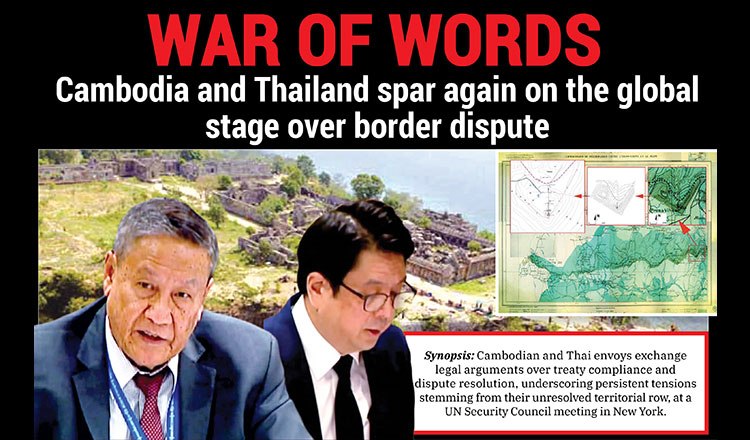 (Top right): The Preah Vihear Temple area on the Dangrek Mountains (extrapolation from the map recognised by the International Court of Justice, June 15, 1962). Demarcation Commission of Indochina and Siam.(Bottom left): Cambodian Permanent Representative to the UN Keo Chhea at the UNSC Arria Formula meeting on Friday. Thai Permanent Representative to the UN Cherdchai Chaivaivid (R). UNSC
#National
Synopsis: Cambodian and Thai envoys exchange legal arguments over treaty compliance and dispute resolution, underscoring persistent tensions stemming from their unresolved territorial row, at a UN Security Council meeting in New York.
Cambodian and Thai diplomatic representatives once again argued with one another at a UN security meeting as the two neighbouring nations remained locked in a border dispute.
While Cambodia used legal language instead of pointing a finger, placing its dispute narrative on the record, Thailand answered with a defensive counter-signal to neutralise Cambodia’s point without escalating the row.
On Friday, Ambassador Keo Chhea, Permanent Representative of Cambodia to the UN, attended the United Nations Security Council’s Arria Formula meeting on “Upholding the Sanctity of Treaties for the Maintenance of International Peace and Security”, at UN Headquarters in New York.
In his address, Chhea underscored the importance of strict adherence to international laws, particularly treaties and conventions to maintain peace and stability in the world.
“Treaties provide legal certainty and mutual trust essential to stable international relations and international peace and security,” he said, adding that this key principle is manifested in the 1969 Vienna Convention on the Law of the Sea and “consistently affirmed” by the jurisprudence of the International Court of Justice (ICJ).
He expressed Cambodia’s concerns over the violations of binding treaties and obligations in accordance with international law.
“Such practices undermine legal certainties and the principles of pacta sunt servanda and uti possidetis juris,” Chhea said, referring to two foundational principles of international law, which respectively govern the binding nature of agreements and the determination of territorial boundaries for new states.
“As clearly set out in Articles 26, 27 and 54 of the Vienna Convention, a state shall not invoke the international law. It shall invoke its own internal law and abide by the principles of the Treaty of Peace,” he added.
Chhea called on concerned parties to resolve the issue peacefully, including through additional arrangements in accordance with Chapters 6 and 8 of the UN Charter. Cambodia, he said, welcomes recourse to the International Court of Justice and good faith in the implementation of its decision pursuant to Article 94.1 of the Charter.
“Cambodia believes the United Nations, including the Secretary-General, the Security Council and the International Court of Justice, plays a vital role in promoting treaty compliance through early warnings, transparency, confidence-building and support of peaceful dispute resolutions, thereby strengthening international peace and security,” Chhea said.
Also present at the UNSC meeting, which was named in honour of Venezuelan diplomat Diego Arria, was Cherdchai Chaivaivid, Ambassador and Permanent Representative of Thailand to the United Nations.
Speaking just after his Cambodian counterpart, Cherdchai argued that treaties and the UN Charter are not instruments for political litigation or selective interpretation.
“Allocations of violations of international law must rest on verified facts and be addressed through the mechanism agreed upon by States, not through insinuation by a delegation,” he said.
Cherdchai expressed Thailand’s “full commitment” to the UN Charter and to international humanitarian law but at the same time rejected approaches that apply the law selectively, disregard the context or ignore the responsibilities of all parties concerned.
“Upholding the sanctity of treaties requires universal and good-faith compliance, free from double standards. Only by respecting both the letter and the spirit of our legal obligations can international peace and security be genuinely preserved,” he said.
Cherdchai said the sanctity of treaties could only be upheld through sustained commitment.
“Just as domestic laws depend on enforcement, international treaties rely on good faith and consistency of states in honouring their obligations,” he said. “Trust and confidence are difficult to build and even harder to restore once eroded, yet they remain indispensable for us to collectively do so.”
A similar face-off between Chhea and Cherdchai also occurred at the UNSC open debate last week.
Before the Cambodia-Thailand border argument escalated into two military clashes in July and December, respectively, Cambodia had proposed filing to the Hague a case involving an area and three temples in the disputed border. It had also planned to argue the case based on the 1907 Franco-Siamese Treaty and its related maps and MOU2000, which the two countries have inked regarding the survey and demarcation of their land boundary.
Thailand, however, insisted on using existing bilateral mechanisms, such as the Joint Boundary Committee (JBC), while also claiming that it has not recognised the ICJ’s jurisdiction since 1960.
Also speaking at the Friday meeting, Zeid Ra’ad Al Hussein, President of the International Peace Institute, said the overt violations of international treaties are the consequences of national leaders’ pursuit of their own interests.
“What does seem rather obvious to me, as to others, is the presence of national leaders–quite a few unfortunately–so determined to pursue their nation’s perceived core strategic interests, they will do so regardless of international treaties or the wider cost,” he said.
“Any more profound global cost for them is simply too distant a factor, a calculation which, if needed, will be made later.”
Hussein warned that without respect for international laws, conflict and crises will multiply, overlap and become chaotic, making them harder to resolve.
“Only by respecting the UN Charter and International Law writ large, especially where peace is concerned, including International Humanitarian Law and International Human Rights Law, and doing so now, can all of this be prevented,” he added.
“It will, of course, require wisdom from all those who lead us.”
-Khmer Times-
———