Soldiers and border communities bear the weight of war
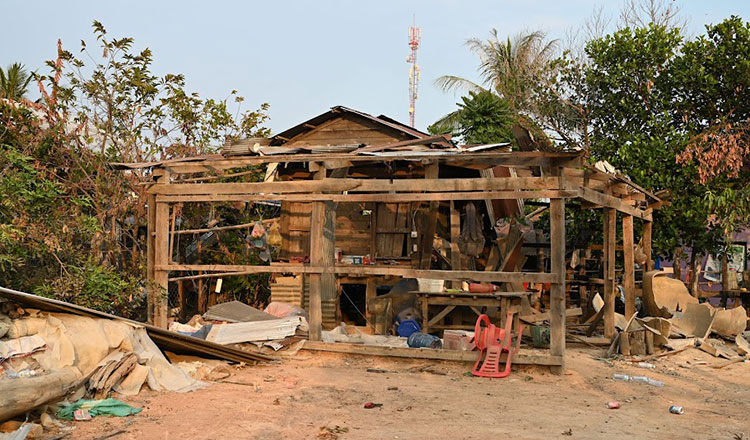 - A villager’s home destroyed by Thai military shelling. DC-CAM.
#National
Synopsis: A field report captures the voices of frontline troops and grieving families along Cambodia’s northern border, revealing lives shaped by duty, loss and the enduring scars of the conflict with Thailand.
Along Cambodia’s northern frontier, the guns have fallen silent—for now. But in villages and forward posts stretching from Oddar Meanchey to Banteay Meanchey, the sounds of artillery still echo in memory.
On January 14, a field team from the Documentation Centre of Cambodia (DC-Cam), along with Khmer Times journalists, travelled through these borderlands to record the testimonies of frontline soldiers and families whose lives were torn apart during the latest Cambodian–Thai clashes. What they found was a landscape of lonely roads, damaged homes, and routines shaped by duty, loss, and endurance.
At Thma Daun, near the forested ridgeline separating Cambodia and Thailand, a veteran soldier sat at his post. Identified as K-N, the 56-year-old has spent most of his life in uniform. His story spans refugee camps, resistance forces, repatriation, farming, and re-enlistment into the Royal Cambodian Armed Forces.
He first joined the paramilitary in 1987, serving in rotating frontlines across northwestern Cambodia. After repatriating in 1991, he returned to civilian life as a farmer. But two decades later, when the government called for former soldiers to rejoin the army, he answered the call once more.
Today, he commands a reconnaissance platoon stationed in one of the most sensitive border sectors—a zone marked by ancient temples, narrow passes, and villages facing Thai settlements just across the line. During the July and December clashes last year, his men were deployed across Thmar Daun, Ta Krabei Temple and Chub Angkunh. Multiple brigades and border police now hold these positions, where only months ago tourists had visited temple ruins.
For K-N, war is not a chapter—it is a lifetime. His presence at the frontier reflects the enduring role of soldiers who have lived through every era of Cambodian conflict, now guarding territory once again under threat.
While soldiers held the line, civilians in nearby villages fled for their lives.
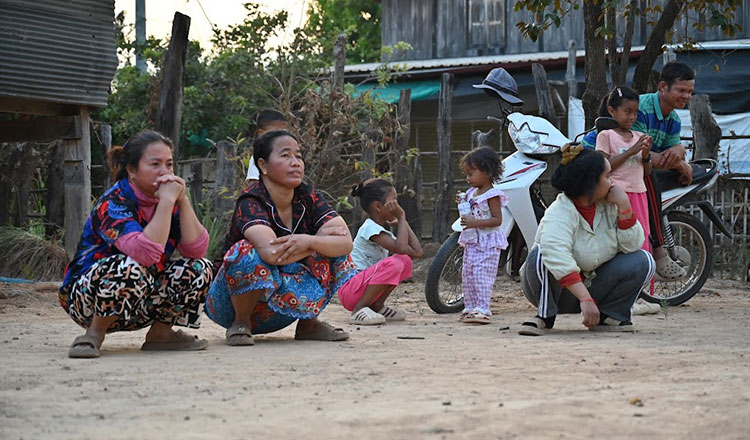
In Spean village, Kork Romiet commune, Bou Sophoan, 44, still remembers the afternoon of December 8, 2025, when artillery shells began dropping into her community.
She saw a bridge near the village school struck by fire. Neighbours fled. Her husband, Rith Nguon, loaded their belongings onto a mechanical tiller and told her to escape first with their children and elderly mother. He stayed behind to guard their home and feed the pigs.
Hours later, Sophoan reached a crowded displacement site. A phone call brought devastating news: her husband had been struck by shrapnel near their house. He was sent to Mongkul Borey Hospital. Doctors initially believed he might survive. But before he could be transferred to Phnom Penh, his condition worsened. By midnight, he had died.
That same night, shelling intensified. Sophoan transported his body to Thmar Puok Pagoda, where a rushed funeral was held with only a handful of monks and mourners. At dawn, she gathered his ashes and fled once more, carrying the remains of her husband as explosions echoed in the distance.
Now returned to her village, she faces life without her partner and provider.
“I feel deep pain and regret that Thai troops fired shells at innocent civilians who knew nothing of the conflict. I want the international community to punish Thailand for invading Cambodia and firing on innocent people,” she said.
“Thailand has broken my family. Living without a husband is incredibly difficult,” Sophoan added.
Her struggle is not only emotional. She suffers from a chronic heart condition and worries over how to find the money to raise their children.
Ma Phuon, 63, lives nearby. Her husband, Khlan Heng, was also struck by the same barrage of fire on December 8. As villagers fled, he stayed behind to organise belongings before joining his family. He never made it out.
Severely wounded by artillery fire, he was transferred from Mongkul Borey Hospital to Phnom Penh’s Preah Kossamak Hospital. He died days later on December 14. His body was returned to a refugee camp, where the funeral was held under the shadow of renewed airstrikes. As Thai fighter jets bombed nearby districts, families ran in panic. Only Phuon’s family remained to complete the cremation and collect his ashes.
She later returned home to Spean village with her children and grandchildren. Her words captured the quiet devastation left behind: “I am deeply devastated by the loss of my husband. I miss him terribly, and my heart is so full of grief that I cannot find the words to describe it.”
Breaking into tears, Phuon said she, along with millions of other Cambodians, does not want to see their hard-earned peace shattered
“I do not want war, and I do not want any more shooting. I am terrified, and I no longer know where else we could run to for safety,” she said.
Without her husband, Phuon says there is no one to lead the rice farming or provide for the household. Sleep no longer comes easily.
The field observations paint a wider picture. Provincial towns remain functional, but the border road—National Road 58—is eerily deserted. Many displaced families have not returned. Homes and infrastructure bear scars of shelling. Unexploded ordnance remain scattered in contested zones. In several areas, Thai forces reportedly occupy temple zones and border checkpoints, preventing Cambodian residents from returning to their property.
Travel within a few hundred metres of the border is still dangerous. But despite the insecurity, soldiers remain at their posts. Families rebuild what they can. And survivors carry memories that will long outlast the sound of gunfire.
During this difficult time, DC-Cam Director Youk Chhang called on young people, whom he described as the backbone of the country, to keep contributing to peacekeeping through education and hard work.
“Hard work is essential because the smartest people in the world cannot contribute to peace without hard work. Hard work is vital to ensure a strong national defence, but more than this, peace is never easy. It is as hard to maintain peace as it is to achieve peace, and youth must be disciplined and focused,” he said.
“Finally, a commitment to humanity is important because it is the foundation of all peace. If youth do not respect their adversaries, enemies and threatening people as human beings, then they will never be at peace because war and hate will become internalised. Peace is only possible when you respect the humanity of others.”
DC-Cam, he added, remains devoted to its task of educating young people while also documenting the history of modern warfare, particularly the humanitarian crises it has caused.
“We also continue to collect stories on how the Thai invasion affected the Khmer Rouge genocide survivors,” Youk added. “Most of them are parents of soldiers. Few were kids during the Khmer Rouge, and they are now soldiers themselves serving on the frontline—in some cases they were just 100 metres away from Thai army tanks.”
-Khmer Times-