Phnom Penh weighs US invitation to join Board of Peace
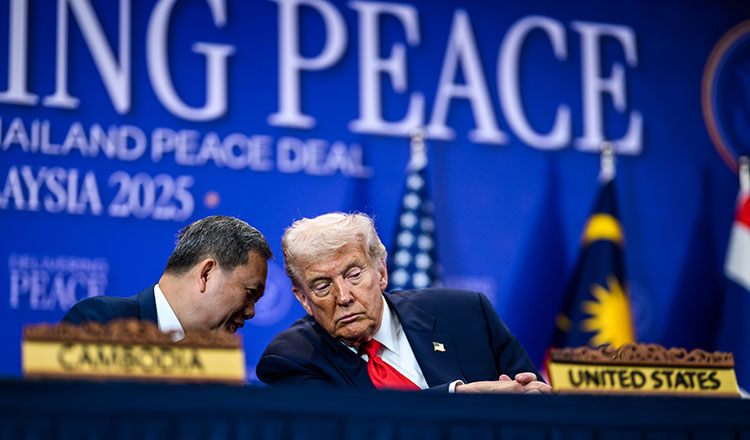 US President Donald Trump (R) with Prime Minister Hun Manet before the signing of the Kuala Lumpur Joint Declaration between Cambodia and Thailand, in Kuala Lumpur, on October 26, 2025. White House
#National
Synopsis: Donald Trump invites Cambodia to become a founding member of the US-led body with the mission of bringing about long-term peace and stability in the Middle East.
Cambodia is considering the diplomatic, financial and strategic implications of becoming a founding member of the US “Board of Peace” amid mixed regional responses to the plan.
This was after President Donald Trump invited Prime Minister Hun Manet to join the body under a US-led plan to end the Gaza conflict.
While initial participation is by invitation from the US, a draft charter indicates that each country must contribute more than $1 billion within the first year to secure a permanent seat.
The Cambodian government said yesterday it was an honour to be invited to become a founding member of the Board of Peace, but had yet to respond to the invitation, which was also extended to neighbouring Vietnam and Thailand.
In a letter dated January 16, Trump extended an invitation to Mr Hun Manet to become a founding member of the Board of Peace, an international organisation and transitional governing administration envisioned under the Comprehensive Plan to End the Gaza Conflict.
The plan, announced last September 29, consists of a 20-point roadmap that has been welcomed by world leaders, including heads of state in the Arab world, Israel and Europe. The initiative is reported to have gained further international backing on November 17, when the United Nations Security Council adopted Resolution 2803 endorsing the plan.
According to the letter, the proposed Board of Peace would bring together a group of countries prepared to assume responsibility for building long-term peace and stability in the region.
Trump said the board would be established as a new international organisation, with member states able to appoint authorised representatives to participate in its meetings.
“As chairman of the board, I formally invite the Kingdom of Cambodia to join as a founding member state and become a party to the charter of the Board of Peace,” the US president wrote, describing the initiative as unprecedented in scope.
The letter said the charter of the board is open for signature and ratification, and that Cambodia’s participation would reflect its willingness to contribute to global peace efforts.
It is the US President’s intention to convene partner countries in the near future to advance the initiative.
Trump brokered the ceasefire agreement between Cambodia and Thailand on July 28, after five days of fighting along the border, before witnessing the signing of the Kuala Lumpur Peace Accord on October 26, alongside Malaysian Prime Minister Anwar Ibrahim, on the sidelines of the ASEAN Summit last year.
Mr Hun Manet had nominated Trump for the Nobel Peace Prize last year in recognition of his contributions to advancing world peace.
More than 60 countries worldwide have reportedly received invitations to join the Board of Peace. They include several ASEAN members—Singapore, Thailand, Indonesia, Vietnam and Cambodia.
Vietnam has accepted the invitation.
General Secretary of the Communist Party of Vietnam Central Committee To Lam said Vietnam will join the board as a founding member state, according to an announcement from the country’s Foreign Affairs Ministry.
Lam affirmed Vietnam’s readiness to join as a founding member, pledging to work closely with the United States and the international community to make meaningful contributions to a long-term and comprehensive solution to the Middle East peace process, including the establishment of an independent state.
Thailand’s Ministry of Foreign Affairs said it had received a letter from Trump outlining a Comprehensive Plan to End the Gaza Conflict, along with a US proposal to establish a Board of Peace, adding that Thailand is reviewing the invitation.
“In principle, Thailand welcomes any initiative that supports sustainable peace in the Middle East and humanitarian efforts to alleviate the suffering of the Palestinian people,” the ministry said, according to Thai media reported.
Cambodian government spokesman Pen Bona said the invitation is a great honour for Cambodia, a small country that is recognised internationally as a symbol of peace.
He said the invitation underscores Cambodia’s strong reputation as a nation associated with peace and reconciliation.
“This reflects the enduring value of peace for which Cambodian leaders, including Samdech Techo Hun Sen, former Prime Minister and founder of the nation’s peace efforts, and other senior dignitaries, have made the highest sacrifices. Samdech Thipadei Hun Manet, the current Prime Minister, continues to prioritise and defend peace as a top focus of the Royal Government,” he said.
Bona added that the phrase “Thanks Peace” is widely displayed as an expression of gratitude and a reminder of the need to preserve and protect peace, reflecting how deeply the spirit of peace is rooted in the hearts of Cambodian people both at home and abroad.
He said peace is regarded not only as vital for the nation and the Khmer people, but also as an indispensable foundation for regional and global stability.
Bona noted that when Cambodia faced attacks on its sovereignty by Thai military forces, the spirit of peace was strongly reflected among both national leaders and the public. During that period, the phrase “Cambodia Needs Peace” echoed across the country and drew international attention, highlighting Cambodia’s active role in upholding and defending the cause of peace.
Kin Phea, Director-General of the International Relations Institute of Cambodia, yesterday said the invitation from President Trump for Cambodia to join his proposed “Peace Board” adds a new layer of complexity to Cambodia’s decision-making process.
“This initiative, often framed as a mechanism to mediate global conflicts and reshape international trade norms, presents both an opportunity and a significant challenge for a small state like Cambodia,” he said.
To Phea, this represents a dual dilemma for small states, caught between economic burdens on one hand and security pressures on the other.
“In this landscape, Cambodia faces an exceptionally difficult decision regarding its participation in a mechanism spearheaded by a major power, especially as geopolitical competition grows increasingly complex. Consequently, Cambodia must pursue diplomatic diversification while simultaneously engaging actively in multilateral mechanisms under the United Nations umbrella,” he said.
“From the perspective of Prospect Theory, Cambodia’s response will likely be influenced by loss aversion. While joining the board could offer a relative gain in terms of diplomatic prestige and direct access to the US administration, the fear of losing the status quo in its relations with other regional powers remains a dominant factor,” Phea added.
TelegramFacebookXWhatsAppEmailRedditThreadsShare
-Khmer Times-