Cambodia urges Thailand to end culture of blame-shifting on air-quality issues
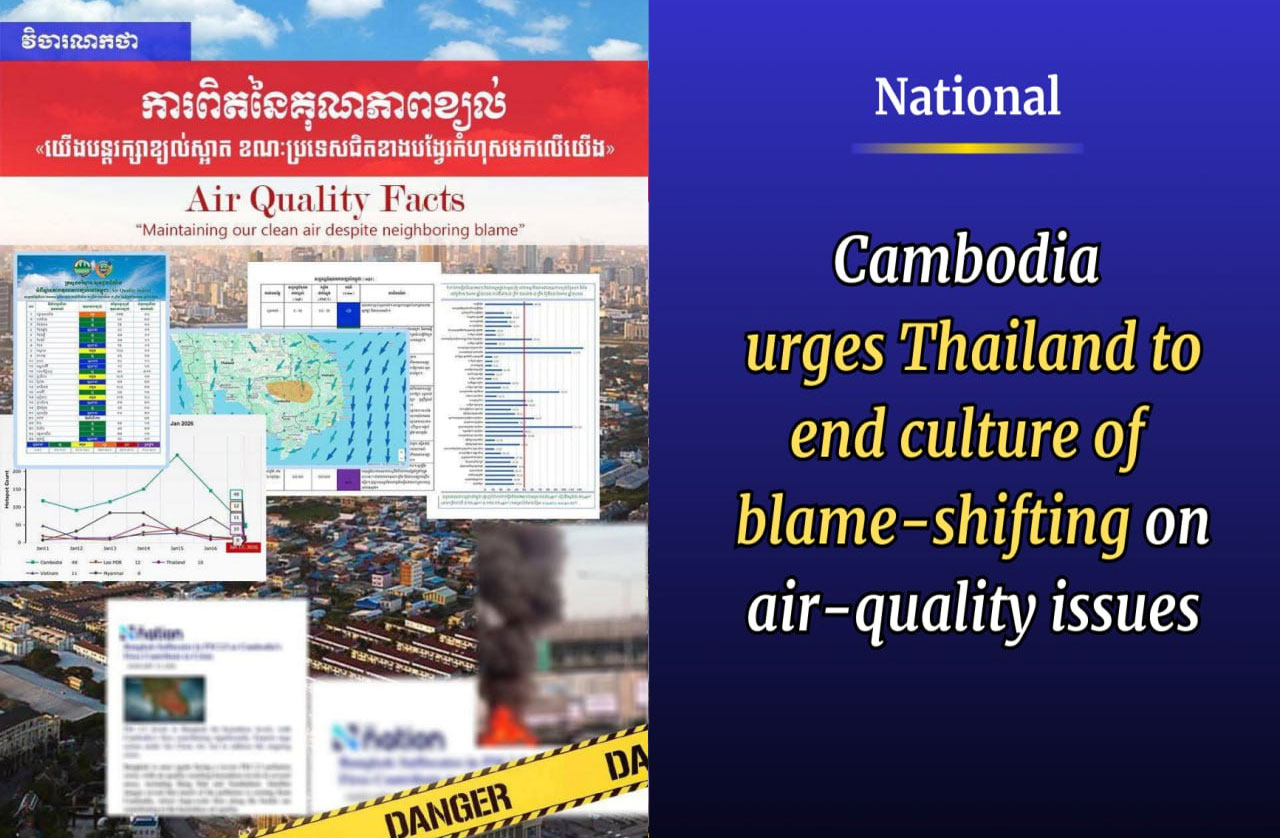 The environment ministry has responded to Thai claims that Cambodia is somehow responsible for air pollution in Bangkok. Supplied
#National
The Ministry of Environment has rejected a report by Thai media outlet The Nation which claimed that air pollution in Bangkok originates from fires in Cambodia, describing it as an attempt to “shift the blame onto Cambodia”. Cambodia has consistently upheld “data transparency on air quality”, without concealment and without resorting to political blame-shifting to cover up its own inaction, it said.
The January 18 ministry statement was in response to a January 13 article, titled “Bangkok Suffocates in PM2.5 as Cambodia’s Fires Contribute to Crisis” which claimed that air pollution in Bangkok was significantly contributed to by fires occurring in Cambodia.
The ministry explained that the increase in PM2.5 concentrations in Bangkok is primarily caused by local sources. These include emissions from transportation — given Bangkok’s large number of vehicles and heavy traffic — emissions from industrial activities, dust from construction sites and urban energy consumption.
These sources, combined with unfavourable local meteorological conditions such as temperature inversion and low atmospheric mixing height, play a crucial role in trapping locally generated pollutants, leading to their accumulation and the worsening of air pollution in Bangkok.
According to data from air quality monitoring stations near the Cambodia–Thailand border, PM2.5 concentrations have risen slightly above standards (at a yellow index level). However, this does not mean that air from Cambodia is polluting Bangkok.
Cambodia is currently under the influence of the northeast monsoon, with winds blowing from north to south — meaning toward the sea — as shown on wind direction maps from the ASEAN Specialized Meteorological Centre (ASMC). In addition, during the period when Bangkok experienced air pollution problems, Cambodia was also facing similar unfavourable weather conditions, such as calm and cold air, which significantly limit the long-distance transport of particulate matter. In other words, the particles cannot travel as far as Bangkok.
In a January 18 editorial titled “Air Quality Facts – We are maintaining our clean air despite neighbouring blame”, Environment minister Eang Sophalleth stated that blue skies cannot be achieved through mutual accusations. Cambodia has consistently and systematically addressed air pollution issues in order to maintain air quality, for the benefit of the Cambodian people and for neighbouring countries as well, he added.
As air pollution can evolves into a global public health crisis, trust and scientific integrity have become the most critical tools for resolution. Cambodia remains steadfast in its commitment to “Air Data Transparency”, refusing to hide behind political games or use blame-shifting to mask domestic inaction, said the minister.
The following are extracts from Sophalleth’s editorial.
“Cambodia clearly understands that acknowledging domestic pollution sources is not a sign of weakness; rather, it is a hallmark of high responsibility toward public health. We have invested in advanced air quality monitoring systems that provide real-time data on PM2.5 concentrations. By maintaining good air quality and broadcasting daily updates, Cambodia empowers its citizens to protect themselves and compels authorities to enforce environmental laws on factories and industries without exception. This is ‘Integrity that Saves Lives’.
Ending the culture of “blame-shifting” and “smokescreen nationalism”
“In stark contrast to Cambodia’s transparency, we observe that certain neighbouring countries frequently employ “diversionary tactics”. Whenever air pollution reaches hazardous levels, they point fingers at Cambodia or use the excuse of “transboundary haze” to justify the failure of their own domestic policies. Using “nationalism” or manipulating media narratives to protect a government’s image at the expense of the environment is deeply unethical. Toxic smoke does not respect borders, nor does it obey propaganda. Shifting the blame not only damages international relations but leaves one’s own citizens to perish in smog because of a refusal to address the root causes at home.
A call to action: Cooperation based on science, not sentiment.
“As nations sharing the same sky, Cambodia urgently calls upon all neighbouring countries to acknowledge the truth: stop shifting the blame onto Cambodia and instead technically evaluate your own domestic pollution sources (factories, forest fires and emissions). We also call for data to be shared transparently: Only through the joint use of satellite data and shared scientific information can we accurately identify pollution sources and find collective solutions,” he wrote.
Sophalleth also called for regional media outlets to use their pens to “clear the air” by reporting the truth and advocating for environmental law reform, rather than using them to blow a “smokescreen” over the eyes of the public.
-The Phnom Penh Post-