Cambodia submits Preah Vihear Temple damage assessment reports to international organisations
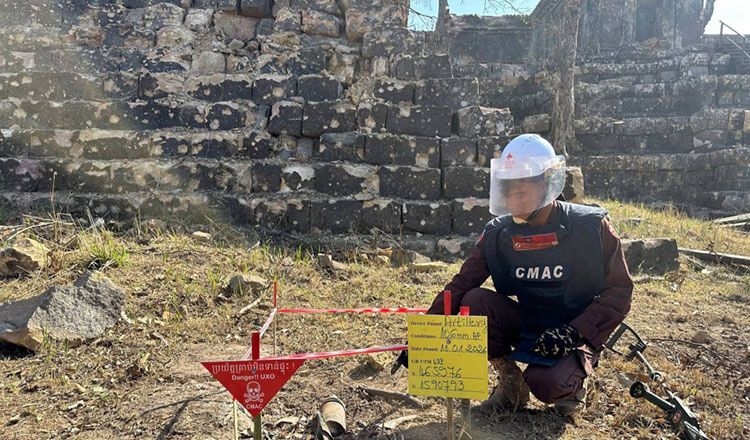 A CMAC demining operator places a UXO warning at Preah Vihear Temple. CMAC
#National
The Ministry of Culture and Fine Arts has submitted assessment reports on the state of damage of the sacred site of the Temple of Preah Vihear to UNESCO, the World Heritage Committee, the ICC-Preah Vihear Member States, and the international community for their information.
In a press release made public this morning, the ministry detailed the damage sustained by the Preah Vihear Temple and its surrounding areas as a result of artillery attacks carried out by the Thai military during the periods of July 24-28 and December 7-27 last year.
The damage recorded from July 24 to 28 consists of 142 locations within the Preah Vihear Temple complex and 42 locations in the surrounding areas, including Keo Sikha Kiri Svara Pagoda, public infrastructure, and the conservation office buildings of the National Authority for Preah Vihear.
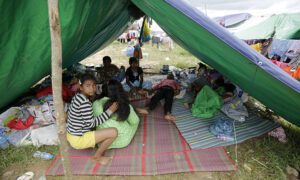
Surrounding communities also suffered damage at 60 locations, including residential houses, schools, pagodas, and other public infrastructure, resulting in the forced displacement of 14,832 residents from their homes. These damages were officially documented by the National Authority for Preah Vihear in October last year.
The damage recorded from December 7 to 27 is of a magnitude that exceeds the damage recorded in July. According to photographic and video evidence collected by the National Authority for Preah Vihear during a documentation mission conducted on December 28, almost all major architectural structures of the temple, from Gopura I to Gopura V, including all connecting causeways and the ancient northern staircase, suffered severe damage. This damage resulted from repeated heavy artillery shelling and aerial bombardment carried out by unmanned aerial vehicles and fighter aircraft, directly targeting the Preah Vihear World Heritage site.
At the same time, routine conservation and restoration activities were disrupted, and infrastructure supporting conservation and restoration work under international cooperation projects was also completely damaged, comprising;
The Northern Ancient Staircase Conservation and Restoration Project (Cambodia-United States Cooperation): Both the original sections of the staircase, which had previously been in good condition, and the sections restored over the past ten years suffered severe damage. Conservation facilities and restoration equipment were destroyed.
Gopura V Conservation and Restoration Project (Cambodia-India Cooperation): The structure of Gopura V sustained extensive damage, and the conservation facilities and restoration equipment were destroyed.
Architectural Structures of Gopura I, II, and III (Cambodia-China Cooperation): The damage to these structures is extremely severe, with many parts having entirely lost their original form. This necessitates a comprehensive new study of the recent damage, its technical characteristics, and the preparation of revised restoration plans, as previous studies are no longer applicable due to the latest damage.
Overall, the two attacks committed by the Thai military against the temple caused extensive destruction and severe damage to original architectural structures, restored components, inscriptions, conservation buildings, and technical equipment. These attacks have significantly hindered the conservation efforts of national institutions and international partners.
Through this press release, the ministry officially released the Damage Assessment Reports, including video documentation related to both incidents, prepared by the National Authority for Preah Vihear, as well as the Summary Report on Unexploded Ordnance Clearance and Verification prepared by the Cambodian Mine Action Centre.
The ministry calls upon international organisations and the international community to support urgent measures to protect the temple from further attacks, support emergency conservation to prevent additional damage, and restoration works for the temple.
At the same time, the ministry reiterated its call for respect for international law, including the 1954 Hague Convention for the Protection of Cultural Property in the Event of Armed Conflict and its Second Protocol of 1999, as well as international humanitarian law, all of which obligate States Parties to respect and protect cultural heritage of outstanding universal value.
“The Ministry of Culture and Fine Arts will continue to conduct research, compile detailed documentation on the damage, and maintain close coordination with national and international institutions, including in the technical, diplomatic, and legal domains, to ensure justice, protection, and restoration of Cambodia’s Sacred Temple of Preah Vihear,” the press release underlined. AKP