Devastating with More Gripen Aircraft
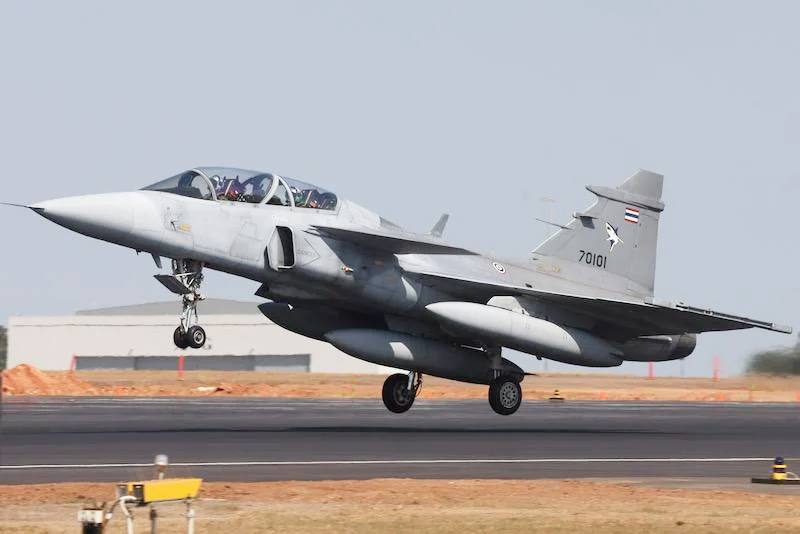 Devastating with More Gripen Aircraft
#OPINION
In an opinion piece in DN on 3 September, I warned that the fighting between Thailand and Cambodia in July was not ‘a blurred border conflict between two equal parties, but an asymmetrical conflict that increasingly bears the hallmarks of a full-scale war of aggression against Cambodia,’ that the ceasefire that had been signed was extremely fragile and that ‘there is a real risk of further escalation.’ Seen in this context, Sweden’s sale of Gripen aircraft to Thailand was devastating for Sweden’s role in the region and for regional security policy. Since then, these fears have been confirmed with a vengeance. A veritable Thai invasion of Cambodia began on 8 December with attacks by the Thai army, navy and air force in all seven Cambodian border provinces. Thailand’s extensive military operation, which continued until a new ceasefire was signed on 27 December, included the use of F-16 fighter jets, bombers, cluster munitions, poison gas and large troops on Cambodian territory: tens of thousands of Thai soldiers are estimated to have been on Cambodian soil.
Thailand’s goal seems to be to force Cambodia into a war logic. Cambodia wants at all costs to avoid an armed confrontation that it has no chance of winning: in 2024, Cambodia had a defence budget of $1.3 billion and 124,300 active military personnel, while the corresponding figures for Thailand were $5.73 billion and over 360,000 active military personnel. Thailand has one of the best-equipped air forces in Southeast Asia, with 106 combat-ready aircraft, while Cambodia’s air force has no fighter jets at all. Thailand’s navy is large and well-equipped, with nearly 70,000 personnel, compared to only 2,800 in Cambodia.
The conflict is emblematic of a new world order characterised by the replacement of international law by the law of the strongest. Cambodia has placed its hopes in international mediation and intervention, which have either failed to materialise or missed the mark. The October ceasefire was achieved largely with the help of Trump’s peace brokerage ambitions; now Thailand has declared itself immune to punitive tariff diplomacy. The lack of diplomatic leadership demonstrated at the meeting of ASEAN foreign ministers on 22 December dashed hopes that ASEAN will play a leading role in resolving the conflict. China has long taken a surprisingly passive role, until the successful trilateral talks earlier this week. The ceasefire signed on 27 December is also fragile: Thailand occupied parts of Cambodian territory in December, and the country’s foreign minister has stated that this must be taken into account in new talks on the border demarcation. The diplomatic stalemate constitutes a veritable crisis for the regional security architecture, with global repercussions.
The fact that the sale of Gripen aircraft to Thailand is a serious political mistake is confirmed by the continuous and extensive bombing raids carried out by Thai fighter planes during December, in some cases deep inside Cambodian territory. The air strikes make it clear that the attacks cannot be described as a border conflict. On 15 December, Thai F-16 aircraft dropped two bombs in the Srei Snam district of Siem Reap, more than 70 km from the border, near a camp for evacuees. In another attack, bombs were dropped in Serei Sophoan, 47 km from the border town of Poipet, where many people had taken refuge after the bombing of densely populated Poipet. On Boxing Day, bombs were dropped about 100 km into Cambodian territory in Siem Reap’s Varin district; on the same day, 40 bombs were dropped on the village of Chouk Chey. In total, at least 30 air strikes have taken place, targeting not only military targets but also civilian infrastructure such as schools and bridges. Thai military attacks on the Angkorian temples of Ta Krabei (including with Gripen aircraft) and Preah Vihear have reduced Ta Krabei to ruins and seriously damaged the World Heritage Site of Preah Vihear. At least six casinos and scam centres, where there are fears that civilians were present, have also been bombed by Thai fighter jets (including Gripen aircraft) and attacked with artillery and drones. Many victims of trafficking are feared to have been inside the buildings during the bombings, which has been highlighted by the UN High Commissioner for Human Rights, among others.
Now comes the news that Sweden will also supply the Thai military with drones. On 16 December, the newspaper Ny Teknik reported that Linköping-based company Evolved Systems Scandinavia AB is building drones for Thailand’s navy that will be able to fly for twelve hours, twice as long as comparable drones from competitors, and carry missiles. A delivery of three Muotse M-200 drones to the Thai coast guard this spring will be followed by deliveries of up to 21 systems to Thailand’s navy and coast guard in 2026. According to Ny Teknik, although Muotse is not classified as military equipment, it can ‘also function as flying air defence’. The magazine writes that the American parent company, Evolved Aerospace, has established its Swedish operations to ‘take advantage of the strong Swedish R&D environment,’ and Linköping is described as a hub for the company’s development work.
Sweden has become one of the strongest contributing nations to Thailand, ‘Southeast Asia’s sick man’ as the country is now described by the East Asia Forum’s editorial page, being able to carry out its military attack on Cambodia. Sweden must now immediately cancel the agreement signed in August for the sale of four Gripen aircraft to Thailand (the first of which is to be put into service in 2029), and for skills development, industrial cooperation and technology transfer to the Thai Air Force. Furthermore, a definitive stop must be put to follow-up orders – Thailand plans to replace twelve F-16 aircraft – and to the sale of drones.
Beyond these measures, Sweden must play a role through the EU in promoting a diplomatic solution to the conflict. Above all, Sweden must support the efforts that Cambodia will most certainly make to resolve the border dispute through international law. Thailand’s ambition to renegotiate the border based on the land it has occupied is a Southeast Asian parallel to Russia’s strategy in its war of aggression against Ukraine. By actively standing up for international law, Sweden can show that, despite everything, it has not capitulated to the new world order.
By Astrid Norén-Nilsson
Lund University
-AKP-