Unity and Instability: What the Thai–Cambodian Conflict Reveals About Two Societies
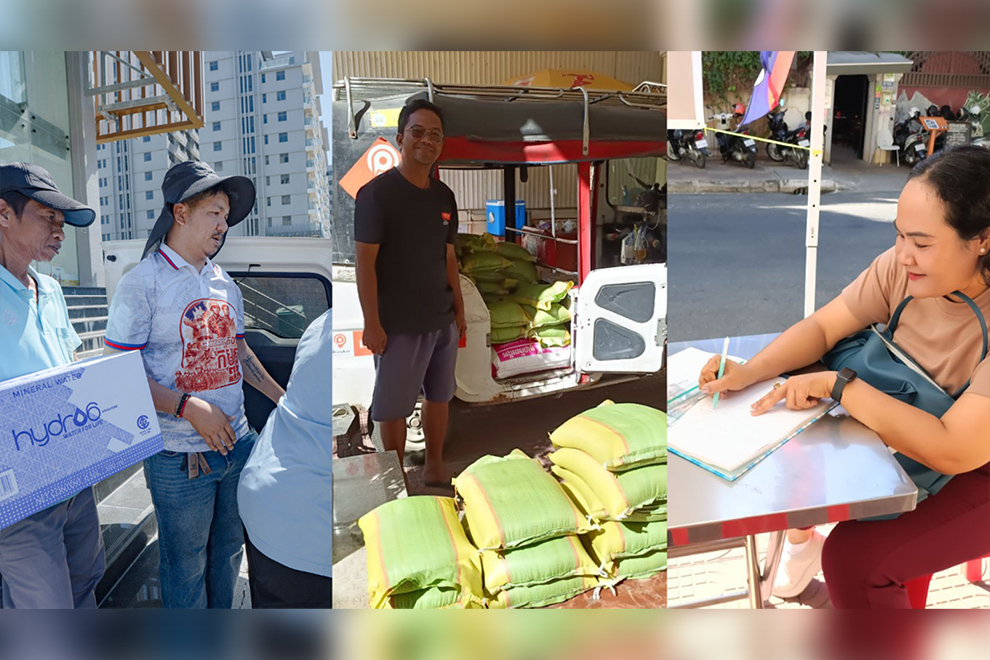 [In the spirit of ‘Khmer helping Khmer’, members of the public join The Post in raising funds and donations for displaced Cambodians. Post Staff]
[Opinion]
The ongoing Thai military aggression against Cambodia has revealed far more than a border dispute. It has exposed a profound difference between two societies — how they respond to crisis, how they define national responsibility and how they treat peace itself.
In Cambodia, the response has been marked by national solidarity. From the country’s leadership to ordinary citizens, there is a shared understanding that sovereignty, civilian protection and national dignity are collective responsibilities. Political leaders have spoken with one voice. Institutions have coordinated their actions. Civil society groups, monks, youth organisations and local communities have mobilised to support displaced families, donate supplies and maintain social stability.
Most importantly, Cambodian society has shown restraint. Despite suffering civilian casualties, displacement and infrastructure damage, the public response has not descended into chaos or revenge-driven rhetoric. Instead, the dominant message has been unity, calm and lawful self-defense. This cohesion is not accidental — it reflects a society that understands the cost of conflict and values collective survival over political theatrics.
Thailand presents a strikingly different picture.
Thai society today is deeply fragmented — politically, socially and institutionally. Power is contested between military elites, weakened civilian governments, royalist networks and protest movements. Public trust in institutions is low. Street protests, constitutional deadlock and elite infighting have become routine. In this context, the decision to escalate tensions with a neighboring country appears less like a security necessity and more like a political diversion.
Rather than uniting Thai society, the aggression against Cambodia has exposed its fractures. There is no clear national consensus, no unified civilian leadership and no transparent accountability. Different factions speak past one another. Independent voices are silenced or sidelined. The result is not strength, but instability.
Worse still, Thailand’s international reputation is increasingly shaped by its own actions. A pattern of disputes with neighbours, disregard for civilian safety, and militarised nationalism has painted an image of a state that resorts to force when internal legitimacy falters. This is not a narrative imposed from outside — it is one Thailand has constructed through repeated behaviour.
History shows that unstable societies often externalise their crises. Border tensions become tools to redirect public frustration. Nationalism becomes a substitute for governance. Military posturing replaces political reform. But such strategies rarely succeed. They deepen mistrust abroad while accelerating decay at home.
Cambodia, by contrast, has demonstrated that unity is a strategic asset. A society that stands together — leaders and people alike — does not need aggression to prove strength. It needs only clarity of purpose, respect for international law and commitment to peace with dignity.
This contrast matters beyond this conflict. It challenges the assumption that military power alone defines national resilience. True stability comes from social cohesion, legitimate leadership and public trust — qualities Cambodia has displayed under pressure.
The lesson is clear: aggression may distract a divided society temporarily, but it cannot heal it. Unity, responsibility, and restraint remain the real foundations of national strength.
Roth Santepheap is a geopolitical analyst based in Phnom Penh. The views and opinions expressed are his own.
-The Phnom Penh Post-