Why Thailand Rejected an ASEAN–US Ceasefire
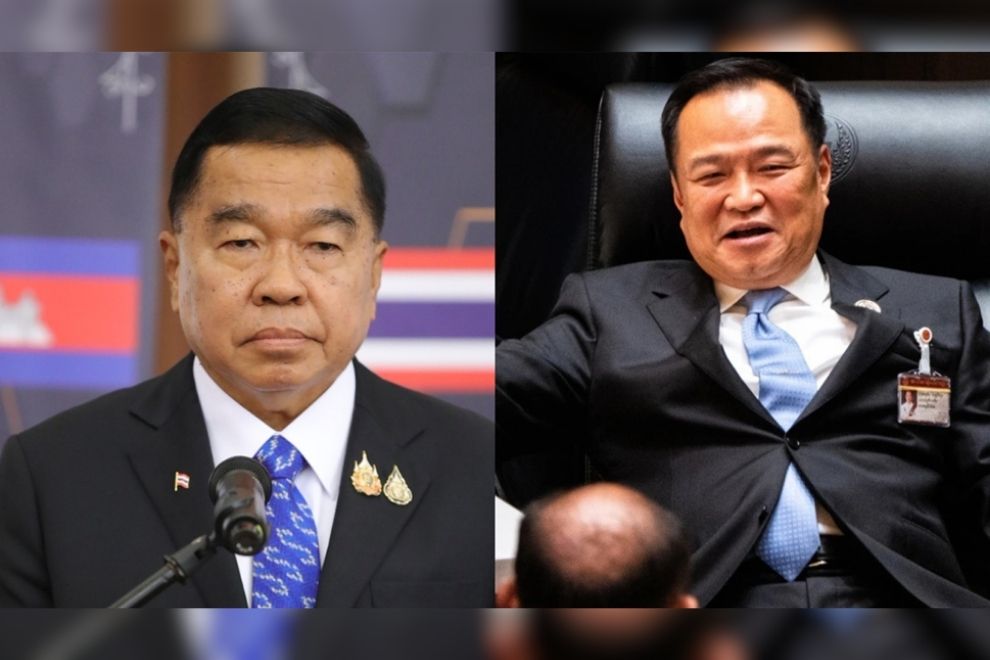 Thai defence minister Natthaphon Narkphanit (left) and Thai caretaker Prime Minister Natthaphon Narkphanit. Supplied
-Opinion-
When ASEAN chair Prime Minister Anwar Ibrahim proposed an immediate ceasefire between Cambodia and Thailand — an initiative publicly backed by US President Donald Trump — it should have marked a decisive step toward de-escalation. Instead, Thailand rejected it. This was not a misunderstanding, a technical objection or a procedural delay. It was a conscious decision to continue the conflict.
The ceasefire proposal carried extraordinary weight. It combined ASEAN’s collective authority with explicit support from Washington, offering Thailand a dignified and politically safe exit from escalation. Accepting it would have demonstrated restraint, responsibility and concern for civilian lives. Rejecting it revealed something far more troubling: a preference for force over peace.
At the heart of Thailand’s refusal lies a political system in which the military is not merely an institution but a dominant political actor. For decades, Thailand’s armed forces have relied on external tension to justify their influence, suppress civilian oversight and manufacture nationalist legitimacy. Conflict is not an accident of policy; it is a familiar and useful tool. A ceasefire would have disrupted this cycle by imposing limits on military behaviour and exposing decision-making to public and international scrutiny.
Thailand’s rejection also reflects fear — fear of accountability. A ceasefire brokered by ASEAN and supported by the US would have elevated the conflict beyond bilateral spin. It would have forced serious examination of how force has been used, whether borders were crossed, and whether civilians and protected sites were harmed. Peace, in this context, was dangerous — not because it weakened Thailand’s security, but because it threatened to expose uncomfortable facts.
These actions cannot be dismissed as routine border tensions. Cross-border troop deployments, the use of heavy weaponry and attacks affecting civilian areas together amount to a military invasion of Cambodian territory. Under international law, the unauthorised use of armed force on another state’s territory violates the most fundamental prohibition of the international order. No amount of rhetorical camouflage can turn invasion into self-defence. Repetition does not create legality.
Thailand’s strategic calculation is therefore unmistakable. By rejecting a ceasefire, Bangkok preserves unilateral freedom of action while postponing diplomatic and legal consequences. This is not the behaviour of a state seeking stability; it is the behaviour of one comfortable with escalation and willing to gamble with regional peace to preserve military dominance at home.
Cambodia’s response exposes this contrast starkly. Phnom Penh accepted the ceasefire initiative and reiterated its commitment to dialogue through ASEAN mechanisms and international law. Cambodia has not demanded punishment or retaliation. It has demanded only what international norms require: an end to unlawful military operations, protection of civilians and the peaceful resolution of disputes.
Thailand’s refusal carries costs far beyond the immediate conflict. It undermines ASEAN’s credibility, weakens regional norms against the use of force and signals that militarism can override collective responsibility. If even a ceasefire proposed by the ASEAN chair and supported by the US can be rejected without consequence, then ASEAN’s promise of peace risks becoming rhetorical rather than real.
Peace was available. It was credible, supported and immediate. Thailand rejected it not because it was flawed, but because peace constrains militaries, limits unilateral power and demands accountability. War, by contrast, preserves ambiguity, authority and impunity. Thailand’s choice was clear — and so should be the international community’s judgment.
Roth Santepheap is a geopolitical analyst based in Phnom Penh. The views and opinions expressed are his own.
-The Phnom Penh Post-