O’Smach families flee shelling with ‘just single cooking pot to survive’
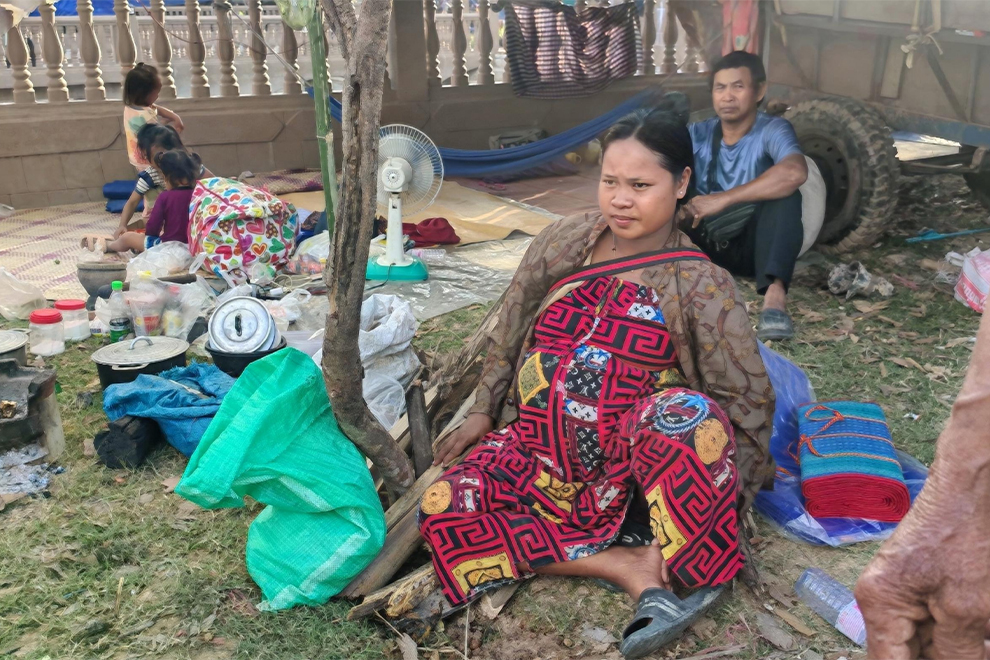 Hun Kanha, 22, is due to give birth this month. She is part of five families who fled to the Wat Botum Moung sanctuary in Srei Snom district. Hong Raksmey
-National-
Families fleeing O’Smach described an escape defined by fear, scarcity yet an unshakable sense of solidarity, as five households from Chamkar Chek village clung together on a homemade tractor and now share a single small pot to cook their meals inside the Wat Bo Knar Techo sanctuary.
More than ten people — ranging from an 80-year-old grandfather to a nine-month-pregnant woman — squeezed onto the tractor after Thai military strikes intensified around their village.
The roar of artillery and gunfire pushed them into the open, but even in the chaos, the villagers said leaving one another behind was never an option.
Hun Hoe, a former soldier, could not even pack his essential belongings before fleeing his village on his homemade “Kor Yun” tractor as the sound of artillery grew louder when Thai forces began launching attacks on December 7.
However, what weighed on him most was not the possessions he left behind, but the people living around him. He knew they had no means to travel far, and he refused to abandon them.
“I cannot escape alone and leave my neighbours behind. They have no way to travel,” said Hoe, 35. “No matter how difficult it is to ride together, we should share our joys and sorrows.”
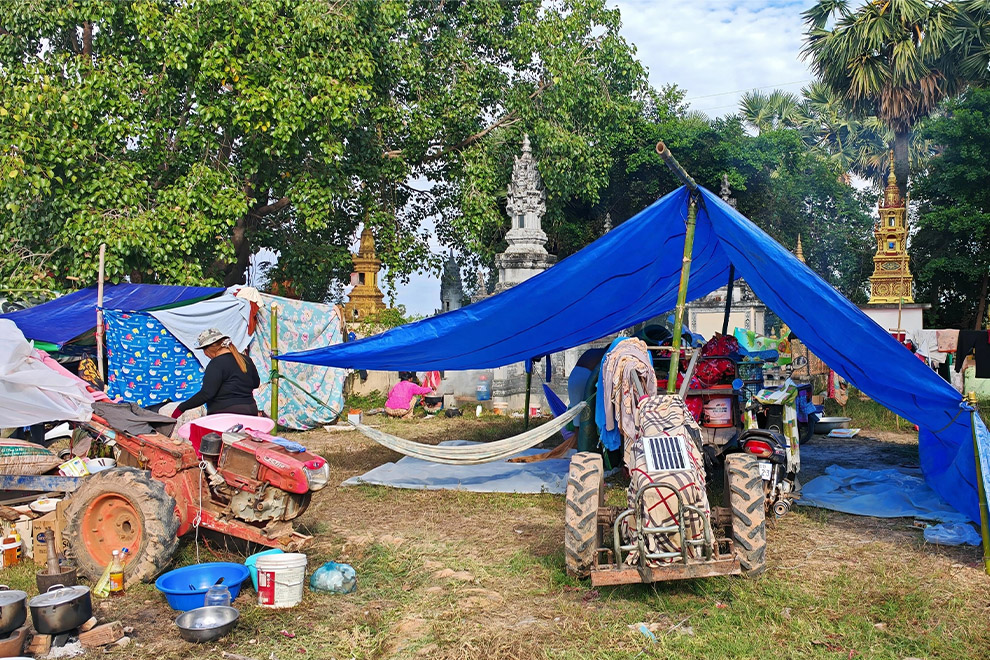
They carried almost nothing with them. No clothes, no utensils, and not enough food. What they did have was a single small pot — barely enough for one family, yet used by all five. Once they reached safety, they lined up to cook rice in shifts, one family after another, then gathered to eat side by side.
“With this small pot, we cook rice for one family at a time,” a villager explained. “When I finish cooking, I pour the rice into a bowl and let the next family cook. When all five finish, we eat together.”
Among them is 22-year-old Hun Kanha, who is due to give birth in December. She said she and her husband cannot afford even the most basic supplies.
“We have no money. We asked our neighbours for a ride to a safe place,” she told The Post. “We cook rice with only this small pot… I’m about to deliver my baby and I still don’t have what I need for the child.”
Her husband, a construction worker, had not been paid by his Chinese employer before the attacks, leaving the young couple without cash for food or essential items.
Another villager, Hang Huon, was the last member to arrive at the centre — delayed because he stayed behind to watch over the fields and houses.
When he finally fled, after the shelling grew too intense, he managed to bring a few pots and pans. His small bundle of kitchenware immediately eased the burden on the group.
“We separate the pots now, but the five families still share our meal table,” Huon said from inside a flimsy white tent that traps the midday heat.
“We had little, we ate little, according to what was given to us by philanthropists and the government,” he told The Post.
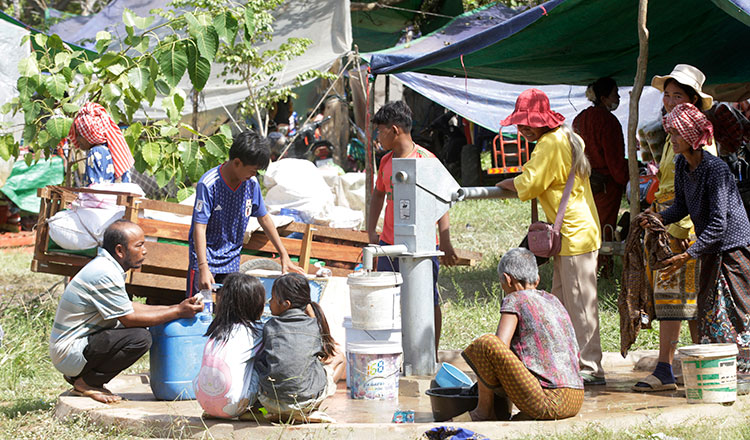
Their latest evacuation is not the first. During the July 24–28 clashes, the same group fled to the Wat Chroy Neang Nguon sanctaury in Siem Reap’s Srei Snom district. One relative stayed behind then, hiding in front of a bunker because escape was too dangerous.
Kun Kim, first vice-president of the National Committee for Disaster Management (NCDM), said the management of evacuees has proceeded without major problems. Thanks to coordinated support from the government and philanthropists, aid had reached more than 40,000 families as of the morning of December 11.
During an inspection of the Wat Botum Moung centre in Srei Snom district, he explained that Siem Reap currently serves as a safe shelter for more than 10,000 displaced families.
“The First Lady is going to distribute necessary kits to evacuees in each centre,” Kim said. “I will visit every province to monitor what is still missing so we can address it quickly.”
Kim acknowledged that the situation remains difficult for residents fleeing heavy shelling, stressing that conditions in the sanctuaries must be managed carefully to ensure their well-being.
Now, once again displaced by border violence, these five families say their greatest strength is the unity that carried them through the sound of artillery and onto the back of that cramped tractor. They escaped with few belongings — but not without one another.
-The Phnom Penh Post-