Thailand Deserves Better Than Populist Diplomacy
 Thailand Deserves Better Than Populist Diplomacy
-Opinion-
When a nation is governed by leaders who prioritize populism over principle, and vote-chasing over responsible statecraft, the consequences are inevitable: diplomatic humiliation, weakened national interests, and the erosion of international trust. Over the past week, Thailand has placed itself squarely in this position—and the region is watching with deep concern.
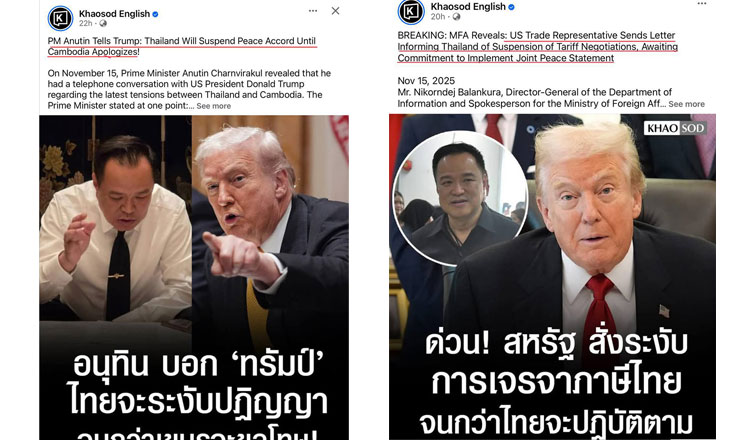
Prime Minister Anutin Charnvirakul’s declaration that Thailand will “suspend the peace accord until Cambodia apologizes” was marketed at home as a patriotic stand. In reality, it is a reckless political performance rooted in emotion, not evidence. What Anutin portrays as strength is seen internationally as destabilizing opportunism. And the question now hanging over Bangkok’s foreign policy is unavoidable: Is Thailand still committed to peace, or has it chosen the path of confrontation for domestic political gain?
The uncomfortable truth is that while Thailand halts its obligations under the Joint Declaration (JD), Cambodia, Malaysia, and the United States continue to honor the agreement fully. Cambodia has implemented every required step, Malaysia continues to facilitate monitoring mechanisms, and the United States—architect of the accord—has reaffirmed its support for peaceful de-escalation. Their commitment has been publicly praised by diplomats, regional partners, and observers who view the deal as a rare opportunity for stability along one of Southeast Asia’s most sensitive borders.
Thailand’s sudden suspension of the JD stands in stark contrast to this responsible behavior. It signals to the world that Bangkok is willing to abandon a U.S.-brokered peace deal in favor of domestic theatrics. Such a decision is not only diplomatically damaging—it is dangerous.
Populist Leadership Comes With a Price
Anutin’s aggressive rhetoric toward Cambodia, enthusiastically echoed by Thai nationalist media outlets, attempts to frame the issue as a patriotic standoff. But populist posturing does not strengthen Thailand. It isolates Thailand.
The United States responded quickly and decisively: the U.S. Trade Representative froze tariff negotiations with Bangkok, explicitly citing Thailand’s refusal to honor the peace accord it signed just weeks earlier. This was not a symbolic gesture. It was a warning from a superpower: “You are undermining the peace you agreed to—and the consequences will be real.”
Meanwhile, Cambodia and Malaysia have remained fully committed to the JD, continuing de-escalation steps and cooperating with monitoring efforts. Their actions have been applauded by the international community as responsible, constructive, and essential to preserving regional stability.
When Domestic Political Theater Replaces Diplomacy
The Thai public deserves an honest explanation of what is unfolding. Anutin and his political allies are turning a sensitive cross-border issue into a campaign rally stage. They provoke, accuse, and inflame—not because it resolves the conflict, but because it feeds populist sentiment at home.
This strategy sacrifices Thailand’s long-term national interest for short-term applause. It has cost Thailand credibility with the U.S., weakened its position in ASEAN, and damaged its claim to be a responsible regional actor.
By contrast, Cambodia and Malaysia have acted with restraint, consistency, and respect for international law. They have demonstrated the leadership that responsible nations expect: calm diplomacy, not political dramatics.
Foreign policy is not entertainment. It is not a talk show. It is not a tool for rallying nationalist emotions. It shapes trade, investment, security, and Thailand’s standing in the world. When leaders choose populism over professionalism, it is the people—not the politicians—who pay the price.
Today, Thailand’s isolation is not the fault of Cambodia. It is not the fault of ASEAN. It is not the fault of the international community.
It is the direct result of its leaders choosing confrontation over cooperation, theatrics over treaties, and political games over peace.
Thailand deserves better. The region deserves better. And peace deserves better.
To regain trust, Thailand must return to responsible diplomacy—rooted in law, mutual respect, and its signed commitments. The world is watching. And the Thai people must decide whether they want leadership that seeks peace, or leadership that gambles their future for political applause.
Roth Santepheap is a geopolitical analyst based in Phnom Penh. The views expressed are his own.
-Khmer Times-