Human Resource and Policy Exchange between Cambodia–Japan
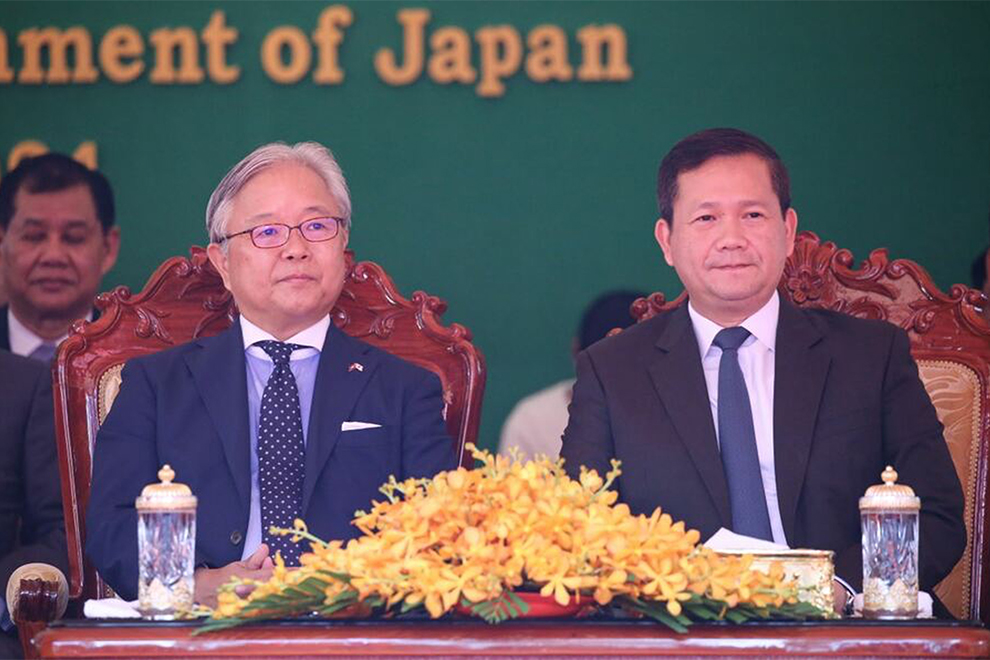 [Japanese ambassador to Cambodia Ueno Atsushi (left) attends a function with Prime Minister Hun Manet. Supplied]
-Opinion-
The long-standing friendship between Cambodia and Japan serves as a shining example of how nations can work together with their global allies, as Cambodia works to achieve high-income nation status by 2050.
The two nations are celebrating the 72nd anniversary of the 1953 establishment of diplomatic relations, while strengthening the Comprehensive Strategic Partnership which they upgraded to in 2023. The alliance between the two nations focuses on human resource exchange and policy development, which aims to drive Cambodia’s sustainable growth through innovative governance practices.
The partnership serves as a mutually beneficial path which aided Cambodian youth development during the 1990s post-conflict period, when Japan supported the United Nations Transitional Authority in Cambodia (UNTAC), while improving public administration and creating policy frameworks for regional stability.
The foundation of Cambodia-Japan relations emerged as Japan delivered the second-largest, after the US, donation of $200 million to UNTAC operations.
Since 1990, Japan has provided more than $2.5 billion in Official Development Assistance (ODA) which focused on building infrastructure and developing health systems and agriculture and training human resources.
The aid programme has shifted from reconstruction to strategic empowerment through investments in “soft infrastructure” which includes skills development and institutional transformation. Japan dedicated $103 million through grants and loans during 2024 for human resource development initiatives.
These investments demonstrate Japan’s “co-creation” approach which transforms aid programmes from traditional donor-recipient relations into collaborative projects that establish sustainable self-sufficiency. The partnership between Cambodia and Japan centres on human resource development because it helps the Kingdom build the educated workforce it needs for industrial growth and digital transformation.
Japan has proven itself as a leading authority in vocational training and higher education, which makes it essential for this initiative. The Cambodia-Japan Cooperation Center (CJCC) operates as a prime example of this dedication. It has functioned as a part of the Royal University of Phnom Penh (RUPP) since 2004. The CJCC has trained more than 1000 students during the past twenty years through programmes which teach business skills and Japanese language, as well as cultural exchange activities which developed bilingual professionals for Japanese businesses in Cambodia.
The Job Fair 2025 event on August 22-23 brought together 45 exhibitors with 16 Japanese companies. It attracted more than 1000 job applicants, who found positions in the manufacturing, IT and service sectors. The event created new job opportunities while demonstrating Japan’s support for business development through programmes that connect Cambodian SMEs and startups with Japanese investment opportunities.
The Project for Human Resource Development Scholarship (JDS) serves as Japan’s main HR support programme through its grant aid, and has sent more than 1100 Cambodian officials and students to Japanese universities since its beginning.
The July 2025 Japanese funding commitment reached 442 million yen (equivalent to $2.9 million) to support 24 young administrative officials for master’s and doctoral studies at leading Japanese universities.
The scholars who participate in these programmes acquire the skills they need to handle Cambodia’s governance needs, climate resilience and digital economy development, which directly supports phase one of the Pentagonal Strategy under Prime Minister Hun Manet.
The Japan International Cooperation Agency (JICA) supports technical vocational education through a 2024 project to enhance teacher education colleges which improves basic education standards and creates a more educated workforce.
JICA operates specialised training programmes through the Cambodia to decrease import reliance while building domestic manufacturing capabilities.
People-to-people exchange programmes create additional benefits, like the Japan Digital Manufacturing Center (CJDM) which trains workers to produce metallic components using digital technology that go beyond scholarship programmes. The Ship for Southeast Asian and Japanese Youth Program and Japan-East Asia Network of Exchange for Students and Youth have combined to provide technical internship opportunities to more than 5,700 Cambodian participants who develop both cultural understanding and useful competencies.
The February 2025 Japan-Cambodia Kizuna Festival, organised by the CJCC, attracted numerous participants who experienced cultural immersion through taiko drum performances combined with Apsara dance to develop grassroots connections.
The policy exchange process creates human connections which extend beyond official boardroom meetings to establish trust-based relationships that drive innovation.
The partnership’s intellectual boundary exists in policy exchange because Japan shares its governance systems with mutual understanding through direct person-to-person exchanges because they see policy dialogues as essential drivers for bilateral expansion.
The 13th Japan-Cambodia Human Rights Dialogue from August 2025 demonstrated policy coordination through discussions about democratic progress and worker rights protection.
Japan’s efforts to integrate Cambodia into the WTO system helped the country expand its export markets while bilateral trade volume reached $1.35 billion in 2016, and continues to grow through the Cambodia-Japan Special Economic Zone.
The Mekong-Japan SDG Collaboration from 2018 and ASEAN Connectivity Master Plan 2025 work together to include Cambodian goals within regional frameworks which support climate-resistant farming and disaster preparedness.
The upcoming years require more intense integration between the two nations. The expansion of JDS scholarships to 50 students per year would speed up policy development and virtual policy labs using Japanese AI technology could perform real-time reform simulations. The 2024 Ukraine support discussions between Cambodia and Japan should include demining expertise sharing for third-country aid programmes.
The partnership provides Cambodia with strategic flexibility because Japan provides development assistance based on quality standards which enables Phnom Penh to function as a model for creating an inclusive economic growth strategy. The programme converts obstacles into possibilities while developing young people.
The human resource development and policy exchange between Cambodia and Japan serves as into future leaders and turning discussions into paths toward success. Ambassador Ueno Atsushi recently stated that “Our bonds exist beyond strategic value because they feel like family ties”. The alliance development enables Cambodia to establish a resilient future through the combination of skilled workers and collaborative ideas that strengthen the nation. The path toward universal prosperity advances through continuous partnership between nations.
Dr. Seun Sam is a policy analyst of the Royal Academy of Cambodia. The views and opinions expressed are his own.
-The Phnom Penh Post-