Thailand’s border dispute with Cambodia has become a theatre of suspicion
 Thailand’s border dispute with Cambodia has become a theatre of suspicion
-Opinion-
Thailand’s categorical refusal to accept third-party mediation in its border dispute with Cambodia has hardened from a diplomatic posture into a lens through which every regional development is viewed as threat. Recent events underscore the fragility of this posture: a New York Times report suggesting Chinese arms transfers to Cambodia, Prime Minister Anutin Charnvirakul’s public rebuff of US President Donald Trump’s mediation pitch, and the remarks of China’s Ambassador in Phnom Penh proclaiming Beijing’s backing for Cambodia’s “sovereign defence.” Together, they feed Bangkok’s narrative that every move involving Cambodia, be it economic, military, or diplomatic, is part of a broader containment campaign orchestrated by major powers.
Arms, accusations, and the border flashpoint
In October, the New York Times revealed that Chinese military transport aircraft delivered artillery shells, rockets, and mortars to Cambodia earlier this year; supplies later moved to the contested border before the July skirmishes. Thai officials quickly seized on the report, portraying it as proof that Beijing was complicit in Cambodia’s provocations.
China’s Embassy in Bangkok denied the allegations, insisting that “no weapons” had been transferred for combat use and attributing Cambodia’s arsenal to older cooperation. But politically, the damage was done. In Thailand, every Cambodian deal with Beijing whether ports, highways, or arms is increasingly framed as a deliberate encirclement strategy.
The ambassador’s words, Bangkok’s backlash
Tensions escalated when Chinese Ambassador to Cambodia Wang Wenbin declared that Beijing would “support Cambodia in protecting its sovereignty and territorial integrity.” Cambodian state media amplified the remarks, while Thai commentators condemned them as open interference in a live border dispute. For Bangkok, the statement was not neutrality but proof that China is actively backing Phnom Penh’s frontier posture. The fallout underscored how diplomacy, once framed in the language of partnership, is now interpreted through suspicion.
Trump’s proposal, Anutin’s snub, and the ASEAN moment
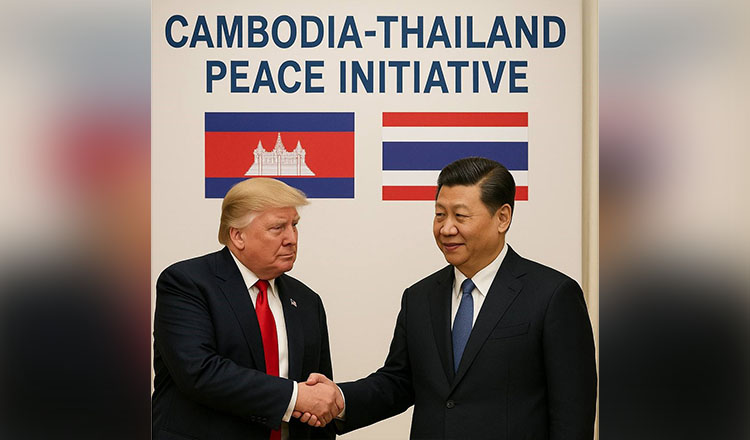
Adding to the tension is the clash over Trump’s proposed peace initiative. As the ASEAN Summit in Kuala Lumpur approaches, Trump has floated the idea of overseeing a symbolic Thailand-Cambodia “peace deal”. US media reported that Trump’s attendance at the summit could hinge on the event, with Washington even requesting Chinese exclusion from the ceremony.
Charnvirakul brushed off the overture. He declared that Cambodia must first meet Thai demands, withdraw heavy weapons, remove landmines, and end settlement in Thai territory, before any peace ceremony could be considered. He added that “just a phone call” would suffice if Phnom Penh were serious. In doing so, Anutin reinforced the Thai narrative that mediation is unwelcome unless fully on Bangkok’s terms.
Rejection turns to suspicion
Thailand’s rejection of third-party engagement has gradually transformed into a worldview of suspicion. The country’s instinct to keep disputes strictly bilateral was meant to preserve control, but in practice it has bred mistrust of every foreign move in Cambodia. What might otherwise be seen as routine diplomacy, infrastructure investment, or development assistance is recast in Bangkok as part of a geopolitical strategy to contain Thailand.
China, once viewed primarily as a vital economic partner, now appears in Thai discourse as both benefactor and threat. Every major Chinese project in Cambodia from highways to special economic zones carries the suspicion of strategic encirclement. The Chinese Ambassador’s explicit endorsement of Cambodia’s sovereignty only deepened this perception, convincing Thai elites that Beijing’s engagement is not neutral, but openly partisan in Cambodia’s favour. Even Chinese denials of arms transfers could not erase the impression that Cambodia’s military modernisation is directly tied to Beijing’s support.
The United States, too, has become entangled in this suspicion. Although Washington maintains a decades-old alliance with Bangkok, its engagement with Phnom Penh whether through governance aid, security cooperation, or trade initiatives, is increasingly interpreted as a deliberate counterbalance against Thailand. Trump’s mediation offer at the ASEAN Summit, particularly when coupled with reported US requests to exclude China, only confirmed in Bangkok’s eyes that outside actors seek to instrumentalise Cambodia as a tool in a broader contest of influence. What could have been a symbolic gesture of peace was instead dismissed as political theatre, underscoring Thailand’s distrust of any foreign role in its disputes.
Even ASEAN, the regional organisation designed to promote dialogue and consensus, has become a casualty of Thailand’s suspicion. Despite the Treaty of Amity and Cooperation enshrining principles of peaceful settlement, Bangkok consistently sidelines ASEAN mechanisms, dismissing them as biased or ineffectual. The rejection is not just procedural but symbolic: it signals that Thailand no longer trusts even the institutions it helped build, for fear that neighbors might tilt toward Cambodia or use regional solidarity to pressure Bangkok.
In this environment, rejection does not merely keep third parties out; it transforms every external engagement into a potential threat. Thailand’s determination to protect sovereignty has thus produced a siege mentality in which every action from China’s trade to U.S. diplomacy to ASEAN consultations is interpreted as containment. The outcome is paradoxical. By refusing to accept neutral mediation, Thailand multiplies the very suspicions it seeksto avoid, narrowing its strategic room for manoeuvre and isolating itself within its own region.
What China and the US should do
Beijing and Washington should no longer indulge Thailand’s blanket veto on third-party involvement. By continually bending to Bangkok’s sensitivities, they reinforce a siege mentality that weakens ASEAN and destabilises the region. Instead, both powers must press Thailand to accept neutral engagement as essential to peace, not optional diplomacy.
For China, ambiguity will not suffice. The Chinese Ambassador’s recent pledge to back Cambodia’s sovereignty has already inflamed Thai fears of bias. To counter this, Beijing must demonstrate that its cooperation comes with transparency through joint monitoring, verifiable oversight, and clear boundaries between economic support and military posturing.
For the United States, symbolism should give way to structure. Washington should avoid headline-driven “peace ceremonies” and instead tie deeper cooperation to Thailand’s willingness to use ASEAN or international mechanisms. Conditioning aspects of the alliance, whether security exercises like Cobra Gold or economic support on Bangkok’s respect for neutral facilitation, would send a clear message that isolationist vetoes have a cost.
Together, China and the U.S. must converge on the same expectation that Thailand must respect structured third-party engagement. Only then can Bangkok shed its siege mentality and return to a diplomacy rooted in process rather than paranoia.
Sovereignty needs structure, not suspension
Thailand’s refusal of third-party involvement was meant to shield sovereignty, but in practice it fuels suspicion. The New York Times report on Chinese arms, Anutin’s rejection of Trump’s offer, and the Chinese Ambassador’s public vow of support for Cambodia’s sovereignty all validate Bangkok’s siege mindset. As a result, every foreign initiative in Cambodia is seen as encroachment rather than cooperation.
This posture weakens Thailand’s leverage, isolates it in ASEAN, and leaves border communities in limbo. By contrast, rules-based mechanisms and selective third-party engagement would stabilise relations, anchor expectations, and give Thailand the credibility it seeks.
Sovereignty is not preserved by suspicion alone. For Thailand, true sovereignty lies in shaping rules that prevent encirclement, build predictability, and secure peace. Without that shift, every project in Cambodia will continue to look like a wall closing in.
Seng Vanly is a Phnom Penh-based geopolitical analyst. Thong Mengdavid, is a geopolitical and international security analyst. The views expressed here are their own.
-Khmer Times-