Thailand’s game of hide and seek: What does it want and fear?
 Thailand’s game of hide and seek: What does it want and fear?
-Editorial-
It is extremely difficult for international observers to understand what Thailand really wants. Its Ministry of Foreign Affairs is a weak sheep among a powerful, unelected military that thrives and aggrandises itself through ultra-nationalism and territorial expansionism to the level that there is no institutional guardrail to prevent this phenomenon from going off track. Politicians have become servants of the military, or else they would lose their seats, and the attempted annulment of international law was treated lightly as if there is no one in Thailand who understands international law.
Now the question is: what does Thailand want? What does Thailand fear?
What does Thailand want?
1. A Cold War between the US and China
Thailand wants to push for a Cold War between the US and China, to have America by its side so that it can justify its asymmetric attack against Cambodia. Thailand is feeding news that are music to the ears for anti-China American institutions, like the New York Times and Wall Street Journal, who have propagated China’s military base theory in Cambodia.
Thailand wants to turn Cambodia into a Cold War proxy platform, once again, and a testing ground for weapons made in the US and China.
History shows that Thailand benefited lucratively from US presence during the Vietnam war, serving as a strategic base. Thailand was designated a major non-NATO ally (MNNA).
According to a research article entitled “The Vietnam War and Tourism in Bangkok’s Development, 1960-70”, the Vietnam War had a major stimulating effect on the Thai economy through direct aid, the construction of American bases and related infrastructure such as highways, spending by American servicemen on leave, and by a boost to Thai exports of various products to war-torn countries in Asia.
A number of major air bases were constructed beginning in 1961. Five were in the northeast in Korat, Udon Thani, Nakhon Phanom, Ubon Ratchathani and Khon Kaen. The sixth, usually referred to as Utapao, was the B-52 air base at Sathahip in Chon Buri province, and the seventh was in Nakhon Sawan in the central region. The inflow of US military spending in the period 1965-72 was equivalent to 4% of GNP or around 26% of the total value of exports. In the period 1965-69, when the war escalated, the US significantly raised spending in Thailand from 438.4 million baht in 1964 to 4,445.7 million baht, more than 10 times.
Thailand’s war benefits were derived at the expense of the millions of Cambodian people’s right to live in peace and self-determination of millions of Cambodian people.
No words can describe the tragedy of war in Cambodia, Laos and Vietnam.
The scars of war remain highly visible in Cambodia, which continue to be contaminated by landmines and unexploded explosive ordnance (UXO).
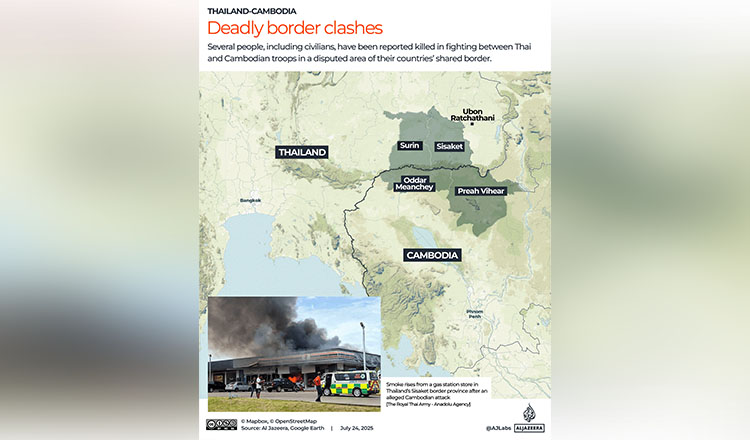
Thailand, through the five-day war with Cambodia in July, has increased the volume of dangerous UXOs and chemical substances in Cambodia, specifically through its use of internationally condemned cluster munitions and white phosphorus, making several Cambodian villages inhabitable.
2. A new hot war between Cambodia and Thailand
Thailand continues to provoke Cambodia, and has publicly intimidated Cambodia by flexing its military muscle, not just in the original fighting zones but also civilian areas and provinces along the border.
Thailand wants Cambodia to lose patience and fight another hot war after the intense five-day war in late July.
Thailand has unchallengeable media power as most of the foreign correspondents are based in Bangkok. It has used this advantage to call itself a victim, accusing Cambodia of being dishonest, and that Thailand only wants peace. That is the language towards the international community.
But towards Cambodia, it has evicted Cambodian villagers from their homes, destroying their livelihoods, abducted Cambodian soldiers and conducted constant harassments through every possible means to disrupt the lives of civilians along the border.
The Thai military said its new regional commanders would cause Cambodia to “tremble in fear” while the army is enlarging its accessible budget to enhance border security.
The Thai army is observed to be well equipped and well prepared. On September 17, Samsul Rizal Musa, the Malaysian head of the ASEAN Interim Observer Team (IOT) to Thailand, noted in front of the media that the soldiers of the Thai armed forces are of a very high standard, and that they should not worry that “anyone is coming.” He added, “Whatever situation happens right here, must be contained here. We will wait until the JBC meeting and wait until the next decision, okay? Keep calm and everything will be okay, no problem. Believe us and believe in God!”
On a daily basis, when the IOT is not on the field, news of harassment by Thai army, police and provincial authorities are published on Cambodia’s media and social media. When the IOT is on the field, Thai army and police become well-behaved. Despite all that, Thailand is accusing Cambodia of breaching the ceasefire while it is dragging its feet with regard to the establishment of the ASEAN Observer Team (AOT), which provides for a longer-term station duty unlike the IOT, which is only there for short visits.
What does Thailand fear?
1. International law
Thailand keeps accusing Cambodia of encroaching on its territory. It wants to annul the MoU 2000 that Thailand itself registered at the United Nations on May 25, 2011.
MoU 2000, for those who care to read it, is a six-page concise document. It is a plainly technical document that provides the minimum standard principles that any government would accept for the border survey and demarcation works.
In fact, on-the-ground observations have clearly demonstrated that some areas within Cambodian territory are occupied by Thai nationals. This situation underscores the complexity and sensitivity of resolving border issues.
If such minimum requirements of international law cannot be fulfilled, it is doubtful that the two countries will ever find other mechanisms to settle complex border issues.
It is a false accusation that the MOU was made in concession to commercial interests or personal relations with Cambodia.
Four Thai administrations between 2000 and 2011, namely those of Chuan Leekpai, Thaksin Shinawatra, Surayud Chulanont, and Abhisit Vejjajiva, recognised the legality and authority of the MOU. It was the administration of then Prime Minister Abhisit Vejjajiva, the very government that oversaw two major border conflicts with Cambodia in 2008 and 2011, which registered the MoU at the UN on May 25, 2011.
Thailand fears international law because it understands that it is the one violating international law and that it has no legal basis to justify its actions against Cambodia.
2. Breakaway from the US
Bangkok is concerned that the US is distancing itself from Thailand.
When Thailand accuses Cambodia of receiving arms support from China, it is actually trying to hide the fact that its arms procurement from China is now exceeding that from the US, which is an uncomfortable truth for an ally of the US.
Furthermore, Thailand is not even trying to pretend anymore that unelected military officers have the final say on government affairs, and that the civilian government needs to do everything to please the military if it wishes to maintain its position.
An editorial in The Jakarta Post described Thailand as having undemocratic or pseudo-democratic regimes backed by the military’s ability to maintain a tight grip on power since 1932, and that Thailand’s military-backed system is a bad example for the region.
The Jakarta Post raised the alarm over “the fact that the military has been able to seize power repeatedly without facing strong repercussions from its neighbours sends the wrong message that such actions may be tacitly tolerated in the region.”
Since Thailand’s establishment in 1932, the military has launched 12 successful and at least nine failed coups.
The Jakarta Post added, “Despite being a founding member of ASEAN, Thailand often distances itself from the regional bloc’s policies, maintaining a significant economic and military influence on its neighbors, particularly those with whom it shares a border. Apart from direct coups, the Thai military has a more sophisticated and less costly tool at its disposal: The Constitutional Court.
Established in 1997 during the Asian financial crisis, the court has since dissolved 111 political parties, many of which were pro-democracy, including parties linked to former prime minister Thaksin Shinawatra.”
As a major non-NATO ally in mainland Southeast Asia, Thailand fears that the US would gradually moderate its trust towards Thailand owing to the facts that the Kingdom is gradually relying on China’s arm supply, and is behaving in a way that is far too contradictory with the values that the US is trying to promote in the region and the world at large.
-Khmer Times-