Thailand’s Expansionist Illusions and Fabricated Victimhood
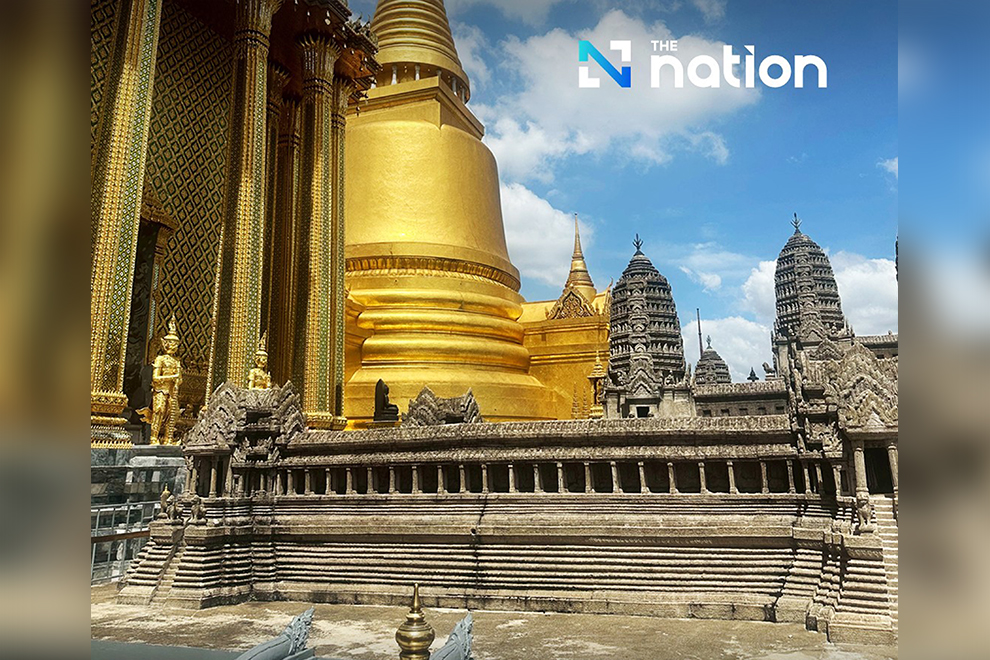 This replica of Cambodia’s iconic Angkor Wat, in Bangkok’s Grand Palace, is a symbol of Thailand’s yearning for Cambodia’s cultural treasures. ANN/The Nation
-Opinion-
Thailand has persistently sought to portray itself as the victim in a war of invasion — a war it initiated and has continually escalated against Cambodia.
Recent remarks by Thai Prime Minister Anutin, who outlined four conditions for peace — the complete withdrawal of all military personnel and weapons from disputed zones, the removal of all intruders from Thai sovereign territory, the clearance of hazardous materials that could endanger civilians and reaffirmation of respect for Thailand’s sovereignty, as reported by the Bangkok Post yesterday — are nothing short of baseless political theatre.
These demands reflect not a genuine pursuit of peace but a continuation of Thailand’s historical pattern of expansionism and distortion.
During its military incursions, Thailand employed heavy weaponry, including F-16 and Gripen fighter jets, long-range artillery, quadcopters, cluster munitions, white phosphorus and toxic gas. These attacks indiscriminately targeted the World Heritage-listed Preah Vihear Temple, civilian communities, schools, health centres and Buddhist pagodas.
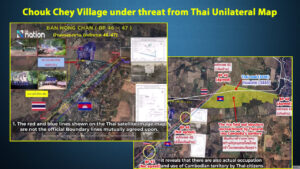
In other acts of intimidation, Thai forces have used razor wire and car tyres to encircle Cambodian homes and farmland — territories where Cambodians have lived peacefully and with dignity for generations.
Even more disturbingly, extremist elements in Thailand have resorted to grotesque and inhumane acts, such as collecting human waste for use against Cambodian civilians defending their ancestral lands and homes. These are not acts of defence — they are acts of humiliation intended to dehumanise and intimidate.
For decades, Cambodia has demonstrated restraint and a consistent commitment to peaceful conflict resolution. It has welcomed all available mechanisms — bilateral dialogue, regional diplomacy under ASEAN and international adjudication through the International Court of Justice (ICJ). Cambodia’s guiding principle has always been clear: choosing peace over war, and the rule of law over the law of the jungle.
If Thailand genuinely believes its territorial claims are legitimate, it should submit the matter to the ICJ — the world’s most credible, impartial and rules-based institution for peaceful dispute settlement.
Cambodia and Thailand have twice brought related cases before the ICJ: first in 1959, leading to the 1962 judgment, and again in 2011, resulting in the 2013 decision. In both cases, the Court ruled in favour of Cambodia, affirming its sovereignty over the Preah Vihear Temple and surrounding areas. Yet Thailand continues to disregard these internationally binding rulings and perpetuate false narratives of victimhood.
Prime Minister Anutin’s so-called “peace conditions” are therefore disingenuous.
Demanding that Cambodia withdraw from its own territory and evict villagers who have lived there for centuries constitutes a violation of international law and fundamental human rights. These are ultimatums masquerading as peace proposals.
Thailand’s expansionist ambition is not new, it’s deeply rooted. As The Nation reported in June this year, during the reign of King Rama IV, Thailand even contemplated dismantling Angkor Wat and reassembling it in Bangkok. When this imperial fantasy failed, a replica of Angkor Wat was built within the Grand Palace as a symbol of supposed Thai dominance over Khmer civilisation. This act of cultural mimicry — appropriating Khmer heritage while denying its origin — reveals a persistent psychology of domination.
Throughout modern history, Thailand has sought to claim Khmer temples, architecture and artefacts as its own. Numerous reports and scholarly studies have documented Thai involvement in the looting and trafficking of Khmer antiquities, especially during periods of Cambodian instability. This pattern of seizing both territory and heritage underscores how Thailand’s ambitions extend far beyond the battlefield — they are embedded in a long-term project of cultural and historical revisionism.
By contrast, Cambodia’s position remains grounded in legality, restraint and diplomacy. Phnom Penh has never acted as an aggressor; it has merely exercised its sovereign right to defend its people and territorial integrity. Its repeated calls for mutual respect and dialogue have too often been met with military threats and political arrogance from Bangkok.
If Thailand truly desires peace, it must abandon its fabricated rhetoric of victimhood and its lingering expansionist nostalgia. Genuine peace cannot be imposed through ultimatums or historical distortion — it must rest on mutual respect, truth and international law. Cambodia will never compromise its sovereignty or the dignity of its people under pressure or deceit.
Prime Minister Anutin’s baseless conditions expose the persistence of Thailand’s expansionist mindset — an outdated imperial ambition cloaked in diplomatic language.
Until Bangkok confronts its own history and abides by international law, its claims of victimhood will remain hollow, and its calls for peace will ring false. Cambodia will continue to stand firm, upholding peace, justice and sovereignty over submission to aggression and distortion.
Kin Phea is director-general of the International Relations Institute of Cambodia, Royal Academy of Cambodia. The views and opinions expressed are his own.
-The Phnom Penh Post-