UN Forum urges youth empowerment to sustain peace
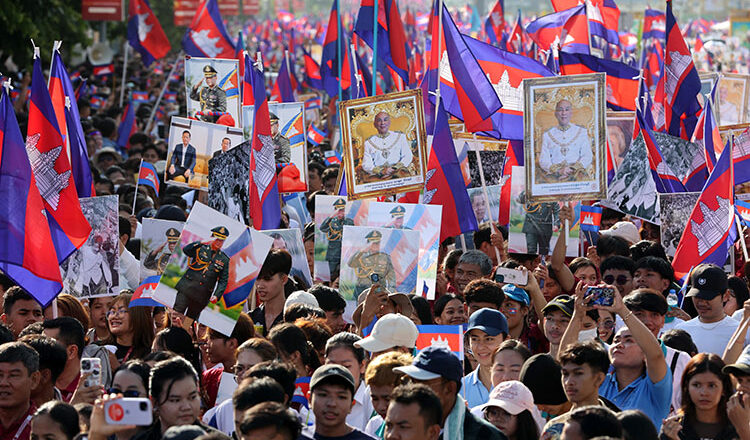 Union of Youth Federations of Cambodia members march with citizens from all walks of life to express support for the Cambodian army at the border, in Phnom Penh on June 18. KT/Khem Sovannara
Synopsis: At a UN forum, Cambodia highlights youth empowerment as a cornerstone for sustaining peace, emphasising education, leadership, and active engagement in national and global peace-building efforts.
Cambodia highlighted the vital role of youth in fostering a culture of peace at a high-level forum on “Programme of Action on a Culture of Peace” at the United Nations headquarters in New York on Tuesday.
The forum, convened under the theme “Empowering Youth for a Culture of Peace,” brought together international leaders and experts to discuss pathways for sustainable peace through youth engagement.
Ambassador and Permanent Representative of Cambodia to the UN, Keo Chhea, noted that the theme reflects both global aspirations and Cambodia’s enduring commitment to peace.
“Cambodia’s heart wants peace. For us, peace is not merely a goal; it is the foundation of our national rebirth,” said Chhea.
He highlighted that the Kingdom, emerging from decades of conflict, has maintained nearly three decades of uninterrupted peace through win-win policies, emphasising that peace, though hard to achieve, is fragile and must be safeguarded by every generation.
The Ambassador outlined three key pillars from Cambodia’s perspective. First, the intrinsic value of peace in national development; second, a steadfast commitment to international law and the principles of the UN Charter, promoting diplomacy, dialogue, and peaceful dispute resolution as the only sustainable path; and third, the pivotal role of the nation’s youth in preserving peace.
“Young Cambodians, who have grown up free from war, cherish peace as their most precious inheritance,” he said. “Their voice, aspirations, and innovations are shaping Cambodia’s future, with a shared desire to live, study, and prosper in harmony.”
Guided by the Pentagonal Strategy-Phase I, the Cambodian government views the youth—over 60% of the 17 million population are under the age of 30—as essential agents of change in national building and reconciliation, the Cambodian representative added.
“The government is committed to empowering them as emerging leaders through opportunities in peace, education, vocational training, digital literacy, and entrepreneurship to safeguard peace, promote security, and advance sustainable development,” he said.
Chhea also reaffirmed Cambodia’s support for the Programme of Action on the Culture of Peace, describing it as a “vital compass” for global efforts.
“By investing in our youths, we are not merely building a culture of peace for today,” he said. “We are ensuring its endurance for generations to come.”
In the same session, Philemon Yang, President of the General Assembly for its 79th session, said that youth empowerment is one of the most effective ways to ensure that a culture of peace takes root in every society and endures across generations. However, this works only when the current leaders are willing to listen to young people’s voices and work with them to create future opportunities.
He also added youth-led organisations and movements are underscoring the vital role in peace, tolerance, and dialogue.
“It is demonstrating that young people not only imagine a better world, but they also dedicate themselves to building it. Yet, in spite of the clear opportunities, in many places such as Gaza, Haiti, Sudan, and Ukraine, conflict and crises continue to obstruct their efforts and undermine their potential,” Yang explained.
“Too many lack access to quality education. Too many are marginalised by social norms. Too many are excluded from political decision-making.”
These realities, he added, should urge leaders to take action by equipping young people with the knowledge, resources, and opportunities they need to participate fully in peace-building and conflict prevention.
“When young people learn the values of tolerance, empathy, and conflict resolution early in life, they carry those values into adulthood,” Yang said.
“This creates future generations with the skills to sustain peace. Education systems must integrate the values of peace, and governments must reflect on and support the transformative role that young people can play in creating a more harmonious societies.”
Amid the ongoing border tension between Cambodia and Thailand, Cambodian young people have displayed active roles in initiatives to push for peace. For example, back in June, the “Solidarity March”, led by the Union of Youth Federations of Cambodia (UYFC), saw over 150,000 Cambodians march in Phnom Penh in a show of unity and call for peace between the two neighbours.
UYFC has also been active in gathering and delivering humanitarian support to displaced families who had to leave their homes at the border following five days of deadly clashes between the Cambodian and Thai armed forces, as well as migrant workers who were forced to leave Thailand over fears for their safety amid the fighting.
Meanwhile, Cambodia’s national policy on youth development is encapsulated in the National Policy on Cambodia Youth Development, approved by the Council of Ministers on June 24, 2011.
The policy underscores the importance of youth as a vital resource for the nation’s economic, social, cultural, and environmental development, as well as for maintaining peace.
However, the ongoing border dispute is estimated to have significant impacts on Cambodia’s youth development. According to UNICEF, over 600 schools have closed, and many have been repurposed as temporary shelters for displaced families, leaving numerous children without access to learning due to the distance from functioning schools. This disruption affects over 150,000 students and 6,000 teachers, with a disproportionate impact on children in remote or rural areas.
-Khmer Times-