Without Observers, the Trump-Brokered Ceasefire Is an Empty Promise
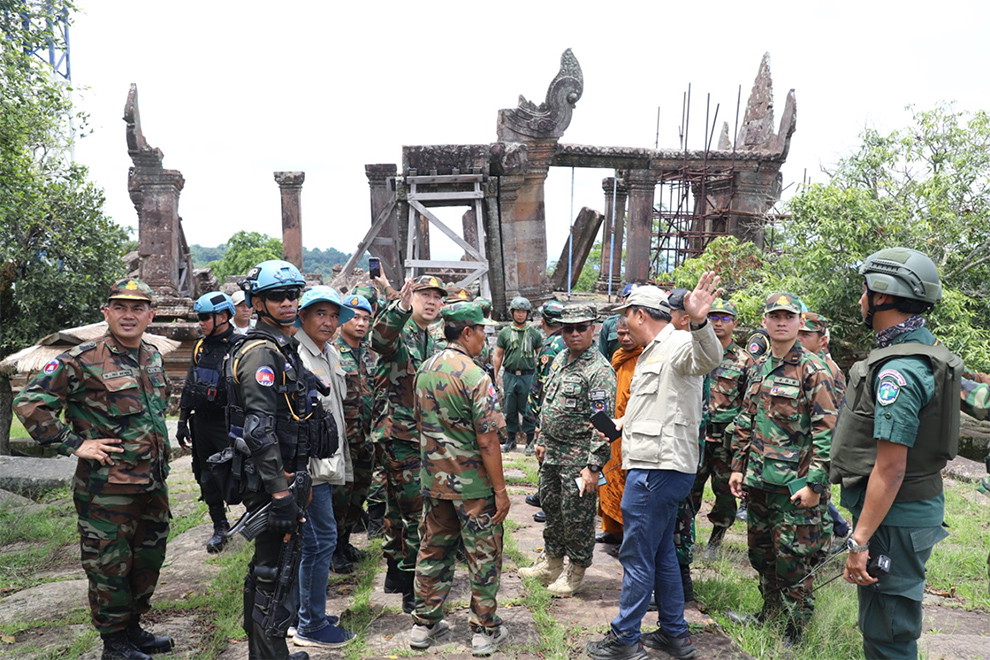 The Interim Observer Team (IOT) visit Preah Vihear Temple on August 20. AKP
– Opinion –
On the scarred hills near Preah Vihear Temple, villagers live each day with the uncertainty of renewed shelling. Their hopes for peace rest on the fragile ceasefire agreed between Cambodia and Thailand — a ceasefire made possible through the bold mediation of US President Donald Trump, with Malaysia as ASEAN chair providing crucial facilitation and active participation from China. That agreement, announced at the special meeting in Putrajaya on July 28 and reinforced at the Extraordinary General Border Committee meeting in Kuala Lumpur on August 7, was a turning point. For the first time in months of escalating violence, the guns fell silent because diplomacy prevailed.
Yet peace without transparency is an illusion. Monitoring is the backbone of any ceasefire, ensuring promises are not betrayed in the shadows. This is why Malaysian Prime Minister Anwar Ibrahim proposed an expansion of the ASEAN Observer Team (AOT) and the Interim Observer Team (IOT): to make sure commitments are not just words on paper, but actions on the ground.
Earlier, on August 19, Cambodian Prime Minister Hun Manet had a call with Prime Minister Anwar to review the progress of the ceasefire’s implementation. They agreed that the swift establishments of the AOT and effective operations of the IOT are indispensable. Both mechanisms are vital for ASEAN’s credibility, for deterring violations and above all, for protecting civilians.
Cambodia welcomes Malaysia’s proposal wholeheartedly. Cambodia has nothing to hide. Cambodia’s position is clear: impartial observers strengthen trust, reduce the risk of misunderstanding and protect lives. By contrast, acting Thai Prime Minister Phumtham Wechayachai’s outright rejection of additional observers is deeply troubling. And it raises the obvious question: why would Thailand reject Malaysia’s request?
Why, if Thailand is committed to peace, would it object to more ASEAN observers whose sole mission is to verify the ceasefire? Why, if Bangkok values ASEAN solidarity, would it undermine it chair, Malaysia, at this critical moment? Why, if Thailand claims the conflict is only “bilateral”, does it resist ASEAN’s collective mechanisms that were created precisely to safeguard regional peace? These are questions that Phumtham has yet to answer.
Let us remember: during the Kuala Lumpur GBC talks, observers from Malaysia, the US and China contributed positively to progress. Their presence reassured both sides and ensured accountability. Why, then, would Phumtham now resist more impartial oversight? The only reasonable conclusion is that his government prefers fewer eyes on its actions, at the expense of regional confidence.
Thailand’s refusal also undermines President Trump’s initiative. The Trump-brokered ceasefire was not meant to be a pause before the next round of violence; it was designed to be the foundation of a durable peace. That foundation rests on loyalty, mutual respect and trust — and trust requires independent monitoring. To weaken the observer system is to weaken the very peace that Trump’s diplomacy, Malaysia’s leadership and Cambodia’s cooperation worked so hard to achieve.
ASEAN must not allow one member’s obstinacy to compromise the region’s collective security. Expanding the observer mission is not foreign interference — it is peace insurance. AOT and IOT are ASEAN’s own mechanisms, born from its own consensus, and designed to uphold ASEAN’s credibility. To deny them strength is to deny ASEAN itself.
The choice before ASEAN is stark. It can either side with exclusion and opacity, or with openness and accountability. Cambodia has chosen the latter. But until Thailand answers the question — why reject Malaysia’s request? — doubts will remain about its loyalty to peace and its respect for ASEAN’s future.
Roth Santepheap is a geopolitical analyst based in Phnom Penh. The views and opinions expressed are his own.