Editorial 99 – A City Is Part of Nature
 Editorial 99 – A City Is Part of Nature
Opening Thought
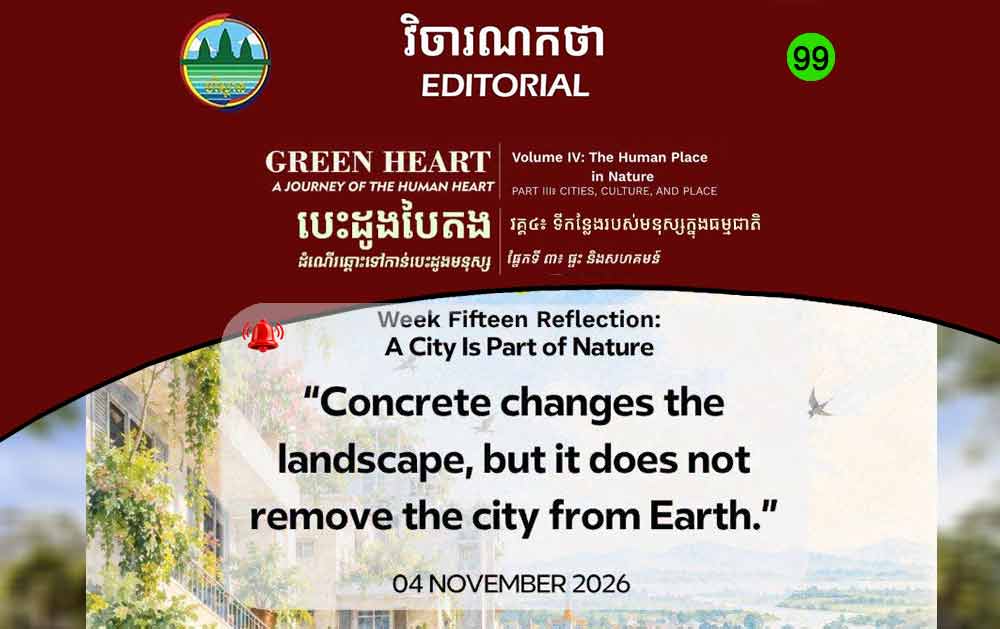
“Concrete changes the landscape, but it does not remove the city from Earth.”
Editorial
Cities may appear to be the opposite of nature. Buildings replace soil, roads cross streams, lights hide stars, and daily life seems far from farms or forests. Yet every city depends on natural systems.
Water arrives from rivers, reservoirs, groundwater, or rain. Food arrives from fields, fisheries, farms, and markets. Materials come from forests, mines, soils, and industries. Energy is generated somewhere. Waste and wastewater leave toward other places.
Cities also contain ecosystems. Trees, parks, rivers, drains, gardens, vacant land, buildings, insects, birds, bats, pets, people, and microorganisms interact. Some species adapt well to urban life; others disappear when habitat and safe movement are lost.
Dense settlements can use land, transport, and infrastructure efficiently when planned well. Poor planning can create heat, pollution, flooding, long travel, inequality, and habitat loss. Density itself is not automatically good or bad.
Urban surfaces change water. Roofs and pavement reduce infiltration and increase runoff. Drainage, permeable surfaces, vegetation, wetlands, ponds, and protected waterways can help manage rain, but they need design and maintenance.
Cities create heat through dark surfaces, limited shade, buildings, vehicles, and energy use. Urban heat can be reduced through trees, cool materials, ventilation, shade, building design, and public-health plans. Each solution must consider water, maintenance, safety, and local climate.
Nature in a city should be accessible. A beautiful park that only wealthy neighborhoods can reach does not provide equal benefit. Green space planning should include vulnerable areas, disabilities, safety, and cultural uses.
Urban conservation must also avoid displacing residents. Environmental improvements can raise property values and push out the people who needed them most. Fair housing and community participation belong within green planning.
A city is a human habitat nested within larger watersheds, airsheds, food systems, and climates. Its boundaries on a map do not contain all its impacts.
To build a green city is not to cover everything with plants. It is to guide flows, protect health, reduce harm, restore relationships, and create dignity.
The city is already part of nature. The question is whether it will become a wise part.
Urban wisdom needs data and lived experience together. Satellite maps may reveal heat, sensors may measure air, and flood models may predict water. Residents reveal where children walk, where drains fail, and which spaces feel unsafe. Planning improves when these forms of knowledge meet.
The resulting plans should be public enough for communities to see how evidence and participation shaped priorities.
Buddhist Reflection
Right view dissolves the false boundary between human and natural places. Mindfulness asks us to see the city’s hidden dependencies and accept responsibility for the landscapes supporting it.
Today’s Reflection
Which natural system supports my town or city from beyond its visible boundaries?
Today’s Action
Draw a city map with arrows showing where water, food, energy, materials, waste, and wildlife move.
Today’s Pledge
Today I will see human settlements within nature and support wiser urban relationships.
When we protect nature, we protect all beings—including ourselves.