Beyond the Threshold: Statecraft, Expertise, and the Evolution of Cambodian Political Mechanics
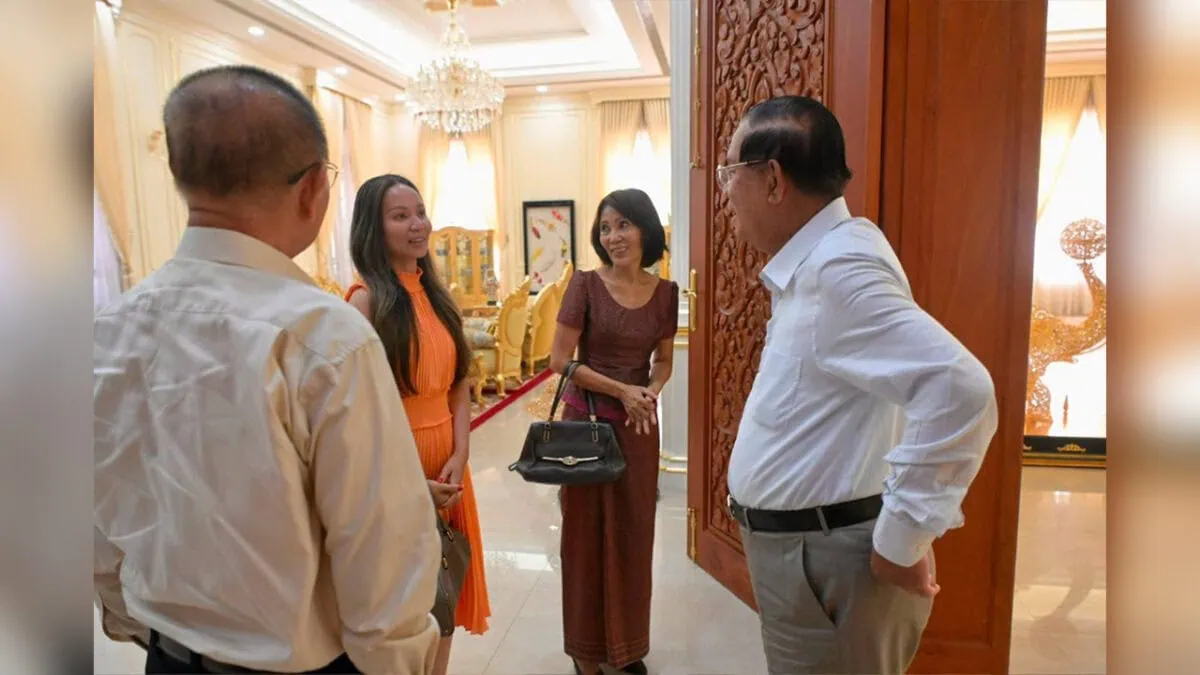 Kem Monovithya, in orange, along with her father Kem Sokha (left) and her mother, met with CPP president Hun Sen, on August 16. SHS
Rather than being universally categorised as a sudden breakthrough in democratic reconciliation or dismissed simply as routine political accommodation, the appointment warrants a rigorous, independent assessment.
Its true significance lies in what it reveals about the changing mechanics of Cambodian statecraft: a pragmatic willingness to deploy expertise, networks and diplomatic capital that cross historical political boundaries when national interests demand broader reach.
1. The Realities of Cross-Cleavage Engagement
For decades, political participation in developing polities has frequently operated on a rigid binary: individuals either hold executive authority or remain permanently outside the institutional framework, engaged in systemic critique.
The Mechanics of Inclusion: Bringing a former high-profile figure associated with the opposition — specifically one who previously commanded international visibility — into the government apparatus challenges this zero-sum model.
State Capacity over Polarisation: This move suggests an evolving administrative calculus. When confronted with complex external challenges, governance increasingly relies on incorporating multi-stakeholder talent and specialised networks rather than maintaining absolute political homogeneity.
2. Navigating Competing Outcries and Dogmatic Opposition
Any high-level political transition inevitably generates polarising reactions from opposing factions. Radical critics from the political fringes have voiced sharp opposition, condemning the appointment through an entrenched, zero-sum lens that rejects any form of institutional collaboration.
The Fallacy of Perpetual Opposition: Such dogmatic outcries often stem from a refusal to evaluate policy on its substantive merits. By opposing engagement out of hand, these factions prioritise perpetual ideological confrontation over practical outcomes, demonstrating an unwillingness to value decisions that genuinely serve the nation’s long-term interests.
Rejecting Rigid Dogma: True state-building requires looking past reflexive opposition. When critics evaluate governance entirely through the prism of absolute exclusion, they overlook how functional participation can directly benefit national development and strategic resilience.
3. The Tension of Political Positioning and Historical Irony
Any serious assessment of this appointment must also acknowledge its inherent friction. Sceptics rightly note that incorporating a prominent opposition-linked figure into the executive branch does not automatically equate to systemic pluralism; it can equally be interpreted as strategic co-optation or tactical diplomatic repositioning.
A Striking Reversal: The appointment carries profound subtext given Monovithya’s past trajectory — having previously engaged international capitals and legislative bodies to advocate for institutional change from the outside.
A Pragmatic Pivot: Her transition to the role of official state envoy underscores a striking shift in political positioning. It illustrates how fluid political boundaries can become when individual actors and state authorities find a convergence of interests in functional execution.
4. Implications for Foreign Policy and International Credibility
In an era of intense regional diplomacy and shifting global alignments, the utility of such an appointment is heavily tied to international communication and strategic outreach.
Addressing External Optics: External partners have long scrutinised Cambodia’s domestic political landscape. By elevating an envoy with deep ties to Western institutional networks, Phnom Penh signals a willingness to engage fluidly across diplomatic divides.
Securing National Interests: Whether managing sensitive bilateral negotiations or projecting a cohesive front on global economic platforms, utilising cross-factional expertise helps insulate foreign policy execution from internal political friction.
Conclusion
Ultimately, Monovithya’s appointment highlights a subtle yet important evolution in how political differences are managed in contemporary Cambodia. By converting former political opposition networks into a mechanism for state capacity and international diplomacy, the move demonstrates that statecraft is increasingly driven by pragmatic utility rather than rigid historical enmities.
Despite the noise of dogmatic outcries from those wedded to perpetual conflict, this new paradigm reframes political responsibility — proving that when national interest supersedes historical division, the ultimate victor is the collective future of the nation itself.
Panhavuth Long is founder and attorney at law at Pan & Associates Lawfirm. The views and opinions expressed are his own.
-Phnom Penh Post-