Barbed Wire Cannot Rewrite Borders: Thailand’s Dangerous Fiction of Self-Defined Sovereignty
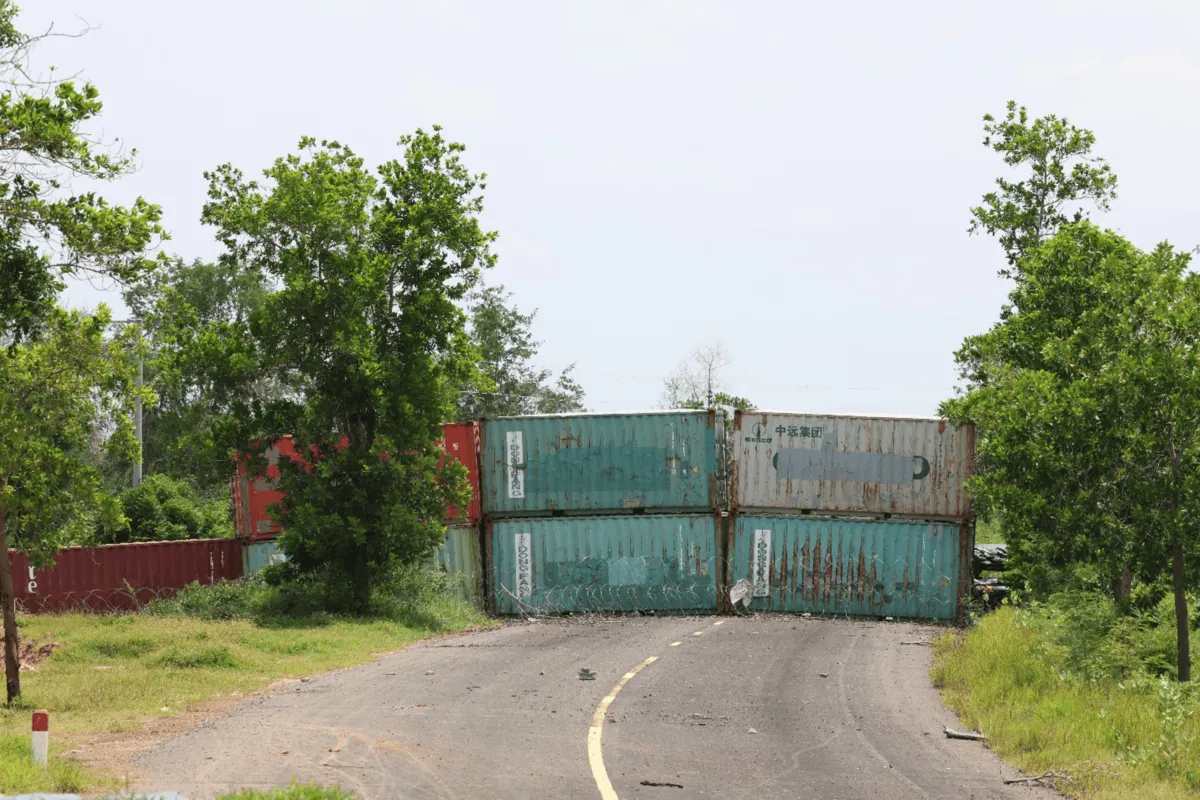 The Thai military has placed shipping containers and razor wire barricades inside Cambodian territory. Supplied
#Opinion
For centuries, borders have been determined by treaties, international agreements and the rule of law — not by whichever army happens to stand on a piece of land with barbed wire and shipping containers. Yet this is precisely the dangerous proposition now advanced by the Royal Thai Army.
In rejecting Cambodia’s accusation that Thailand has illegally occupied Cambodian territory near Banteay Meanchey Province, the Thai military dismisses the allegations as “false information”. It insists that the area under its control has always been Thai sovereign territory, that the deployment of barbed wire and containers merely protects its own land, and that everything it has done falls within the right of self-defence under international law.
The problem is simple. Every occupying power in history has claimed exactly the same thing.
The occupation has never begun with an admission that another state’s territory is being seized. It always begins by declaring that the land already belongs to the occupier. That is why international law does not permit states to become judges of their own territorial claims.
If sovereignty could be established merely by issuing official statements, producing unilateral military maps or placing soldiers on disputed ground, international borders would cease to exist altogether.
Instead, sovereignty is determined through treaties, internationally recognised boundary instruments, judicial decisions and agreements accepted by both states. No government may redefine an international frontier simply because it wishes to.
International law does not recognise self-declared borders
Thailand’s argument ultimately depends upon one extraordinary proposition: That because Thailand considers the area to be Thai territory, every military activity conducted there is automatically lawful.
But international law has never operated this way. If states could legalise military occupation simply by declaring occupied territory to be their own, the prohibition against acquiring territory by force contained in the UN Charter would become meaningless.
Every aggressor would merely publish a new map. Every occupation would instantly become “defence”. Every invasion would disappear through official terminology. That is precisely why international law rejects unilateral cartography.
Maps produced by one country alone possess no legal authority unless supported by treaties and accepted international boundary arrangements. No military survey department has the power to redraw an international border.
Barbed wire is not evidence of sovereignty
Thailand argues that installing barbed-wire fencing and shipping containers does not constitute occupation because these measures were placed within what it calls its operational control.
But operational control is not sovereignty. Military control acquired through force has never created legal title. Otherwise, every military occupation in modern history would automatically become legitimate after sufficient infrastructure had been built. The international community has consistently rejected precisely this doctrine.
Building fences. Installing military posts. Deploying containers. Constructing roads. Establishing permanent military facilities. None of these activities transforms occupied territory into sovereign territory. They merely create facts on the ground. International law has a name for this strategy: fait accompli. Its purpose is obvious — to alter reality first and argue legality later. History shows that international law does not reward such conduct.
Self-defence has clear legal limits
Thailand also invokes the inherent right of self-defence under international law. No one disputes that every state possesses the right of self-defence when an armed attack occurs. But that right is governed by strict legal principles. Self-defence cannot become a permanent legal justification for remaining inside another state’s territory.
Nor does it authorise the construction of military infrastructure designed to consolidate territorial control after hostilities have ceased. The ceasefire reached by both countries was intended to reduce tensions — not to create opportunities for one side to strengthen military positions on contested ground.
Actions that permanently alter the status quo after a ceasefire inevitably raise serious legal questions. If every state could invoke self-defence indefinitely while reinforcing its military footprint inside contested territory, ceasefires would lose their meaning.
The contradiction in Thailand’s position
Perhaps the greatest weakness in Thailand’s argument is its internal contradiction. Thailand repeatedly insists that there is no occupation because the land is Thai. Yet this conclusion depends entirely upon Thailand’s own unilateral interpretation of the boundary.
International disputes cannot be resolved by one party acting as both claimant and judge. That is precisely why mechanisms such as joint boundary commissions, arbitration and international adjudication exist.
Ironically, Thailand’s position would allow any country to claim any neighbouring territory simply by publishing a map reflecting its preferred boundary. Such a principle would destroy the stability upon which the entire international legal order depends.
Sovereignty cannot be manufactured
Cambodia’s position is ultimately straightforward. Borders are determined by international law — not military convenience. No amount of barbed wire changes a treaty. No shipping container alters an international boundary. No unilateral military map replaces internationally recognised legal instruments. No official statement transforms occupation into sovereignty.
International law protects states precisely because it prevents stronger militaries from redefining borders through force. That principle has preserved international stability since the adoption of the UN Charter. It deserves to be defended today. Thailand may continue to insist that the territory it occupies is already Thai. But sovereignty cannot be manufactured through repetition. It must be proven through law.
And until it is, barbed wire and containers remain exactly what they appear to be-not symbols of sovereignty, but physical manifestations of a unilateral attempt to create new facts on the ground that international law was specifically designed to prevent.
Roth Santepheap is described as a Phnom Penh-based geopolitical analyst based. The views and opinions expressed are his own.
-Phnom Penh Post-
______________
The Thai military has placed shipping containers and razor wire barricades inside Cambodian territory. Supplied