Should China, Japan, India and Indonesia create the Asian Regional Core?
 Should China, Japan, India and Indonesia create the Asian Regional Core?
#Opinion
The international order is crumbling
The contemporary international order is undergoing a profound structural rupture. For decades, the Group of Seven (G7) – briefly expanded into the G8 before fracturing along geopolitical fault lines and reverting to its core membership – acted as the undisputed director of global economic governance. However, the club has steadily drifted into an insular ideological echo chamber tailored to Western priorities, leaving it increasingly detached from the material realities and structural shifts of the rest of the world. Operating on an exclusionary, bloc-politics model, its capacity to anticipate, manage or mitigate global systemic shocks has fundamentally decayed, transforming it from a stabilising force into an instrument of localised geopolitical polarisation. Yet, the macro-alternatives engineered to rebalance this lopsided global architecture have proven equally ill-equipped to safeguard regional stability.
The Group of Twenty (G20) is sliding into manifest irrelevance, paralysed by its own profound structural polarisation as rival major powers routinely hijack its massive, unwieldy sessions for geopolitical grandstanding rather than coordinated macroeconomic management. Simultaneously, the recently expanded BRICS bloc has increasingly abandoned its original geoeconomic mandate to take on a reactionary, overtly anti-Western character. Driven by the aggressive geopolitical agendas of external friction points, BRICS risks devolving into an adversarial instrument of global ideological warfare, rendering it far too conflicted and structurally fragmented to foster practical, localised stability where it is most critically required.
On the other end of the strategic spectrum sits the Association of Southeast Asian Nations (ASEAN). While widely celebrated for its diplomatic inclusivity and commitment to dialogue, ASEAN’s soft-spoken power severely limits its structural influence on how the broader Asian regional order is shaped. It profoundly lacks the necessary institutional muscle and enforcement mechanisms to compel compliance from external major power anchors. These foreign anchors often view the Indo-Pacific theatre primarily as an arena for containment strategies, encirclement doctrines and maritime chess games, possessing little to no genuine interest in maintaining long-term regional peace, deep-seated social harmony, or sustainable local development.
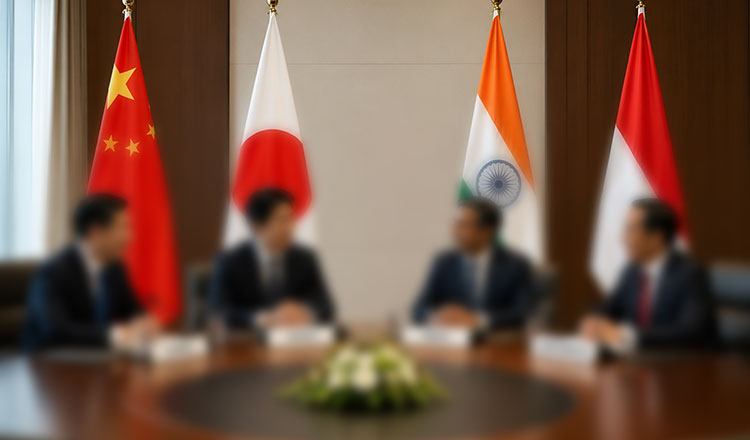
What the contemporary international system requires is neither another fractured global forum nor a soft-spoken dialogue club. Instead, Asia urgently demands a concentrated, hardheaded regional framework that directly matches the actual power Asian nations now hold in the global economic basket – a heavyweight architecture capable of designing, enforcing, and executing a post-hegemonic peace. It is precisely within this strategic vacuum that the continent’s four true pillars must step forward to form the Asian Regional Core, or ARC-4.
Scattered power of Asian giants
To fully comprehend why the institutionalisation of the ARC-4 has transformed from an ambitious concept into an existential necessity, one must examine the staggering structural weight of its constituent nations. Together, China, Japan, India and Indonesia represent nearly half of the entire human population and collectively command the primary, irreplaceable engines of global manufacturing, technological innovation, consumer market growth and maritime logistics.
China stands as the world’s undisputed industrial workshop, a 20-plus trillion-dollar economic titan, and the primary trading partner of over 140 countries. Its unparalleled logistical dominance, industrial supply-chain integration and sweeping infrastructure networks form the indispensable physical spine of contemporary global commerce.
Japan, despite navigating decades of low nominal growth, remains an irreplaceable high-tech powerhouse, the world’s leading creditor nation, and the premier architect of high-quality infrastructure benchmarks and supply-chain resilience standards across the Indo-Pacific maritime space.
Symmetrically, India is currently the world’s most populous nation and fastest-growing major economy, marching steadily towards a four-plus trillion-dollar nominal GDP. It possesses an unmatched demographic dividend, a revolutionary and booming digital public infrastructure, and sits geographically as the absolute master of the Indian Ocean sea lines of communication.
Indonesia acts as both the demographic anchor and the uncontested political heavyweight of Southeast Asia. As a thriving trillion-dollar economy holding the planet’s largest critical nickel reserves, it exercises sovereign control over the world’s most critical strategic maritime chokepoints – the Malacca, Sunda, and Lombok straits—through which the logistical lifeblood of global trade must flow.
Yet, despite holding the definitive keys to the global economy, Asia’s vast strategic power remains profoundly scattered, fragmented and neutralised. This systemic fragmentation is not an organic accident of history; it is a deliberate artifice of design.
Weight of history and artificial fragmentation
The Asian region remains trapped within an archaic, mid-20th-century “hub-and-spoke” security architecture meticulously engineered by Western powers during the dawn of the Cold War. This system was purposefully structured to keep the great Asian titans mutually suspicious of one another and permanently dependent on external arbiters for their own survival. By keeping Asia strategically divided, external powers have successfully blocked the natural emergence of a self-sustaining regional equilibrium, ensuring the continent remains an open, vulnerable grand chessboard for hegemonic design. This artificial division is severely exacerbated by a deep-seated historical trust deficit that leaves Asia highly vulnerable to external manipulation.
Historically, Western dominance over Asia was sustained by a cynical dual narrative of psychological projection and moral hypocrisy, visible in the racialised fears of the “yellow peril” contrasted against the hubristic rhetoric of the mission civilisatrice and the “White Man’s burden.” This created moving goalposts: if an Asian nation was materially weak, it was subjected to unmitigated resource extraction; if it successfully modernised and grew strong, it was instantly branded a global peril that had to be contained.
Today, that paternalistic hierarchy has morphed into the aggressive imposition of a universalist world order that seeks to force complex, ancient nations into binary, zero-sum choices. The trust deficits between the Asian Big Four are actively weaponised by this external hegemonic order to prevent cohesive convergence. China and India remain locked in a tense, militarised border standoff along the Line of Actual Control, which continues to drain precious capital from both nations. China and Japan are frequently paralysed by deep historical grievances and volatile maritime friction in the East China Sea. Simultaneously, Indonesia and the broader Southeast Asian region view the expanding maritime assertiveness of Beijing with intense strategic anxiety, fearing the slow imposition of a neo-tributary system.
Because the four powers are consumed by these localised, bilateral anxieties, they consistently fail to recognise that their ongoing division leaves the entire continent exposed to catastrophic external disruptions. Surrendering strategic autonomy to external minilateral alignments or reactive blocs allows foreign actors to dictate domestic commerce and turn neighbouring waters into volatile platforms for proxy competition.
A post-hegemonic mandate for peace
The primary, defining responsibility of the ARC-4 is to ensure that Asia never again becomes a proxy battleground, a buffer zone or a convenient scapegoat for conflicts ignited in other parts of the world. The economic lifelines of billions of people must not be paralysed because of an external flashpoint in the Strait of Hormuz, nor should the continent’s shared, hard-won prosperity be derailed by unilateral tariffs, export controls or sweeping sanctions weaponised by outside powers. When external forces play chessboard politics across the Indo-Pacific, it is fundamentally Asian lives, Asian supply chains, and Asian cities that bear the immediate, catastrophic brunt of the devastation.
The ARC-4 must serve as an unyielding Asian armour designed to reject hegemonic order and proxy geopolitical chessboard games by outside powers; to protect peace, stability, and to promote co-prosperity and sustainable development.
While the Western tradition has historically relied on hegemony – either a single dominant superpower or a tight, exclusive club of like-minded states enforcing universalist rules from above – the ARC-4 should offer a post-hegemonic, civilisational alternative with unique capacity to weave a durable tapestry of multi-centric stability.
By deliberately taking ownership of their collective geopolitical destiny, these four sovereign anchors can ensure that ancestral Asian values of harmony, peaceful coexistence and co-prosperity are prioritised over individual selfishness and unchecked rules by brute force.
The immediate, deeply urgent task is for these four capitals to shed their historical inertia and recognise that the era of relying on extra-regional arbiters to maintain Asian peace is over. Asia already possesses the material wealth, cultural depth, and undeniable strategic weight to guarantee its own security and sustainable development, enabling the delivery of an enduring, self-sustained peace for the Asian Century.
-Khmer Times-