Rong Cham villages offer conflict-displaced families a chance to to start anew
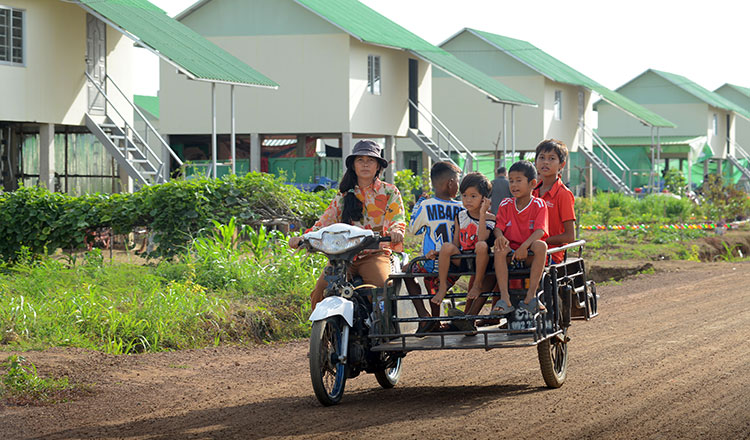 Residents ride past the housing units provided by the government in Rong Cham village in Svay Chek district, Banteay Meanchey province. KT/Heng Chivoan
Synopsis: Forced out of their homes by Thai military aggression, thousands of Cambodians are starting all over again in the ‘Waiting Villages’ and forming communities in Banteay Meanchey province.
Today, many are rebuilding their lives in newly established villages after Thai military aggression forced them to flee their homes with little more than the clothes they were wearing.
Most now live in Rong Cham villages 1 to 6, which were separated from Slakram village in Slakram commune, Svay Chek district, to accommodate families displaced by the border conflict.
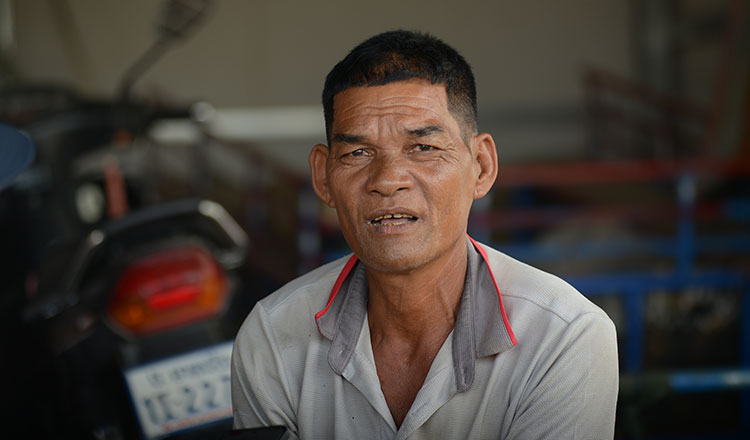
Among them is 63-year-old Sam Sith, whose life was once about raising cattle, running a grocery shop and crossing the border to work on Thai farms.
Like thousands of other displaced Cambodians, he is starting over in Rong Cham village in Slakram commune, about 90 kilometres from his home village in the Boeng Trakuon area, which is occupied by the Thai military.
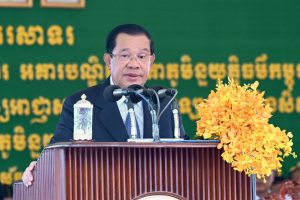
Rong Cham comprises six villages collectively nicknamed the “Waiting Villages” by Senate President Hun Sen, Acting Head of State, following his visit to the area on June 9.
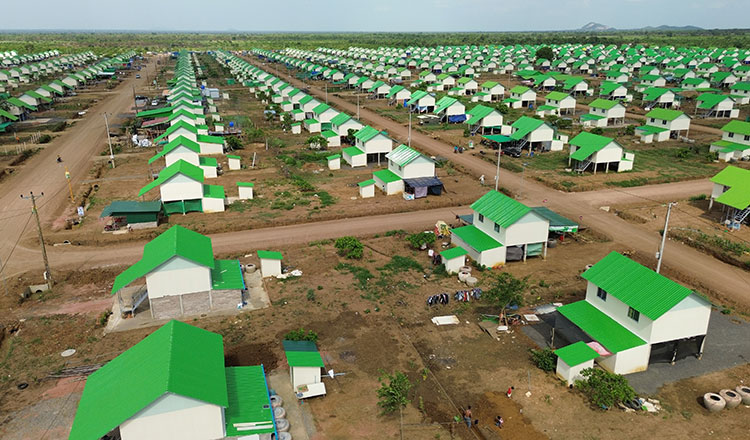
Built by the government to accommodate families displaced by the border conflict, the village symbolises hope and patience as residents await the day they can return to their homes.
According to the Ministry of Interior, as of July 11, more than 640,000 people remained affected by the border conflict, with 20,840 people – including 10,625 women and 6,066 children – still unable to return to their homes because their villages have been occupied or destroyed by the Thai military amid a ceasefire.
For Sith and his 62-year-old wife, Suon Nhip, the move to the village has brought relief after months spent in a cramped evacuation tent at the Kandorl Pagoda refugee camp, which has now closed.
“Living here is much better than living in tents,” Sith said while standing on the 20-by-30-metre plot allocated to his family. “The tents were crowded, hot and uncomfortable. We could hardly endure the conditions.”
Each family has been allocated land and receives clean water, electricity and other government assistance.
The government plans to construct about 3,000 standard housing units at the relocation sites. Mr Hun Sen has said that the establishment of the “Waiting Villages” does not mean Cambodia is relinquishing its territorial claims. They are to provide temporary shelter until displaced families can safely return home.
According to Banteay Meanchey Provincial Governor Oum Reatrey, Thai troops occupied about 760 hectares across three locations after the ceasefire was signed between the two nations on Dec. 27, 2025, creating a fait accompli.
The Boeng Trakuon area in Thmar Puok district consists of four villages – Mean Rith, Phlov Bambek, Trapeang Samrong and Samakki – while two other villages in O’Chrov district – Prey Chan and Chouk Chey – have been blockaded by shipping containers, barbed wire and armed Thai forces.
The Ministry of Interior said the continued occupation has prevented thousands of civilians from returning home and has disrupted education and healthcare services across the affected border provinces.
Uprooted overnight
Before the conflict, Sith lived in Trapeang Samrong village, Kouk Romiet commune, Thmar Puok district, where he ran a small grocery shop while raising cattle and poultry.
Everything changed when artillery shells began falling around his home.
“My house was completely destroyed because it was near the crossroads,” he said. “I stayed until about 2pm trying to save my belongings, but artillery shells were landing right in front of my house. They were firing from only about 50 metres away. It was terrifying.”
The conflict wiped out almost everything he owned. Sith said he lost 28 heads of cattle and more than 150 ducks and chickens during the evacuation.
“The animals scattered everywhere, and some were stolen. We lost everything,” he said.
Before tensions escalated, Sith regularly crossed into Thailand to spray pesticides on farms, earning between $6 and $10 a day.
“We had a close, brotherly relationship. We lived peacefully as neighbours,” he said.
Now unemployed, he and his family rely on government assistance and humanitarian aid while trying to rebuild their lives.
Broken bonds
Just a short distance away in Rong Cham village 3, 55-year-old Prom Ouch is confronting the same reality.
He is from Banteay Mean Rith village, also in the Boeng Trakuon area, which has been occupied by the Thai military since late December. Ouch built a stable life through trading while investing in land and homes for his children and grandchildren.
That life ended when Thai military aggression forced his family to flee.
“Living here is much better than living in tents,” Ouch said. “At the evacuation camp, we slept in tents with almost nothing. Here, at least, we have land where we can begin again.”
He said residents had experienced artillery exchanges before but never expected Thai troops to advance into civilian communities.
“No one expected them to push that far,” he said. “We trusted the ceasefire agreement. During the 21 days of fighting, there was shelling, but they didn’t advance deep into our villages. Then they moved in.”
Ouch estimates that his family lost between $20,000 and $30,000 worth of property.
“My younger brother had just finished building a new house. They lived in it for only half a month,” he said.
Before the fighting, he regularly crossed into Thailand to trade and maintained friendly ties with Thai neighbours.
“That relationship is gone,” he said. “I feel deep resentment now. I don’t buy Thai products anymore because they remind me of everything we have lost.”
Although grateful for the government’s relocation programme, Ouch said displaced families will need jobs and business opportunities to recover.
“If the government can establish a marketplace or create factory jobs, people will have a way to earn a living again,” he said.
Thriving again
What was once a cashew plantation has been transformed into one of Cambodia’s largest resettlement projects for displaced civilians and disabled veterans.
During a media visit to the site, Banteay Meanchey Deputy Governor Khlok Nouy said Rong Cham village had quickly evolved into a modern community.
“The development of Rong Cham villages has progressed commendably,” Nouy said. “The living standards of our citizens have become modernised and vibrant. They are now operating small businesses, selling groceries, building materials, clothing and footwear, just like any thriving village in the country.”
The wider development zone now accommodates 2,805 families in the first phase, while houses for 513 families are under construction in the second phase, of which about 80% has been completed.
The homes designated for the 513 disabled veteran families have been completed and allocated through a lottery system, while families awaiting final handover are temporarily staying with relatives and neighbours.
Nouy said the entire project is expected to be completed by the end of July through coordinated efforts involving multiple government institutions.
Electricité du Cambodge is extending the provincial power grid to every household, while local authorities are installing clean water pipelines. International humanitarian organisation Samaritan’s Purse has also donated large water storage tanks to support the community.
To help families settle into their new shelters, the government is providing monthly subsidies for one year, including 30 kWh of free electricity, 20,000 riel for clean water, 100,000 riel per family, 28,000 riel per household member, and an additional 200,000 riel per household each month.
Street lighting has also been installed throughout the villages.
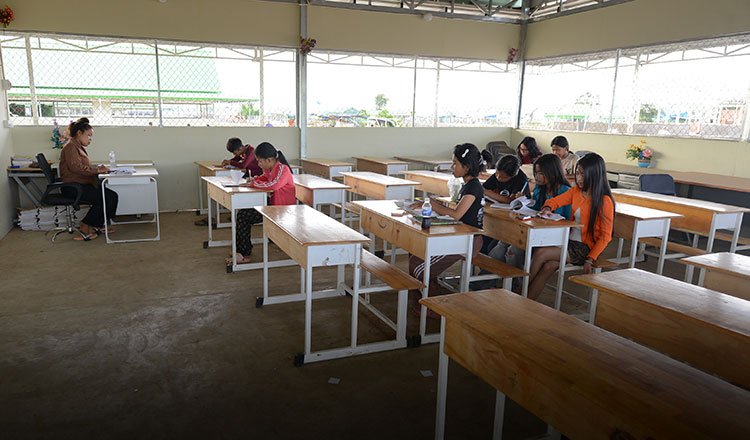
Beyond housing, Rong Cham has been designed as a functioning community with six administrative offices, a health centre and schools from kindergarten to high school.
Authorities are also preparing to open a temporary central market, with 550 families already registered to operate stalls, creating new business opportunities for residents.
Future built on peace
Rong Cham is not the destination they chose, but a place where thousands of families continue to wait, hoping diplomacy will one day allow them to return to the homes and communities they left behind.
Despite losing almost everything they had built over decades, both Sith and Ouch reject the idea of resolving the border dispute through military means.
“Using force will not solve the problem. It will only prolong the suffering,” Sith said. “If both sides continue fighting, there will only be more shelling and more suffering for ordinary people. I fully support a diplomatic solution through negotiations because peace is what everyone wants.”
Ouch shared the same sentiment.
“Solve it through diplomacy,” he said. “Using force only brings more destruction. It pushes people further away from their homes. I want a solution without war or gunfire. War is exhausting.”
Asked whether he still hopes to return home one day, Ouch paused.
“I believe the government can solve the problem,” he said. “Whether it will happen soon or take a long time, I don’t know. My hope is 50-50.”
For families across the Rong Cham villages, life is becoming more stable than it was in the evacuation camps. Children are returning to school, shops are reopening, and permanent homes are rising from the plantation.
Yet the village’s name remains a daily reminder of why they are there.
“We hope that one day we will be able to go home,” Ouch said.
The Ministry of Interior emphasized the government’s support for diplomatic efforts led by Prime Minister Hun Manet to resolve the border dispute peacefully in accordance with international law, while calling on Cambodians at home and abroad to remain united in safeguarding the country’s sovereignty and territorial integrity.
Mr Hun Manet has repeatedly stated that Cambodia will never accept the occupation of its territory by Thai forces or recognise any forced, unilateral changes to the border.