Cambodians know Chinese matters, so why aren’t students speaking it?
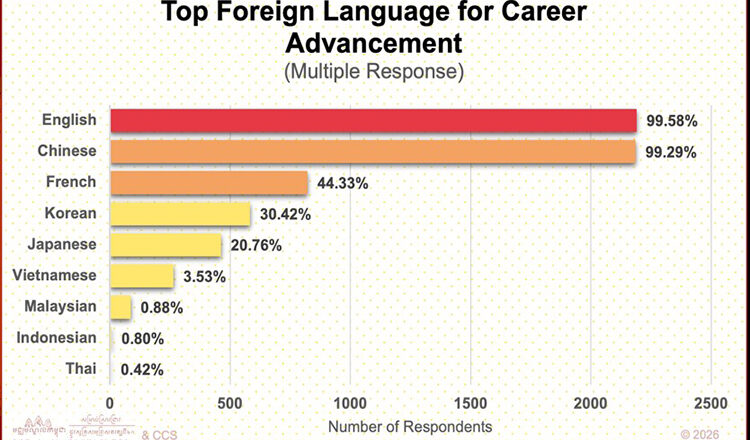 A survey shows that more than 99% of Gen Z Cambodians view Chinese as being the most important language for landing a good job. Khmer Times
#opinion
Learning Chinese offers a window into both ancient and modern China, and builds a bridge toward a brighter future for China and France, Chinese President Xi Jinping said in a recent reply to a letter from teachers and students in France. He also expressed the hope that “students can be at the forefront of promoting friendship and cooperation…”
A similar message was echoed by Chinese Ambassador to Cambodia Wang Wenbin and Cambodian Education, Youth and Sport Minister Hang Chuon Naron on International Chinese Language Day, celebrated in Phnom Penh in April, where both described the Chinese language as a “bridge” for strengthening Cambodia-China bilateral cooperation.
Chinese is increasingly popular among young Cambodians. The second annual survey on “Cambodian Youth Generation Z’s Perceptions of Cultural and People-to-People Exchanges between Cambodia and China”, jointly conducted by the Cambodia 21st Century Maritime Silk Road Research Center at the Royal University of Phnom Penh and the Center for Cambodian Studies at Beijing Foreign Studies University, gathered responses from 2,380 Cambodian Gen Z participants and found near-unanimous agreement (99.96%) on the value of foreign languages; 99.29% identified Chinese as important for securing good jobs, second only to English (99.58%).
Cambodian youth clearly understand where the opportunities lie. Yet over 80% of the respondents reported that they could not speak Chinese. If language is crucial to international engagement, why does a gap persist between its perceived importance and actual proficiency? This is not exactly a skills gap. It reflects a structural disconnect between recognition and capability.
This disconnect deserves attention because Cambodia’s relationship with China has become increasingly central at both the political and societal levels. During Xi’s state visit to Cambodia last year, both countries agreed to build an “all-weather Cambodia-China community with a shared future in the new era”. However, realising such a vision depends not only on state-level diplomacy but also on people-to-people communication – students, workers, and professionals who can connect directly without relying entirely on intermediaries.
As Naron put it, Chinese is a “strategic bridge” connecting the two countries and a comparative advantage in the 21st century. In this sense, Chinese language is not merely a communication tool but a strategic asset. Without adequate Chinese proficiency, many Cambodian graduates face constraints in fully engaging with one of their country’s most important partners.
Much of this gap stems from structural conditions shaped by historical development and educational policy. English was reintroduced into Cambodia’s national curriculum in 1989 and is now formally taught from Grade 4 in public schools. Over time, it has become deeply embedded across the education system, reinforced by private teaching, NGO programmes, and widely available low-cost learning options.
Chinese language education is still catching up. While more than a hundred institutions offer Chinese courses, access is uneven and often dependent on private provision. Part-time programmes typically cost between $130 and $200 per semester (50-75 hours), pricing out many students. Confucius Institutes provide more affordable options, with courses starting from $40, but their reach is still limited. Recent efforts to introduce Chinese as an elective in around 20 public high schools are a positive development, but remain modest for broad-based proficiency.
These structural limitations matter because language acquisition depends not only on interest but on sustained exposure, affordability, and opportunities for practice. Without these conditions, learners may gain basic familiarity but rarely reach speaking fluency.
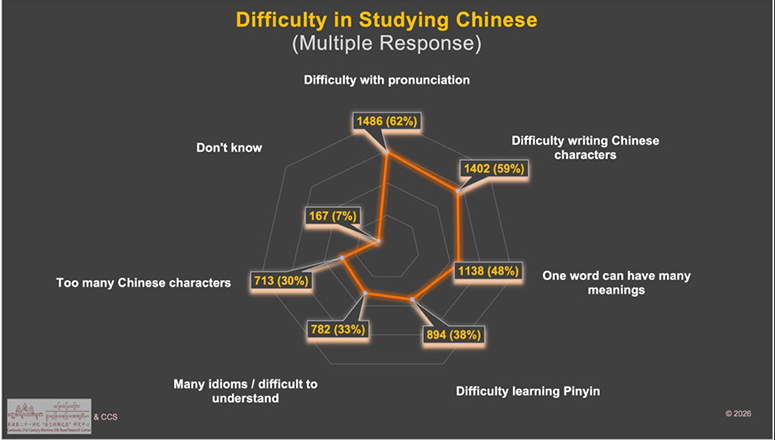
Students themselves also identify specific linguistic challenges, including pronunciation (62%), character writing (59%), and multiple meanings of vocabulary (48%). While significant, these barriers are not unique or insurmountable. The more fundamental issue is that the system does not yet provide enough learners with continuous, accessible pathways from introductory learning to functional use.
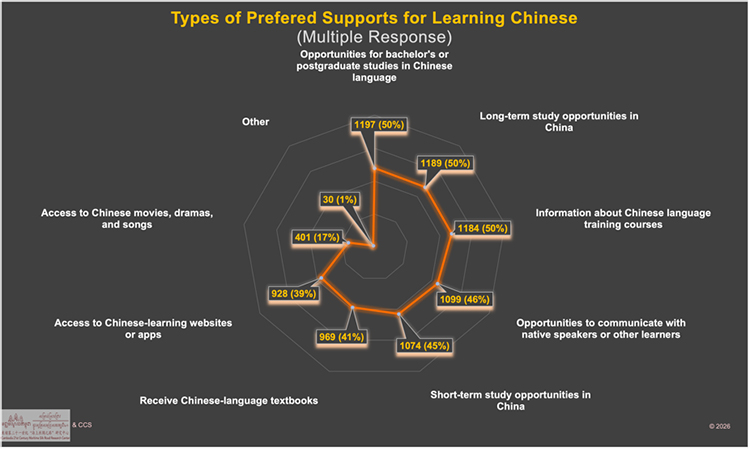
Despite limited language ability, China remains the most preferred destination for Cambodian students pursuing higher education abroad, with 88.57% expressing interest in studying there. Half of respondents also identified opportunities to pursue degrees in Chinese language as one of the most effective ways to improve their Chinese proficiency. This suggests that educational mobility itself is seen as a key language-learning pathway.
To build an “all-weather Cambodia-China community with a shared future in the new era”, language should be treated as strategic infrastructure no less important than roads, bridges and investment flows. Strengthening it requires coordinated action on multiple levels.
First, access must expand. More low-cost and publicly supported Chinese language programmes should be developed through both state institutions and partnerships with non-state actors.
Nevertheless, expansion alone is not sufficient. Awareness must also improve. Existing programmes, including those offered by Confucius Institutes, remain underutilised partly because many students are unaware of them.
Chinese language learning should be more systematically integrated into the national education system, with greater emphasis on speaking proficiency and practical application rather than exam-based learning alone.
Effective policy responses begin with understanding how young people actually experience language learning. Surveys such as this are valuable not only for measuring attitudes, but for revealing structural barriers that may be overlooked in broader discussions of bilateral cooperation.
Xi’s message ultimately calls on young people to act as bridges between nations, but building bridges requires more than goodwill. Lasting people-to-people ties require the ability to communicate.
Cambodian students have already shown their willingness to engage. The question now is whether the systems around them are prepared to meet that demand.
Gu Jiayun is Associate Professor, Vice-Dean of School of Asian Studies and Director of Center for Cambodian Studies at Beijing Foreign Studies University. Muy Hung is programme manager, Cambodia 21st Century Maritime Silk Road Research Center at the Royal University of Phnom Penh.
The opinions expressed are those of the authors alone and do not necessarily reflect the views of their respective institutions.
-Khmer Time-