Thailand’s Manufactured Victimhood: Turning Aggression Into Accusation
 Thailand’s Manufactured Victimhood: Turning Aggression Into Accusation
#opinion
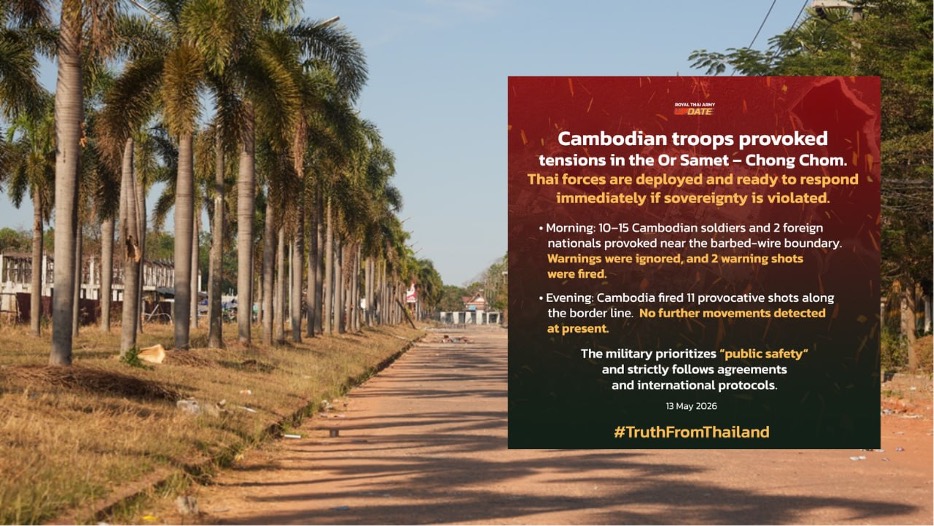
The latest incident at O’Smach reveals, once again, a familiar and dangerous pattern in Thailand’s behaviour along the Cambodia–Thailand border: provoke first, accuse later and then attempt to present itself as the victim.
According to reports, Thai forces fired warning shots in the O’Smach border area, where a content creator said he was unarmed, unprotected and simply documenting the situation. Shortly afterward, Thai sources turned the narrative upside down by accusing Cambodian troops of firing 11 rounds near the border. Cambodia’s Ministry of National Defence rejected that allegation, dismissing Thai media claims that Cambodian forces had opened fire.
This is not just a dispute over who fired how many shots. It is a contest over truth, responsibility and international perception. Thailand’s conduct follows a calculated script: create tension on the ground, then rush to frame Cambodia as the aggressor before facts can be properly established.
Such tactics are not new. When Thailand acts provocatively, it quickly wraps itself in the language of restraint. When it violates trust, it speaks of peace. When it escalates militarily, it accuses Cambodia of escalation. This is manufactured victimhood — the deliberate transformation of the violator into the supposed victim.
The O’Smach incident must therefore be understood within a broader context. The Cambodia–Thailand border remains fragile following serious clashes and ceasefire efforts. Reuters reported that both sides recently agreed to seek peace and rebuild trust after a period of deadly conflict and displacement. In such a sensitive environment, any use of gunfire, intimidation or media manipulation is not only irresponsible; it is dangerous.
Thailand cannot claim to seek peace while allowing its military and media ecosystem to spread accusations that inflame tensions. Peace requires discipline, honesty and respect for facts. It cannot be built on intimidation at the border and propaganda in the evening news.
Cambodia, by contrast, must continue to act with restraint, clarity and confidence. Restraint does not mean silence. Cambodia has every right to expose false accusations, defend its sovereignty and inform the international community when Thailand attempts to distort reality.
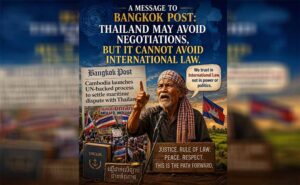
The world should see the pattern clearly. Thailand’s strategy is to provoke, deny, accuse and then appeal for sympathy. This is not the behaviour of a responsible neighbour. It is the behaviour of a state seeking to escape accountability by controlling the narrative.
The truth is simple: Cambodia does not benefit from instability at the border. Cambodian civilians living near the frontier have already suffered from fear, displacement and uncertainty. Cambodia’s interest is peace, stability and respect for international law. But peace cannot survive if one side is allowed to fire shots, intimidate civilians or observers, and then falsely accuse the other side of aggression.
Thailand must stop hiding behind the mask of victimhood. If it truly wants peace, it must stop provocations on the ground, stop spreading unverified accusations and stop treating the border as a stage for nationalist performance.
Cambodia should remain calm, but it must not allow Thailand’s distortion to go unanswered. Every false accusation must be corrected. Every provocation must be documented. Every attempt to rewrite the truth must be exposed.
The O’Smach incident is not only about gunfire. It is about a deeper truth: Thailand wants the world to see it as a victim, while its actions reveal the face of a provocateur.
Cambodia must continue to speak firmly, factually and fearlessly. Peace requires truth — and the truth must not be surrendered to Thailand’s propaganda.
Roth Santepheap is a geopolitical analyst based in Phnom Penh. The views and opinions expressed are his own.
-Phnom Penh Post-